


Travertine is a famous type of limestone which is made out of fast precipitation of calcite (another name for calcium carbonate). This sedimentary stone is made out of mineral deposits. The mineral deposits involved in the process of making travertine can come from natural springs.
Travertine is made primarily of calcium carbonate (calcite). It is a natural sedimentary limestone that forms when mineral-rich water releases calcium carbonate deposits around springs, caves and other water-rich environments. Over time, those deposits build up into the stone known as travertine.
Its formation explains the features buyers recognise: natural pores, subtle cavities, veins and colour variation. Travertine is quarried from natural deposits, rather than manufactured in a factory, so each tile or paver has its own character.
What Is Travertine Made Of?
The main component of travertine is calcium carbonate, most commonly in the mineral form known as calcite. This is why travertine is classified as a limestone. Small amounts of other minerals can be present too, influencing the colour and visual movement of the stone.
| Component or process | Its role in travertine |
|---|---|
| Calcium carbonate (calcite) | The main mineral that forms the stone’s layered structure. |
| Mineral-rich water | Carries dissolved calcium carbonate through springs, groundwater and caves. |
| Carbon dioxide release and evaporation | Helps calcium carbonate precipitate out of the water and settle into deposits. |
| Other trace minerals | Can create beige, cream, walnut, gold, silver or warmer tones. |
| Gas bubbles and organic material | Can leave the pores and cavities typical of natural travertine. |
How Is Travertine Formed?
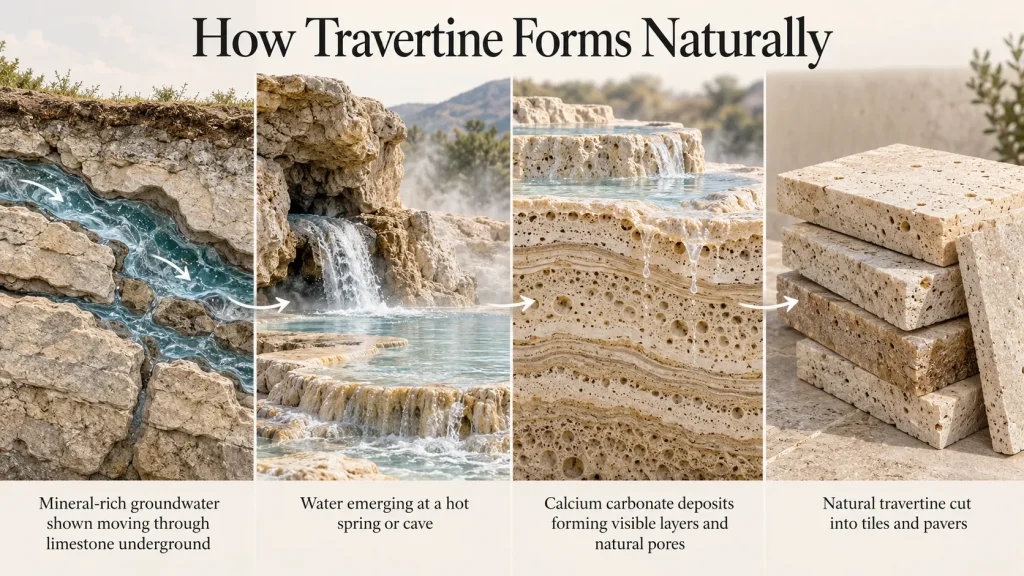
Travertine forms through a natural precipitation process. Water travelling through limestone-rich ground dissolves calcium carbonate. When that mineral-rich water reaches the surface, enters a cave, warms, cools, loses carbon dioxide or evaporates, calcium carbonate can no longer remain fully dissolved. It settles in layers and gradually hardens into stone.
1. Mineral-Rich Water Moves Through the Ground
Groundwater or spring water picks up dissolved minerals, including calcium carbonate, as it passes through limestone environments.
2. The Water Reaches Springs, Streams or Caves
Travertine is commonly associated with hot springs, mineral springs and cave systems. Stalactites and stalagmites are familiar examples of calcium-carbonate deposits created in cave environments.
3. Calcium Carbonate Precipitates into Layers
As conditions change, dissolved calcium carbonate separates from the water and deposits in successive layers. This is why travertine has a sedimentary structure rather than a manufactured, uniform composition.
4. Pores, Cavities and Colour Variation Develop
Gas bubbles, plant material and changing mineral content can create the holes, texture and tonal variation that distinguish travertine from many other stones.
Why Does Travertine Have Holes?
Travertine’s voids are a natural outcome of its formation. As mineral deposits accumulate, trapped gas bubbles and organic material can leave open spaces in the stone. These pores may be left visible, filled during processing or treated differently depending on the finish and intended application.
Porosity gives travertine much of its natural character, but it also affects care. For a practical guide, read Is Travertine Porous?.
Where Does Travertine Come From?
Travertine deposits occur in different parts of the world where mineral-rich water and calcium-carbonate geology create the right conditions. The exact source and mineral composition can influence the stone’s tone, density, pore structure and appearance. This is why natural variation between products and batches is expected.
Is Travertine Natural Stone or Man-Made?
Travertine is natural stone. It forms in the earth through mineral deposition and is quarried before being cut and finished into tiles, pavers, coping or cladding. It should not be confused with porcelain, ceramic or engineered materials that are manufactured in a factory.
Read our complete guide to what travertine stone is, including finishes, uses, benefits and care considerations.
What Is Travertine Used For?
The make-up of travertine gives it a distinctive look that works across both classic and contemporary projects. Once the correct product, finish, thickness and installation system are selected, travertine can be used for:
- Indoor flooring and feature areas
- Wall cladding and façades
- Patios, courtyards, garden paths and outdoor entertaining spaces
- Pool surrounds using products suitable for wet outdoor conditions
- Steps, coping and other architectural details
Explore specialised guides for travertine flooring, outdoor travertine and travertine pool decks.
Travertine Through History
Travertine has been used as a building stone for centuries. The Colosseum in Rome is one of the best-known examples, while other architectural projects around the world have used travertine for structural and decorative elements. Its long history reflects its visual appeal and adaptability, but a modern project should always be specified according to its own location, use and installation requirements.
Explore Travertine Tiles and Pavers
If you are choosing a natural stone for a flooring, landscaping or outdoor project, compare available colours, sizes and finishes before ordering. Hunter Pavers offers travertine tiles and pavers for a range of architectural applications.
Shop Travertine Tiles & Pavers | Talk to a Stone Specialist
Frequently Asked Questions
What is travertine made of?
Travertine is made mainly of calcium carbonate, most commonly as calcite. It is a naturally formed sedimentary limestone.
How is travertine formed?
Travertine forms when mineral-rich water deposits calcium carbonate in layers, often around springs, caves and groundwater environments.
Why is travertine porous?
Its pores and cavities are caused by the natural formation process, including trapped gases and organic material within the depositing minerals.
Is travertine natural stone?
Yes. Travertine is quarried natural stone, not a man-made tile or engineered surface.
What colour is natural travertine?
Pure travertine is light in colour, but mineral content can create cream, beige, brown, gold, walnut, silver and other natural tones.