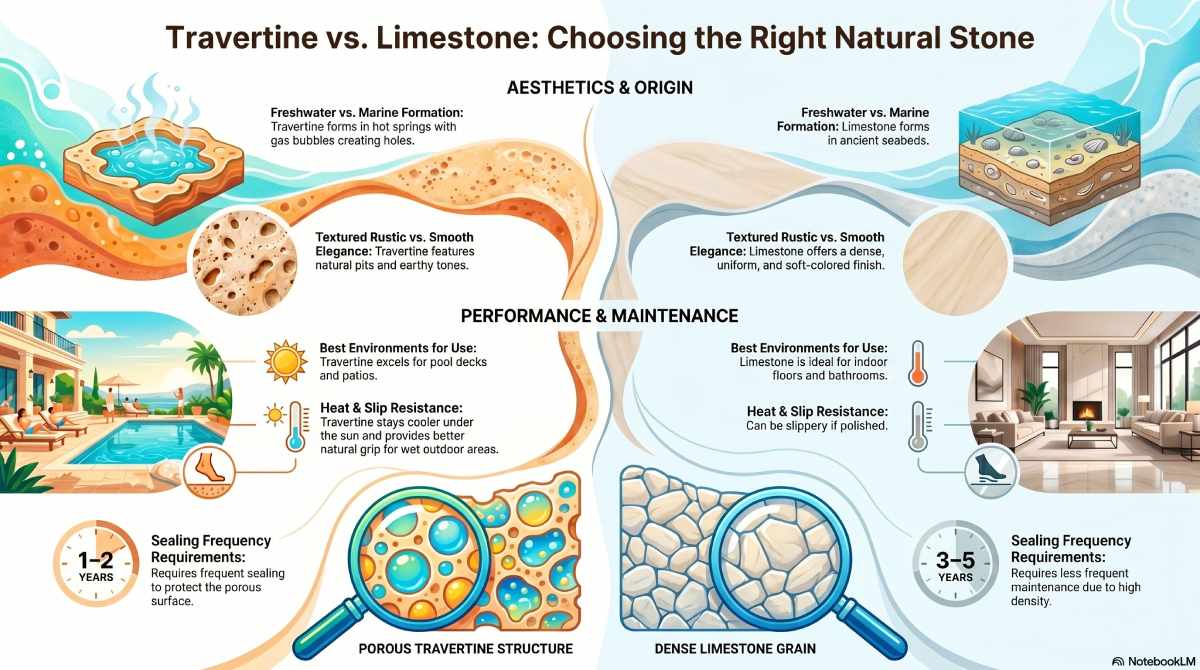
Choosing between travertine and limestone becomes much easier when you stop looking at them only as “beautiful natural stones” and start comparing how they actually perform in real spaces. Travertine is usually the better choice when you need a warmer, more textured, and outdoor-friendly stone for areas like patios, pool decks, garden paths, and Mediterranean-style interiors. Limestone is often better when you want a smoother, denser, and more refined surface for indoor floors, bathrooms, wall cladding, and calm modern spaces.
In the travertine vs limestone comparison, the right answer depends on location, moisture, foot traffic, design style, and maintenance expectations. If the area is exposed to water, sun, or outdoor use, travertine can be more practical because it stays cooler and offers better natural grip. If the space needs a clean, elegant, and uniform finish, limestone may be the smarter option. The best decision comes from checking details carefully instead of choosing only based on appearance.
Table of Contents
Comparison Point
Travertine
Limestone
Best for
Pool decks, patios, garden paths, rustic interiors, outdoor flooring
Interior flooring, bathrooms, wall cladding, hallways, classic and modern spaces
Appearance
Textured, porous, warm, earthy, rustic, natural pits and holes
Smooth, dense, uniform, soft colours, sometimes with fossil details
Maintenance need
May need more frequent sealing depending on finish, exposure, use, and the sealer system
Maintenance and resealing frequency depend on the stone, finish, exposure, use, and sealer guidance
Porosity
Usually more visibly porous, with natural pits and voids depending on the cut and finish.
Often appears denser and more uniform, although porosity still varies by limestone type.
Cost
Varies by grade, colour, finish, size, thickness, source and processing.
Varies by stone type, finish, size, thickness, source and availability.
Best outdoor use
Patios, pathways, courtyards and other outdoor areas when the finish and specification suit the application.
Patios, pathways, courtyards and other outdoor areas when the finish and specification suit the application.
Best indoor use
Flooring, bathrooms, feature walls and warm, character-rich interiors.
Flooring, bathrooms, hallways, wall cladding and refined interior schemes.
Travertine vs Limestone: The Basic Difference
Travertine and limestone are both natural sedimentary stones made mainly of calcium carbonate. This means they come from mineral deposits and natural geological processes rather than being manufactured materials. Because of this, choosing between travertine tiles and limestone tiles means selecting a surface where each slab or tile has its own unique tone, pattern, texture, and character.
The main difference between the two comes from how and where they form. Limestone usually forms in marine environments over millions of years. It is created from compressed shells, coral, algae, and organic marine remains. This gives limestone a generally dense and uniform structure.
Travertine, on the other hand, is a specific type of limestone that forms in freshwater environments, especially around hot springs, mineral springs, and limestone caves. As minerals deposit in layers and gas bubbles escape, the stone develops its famous porous surface. These natural pits and holes are one of the most recognisable features of travertine.
Geological Formation and Composition
Limestone is formed mainly under the sea. Over long periods, shells, coral fragments, algae, and other organic debris settle on the seabed. Pressure and mineral reactions slowly turn these materials into stone. Because it develops in marine environments, limestone can sometimes contain visible fossils, shell fragments, or subtle natural markings.
This origin gives limestone a calm and refined look. It is often used in elegant interiors, modern bathrooms, classic flooring, wall cladding, and architectural details where a clean natural appearance is preferred.
Travertine forms differently. It develops when mineral-rich water flows through hot springs, caves, or freshwater environments. As the water releases carbon dioxide, calcium carbonate is deposited in layers. The escape of gases creates holes and channels in the stone. This gives travertine its textured, earthy, and slightly rustic appearance.
Because of this formation process, travertine often feels more natural, aged, and organic. It is especially popular in Mediterranean-style homes, outdoor patios, garden paths, pool decks, and warm interior designs.
Visual Characteristics of Limestone
Limestone is known for its smooth and consistent appearance. It usually comes in soft, classic colours such as white, beige, cream, light grey, and warm sand. These colours make it easy to match with different interior styles, from minimal modern spaces to traditional homes.
One of limestone’s biggest advantages is its subtle elegance. It does not usually have dramatic veining or strong colour variation. Instead, it offers a calm background that allows furniture, lighting, decor, and architecture to stand out.
Some limestone varieties include visible fossils or shell impressions. These details add natural beauty without making the surface look too busy. For people who want a refined stone with quiet character, limestone is often a strong choice.
Visual Characteristics of Travertine
Travertine has a warmer and more textured appearance than limestone. It is commonly available in cream, beige, tan, walnut, gold, rust, silver, and brown shades. Some types also feature red, dark grey, or dramatic vein patterns.
The natural pits and troughs in travertine give it a distinct personality. These holes can be left unfilled for a rugged and rustic look, or filled with resin or cement for a smoother and more practical surface. Filled travertine is often used indoors, while unfilled travertine is more common in outdoor and decorative applications.
Travertine is often chosen when the goal is to create warmth, texture, and natural movement. It works well in spaces that need a more relaxed, earthy, or timeless feel.
Travertine vs Limestone for Durability
Both travertine and limestone are durable enough for many residential and commercial uses, but they perform differently. Limestone is usually denser and less porous. This means it can be easier to maintain in certain indoor spaces, especially when sealed properly.
Travertine is more porous and has a sponge-like structure. This makes it more vulnerable to water absorption and staining if it is not sealed correctly. However, hardness can vary by stone source and product, so a single Mohs value should not be used as the main basis for selecting either material.
That said, hardness is not the only factor. Porosity, finish, sealing, installation quality, and cleaning habits all affect long-term performance. A well-sealed travertine patio can last for many years, while poorly maintained limestone can stain or etch quickly.
Porosity and Water Resistance
Porosity is one of the most important points in the travertine vs limestone comparison. Limestone generally has lower porosity and a denser grain. This means it tends to absorb less moisture than travertine, although it still needs sealing.
Travertine has higher porosity because of its natural holes and channels. This makes sealing more important, especially in wet areas such as bathrooms, kitchens, pool decks, and patios. If travertine is not sealed, liquids can enter the stone and cause stains, dark patches, or surface damage.
For outdoor use, travertine can still be a strong option when the selected finish, product specification, sealing approach and installation system suit the project.
Slip Resistance
Travertine is often selected for outdoor walkways, garden paths and patios because textured finishes can provide useful surface grip. However, slip resistance depends on the actual finish and product specification rather than the stone name alone. Surface temperature also varies with colour, density, finish and exposure, so product-specific performance should be checked for sunny areas.
Limestone can also be used outdoors, but slip resistance depends heavily on the finish. A polished limestone surface may become slippery when wet, while a honed, brushed, or textured finish can provide better grip.
For wet areas, the finish matters as much as the stone type. If safety is a priority, avoid highly polished surfaces and choose finishes designed for traction.
Heat Resistance
Both travertine and limestone can work in warm outdoor environments, but surface temperature is influenced by colour, density, finish and direct solar exposure. Lighter colours may feel cooler than darker surfaces, regardless of whether the stone is travertine or limestone.
For sunny patios and other exposed areas, compare the actual product colour and finish rather than assuming one stone family will always remain cooler.
Maintenance and Care
Both travertine and limestone are sensitive to acidic substances. Vinegar, lemon juice, harsh bathroom cleaners, acidic detergents, and some kitchen spills can cause etching. Etching happens when acid reacts with calcium carbonate and leaves dull marks on the surface.
For daily cleaning, use a pH-neutral cleaner made for natural stone. Avoid bleach, acidic sprays, abrasive powders, and rough brushes. A soft cloth, mop, and stone-safe cleaner are usually enough for regular maintenance.
Sealing can be beneficial for both stones, but sealing requirements and frequency should be based on the specific stone, sealer and supplier guidance. Travertine may need more attention where its open pores and exposure increase stain risk, while limestone requirements also vary by finish and use.
Expert Care Guidance for Travertine and Limestone
“Calcium Carbonate is sensitive to acidic solutions so mild, non-acidic cleaners are recommended.”
— Natural Stone Institute, Care & Cleaning of Natural Stone
The Natural Stone Institute also explains that sealing does not make stone stain-proof and recommends following supplier or sealer-manufacturer guidance for the appropriate sealing frequency.
Cost Comparison
In general, travertine is often more expensive than standard limestone at the initial purchase stage. This is partly because extracting, cutting, filling, and finishing travertine can require more labour. The natural holes may need to be filled, and some premium varieties require more careful processing.
However, cost depends heavily on stone quality, origin, finish, thickness, size, supplier, and installation method. High-end limestone slabs can be more expensive than many travertine options, especially rare or imported varieties.
Travertine is still usually more affordable than luxury stones like marble or some types of granite. Limestone can be very cost-effective for large flooring projects, especially when a simple and uniform appearance is desired.
Best Uses for Travertine
Travertine is a strong choice when you want texture, warmth, and natural charm. It works especially well in outdoor and semi-outdoor spaces because of its heat resistance and slip-friendly surface. Common uses include:
Pool decks and patios
Garden paths and courtyards
Bathroom walls and floors
Feature walls and fireplaces
Mediterranean-style interiors
Travertine is also useful when you want a surface that feels aged and character-rich rather than perfectly smooth. Its natural variation makes it ideal for relaxed luxury designs.
Best Uses for Limestone
Limestone is ideal for refined, smooth, and timeless spaces. Because it usually has a more uniform appearance, it works beautifully in modern interiors and classic architectural designs. Common uses include:
Interior flooring
Bathroom walls
Kitchen flooring
Hallways and living rooms
Wall cladding and decorative features
Limestone is often preferred when the design needs softness, balance, and elegance without too much visual movement. It is also a good option for people who want natural stone but prefer a cleaner and less rustic surface.
Popular Travertine Models
Classic Travertine
Classic Travertine is one of the most common and widely used varieties. It usually features light beige and cream tones, making it suitable for both indoor and outdoor projects. Its neutral colour allows it to blend easily with wood, metal, glass, and natural landscapes.
This option is often chosen for patios, bathrooms, flooring, and wall cladding. It offers a timeless look without being too bold or expensive.
Silver Travertine
Silver Travertine has a sophisticated mix of grey, silver, cream, and sometimes beige tones. It is popular in modern landscapes and high-end pool decks because it combines the texture of travertine with a cooler colour palette.
This variety works well in contemporary homes, especially when paired with dark metal, white walls, or minimalist outdoor furniture.
Walnut Travertine
Walnut Travertine has deeper brown, tan, and earthy tones. It creates a warm and lived-in atmosphere, making it suitable for rustic interiors, traditional patios, and cosy outdoor areas.
Because of its darker tones, it can also hide some dust and outdoor marks better than very light stones.
Ivory Travertine
Ivory Travertine is light, clean, and elegant. It gives a bright look similar to some luxury stones, but with the natural texture of travertine. It is often used in bathrooms, pool areas, and stylish interior floors.
This model is a good choice when you want a soft and bright surface without losing the natural character of stone.
Giallo Gold Veincut Travertine
Giallo or Gold Veincut Travertine is known for golden-yellow tones and linear patterns. The veincut style creates long, flowing lines that make the stone look more dramatic and architectural.
It is often used for feature walls, statement floors, and decorative surfaces where the stone itself becomes part of the design.
Red Travertine
Red Travertine is rare and bold. It features deep red, burgundy, and warm earthy tones. Because of its strong colour, it is usually used for accents rather than large continuous surfaces.
It can work beautifully in statement walls, decorative panels, and luxury design details.
Noce Travertine
Noce Travertine is a dark chocolate-brown variety. It is durable, warm, and practical for outdoor spaces because it can mask dirt better than lighter stones.
This model is often selected for patios, garden paths, and areas where a deep natural colour is desired.
Summary Travertine
Titanium Travertine has a modern and dramatic appearance, often combining dark grey, black veining, and lighter background tones. It is a good option for bold contemporary projects.
It works well in luxury interiors, feature walls, and spaces where designers want a natural stone with strong visual impact.
Popular Limestone Models
Gohera Limestone
Gohera Limestone is known for its consistent beige colour and high density. It is commonly used for flooring and wall applications where a clean, warm, and stable appearance is needed.
Its neutral tone makes it suitable for both classic and modern interiors.
Ash Grey Limestone
Ash Grey Limestone offers a cool and contemporary grey palette. It fits very well in industrial, minimalist, and modern designs.
It can be used for floors, walls, bathrooms, and outdoor spaces where a calm grey stone is preferred.
Fossil Limestone
Fossil Limestone is one of the most visually interesting limestone options. It contains visible aquatic fossils, shell marks, and natural impressions.
This stone is ideal for people who want a surface with history, character, and natural storytelling.
Black Limestone
Black Limestone is dense, bold, and striking. It is often used for pathways, driveways, garden borders, and high-contrast outdoor designs.
Its dark colour creates a strong design statement, but it may need proper sealing and care to maintain its appearance.
Bianco Perlino Limestone
Bianco Perlino is a high-end Italian limestone with a creamy white base and subtle veining. It is often used in elegant interiors where a refined and luxurious surface is desired.
It works beautifully in bathrooms, floors, wall panels, and sophisticated residential spaces.
Limestone Persiano
Limestone Persiano has a warm sandy colour and a slightly more textured surface. It offers a natural look without being as porous or rustic as travertine.
This model is suitable for warm interiors, feature walls, and relaxed natural designs.
Ivory Limestone
Ivory Limestone is similar in colour to Ivory Travertine but has a smoother and denser appearance. It does not have the same visible pits, which makes it suitable for cleaner and more refined spaces.
It is often used in interiors where brightness and simplicity are important.
Compare Travertine and Limestone Products
If you have narrowed your project down to these two stones, compare the actual colours, finishes, thicknesses and product specifications before making the final decision.
Travertine vs Limestone: Which One Should You Choose?
The best choice depends on where you want to use the stone and what kind of look you prefer. If you want a warm, textured, rustic, and outdoor-friendly stone, travertine is often the better option. It is especially strong for pool decks, patios, courtyards, and Mediterranean-inspired spaces.
If you want a smoother, denser, more uniform, and elegant stone, limestone may be the better choice. It works beautifully in interiors, bathrooms, hallways, living rooms, and classic architectural spaces.
For wet areas, both stones need sealing. For high-traffic areas, choose a durable finish and maintain the stone regularly. For outdoor sunny areas, travertine often has an advantage because it stays cooler and provides better natural traction.
Common Mistakes When Comparing Travertine vs Limestone
One common mistake is choosing based only on colour. A stone may look beautiful in a showroom but perform poorly if it is not suitable for the location. For example, polished limestone in a wet outdoor area may become slippery, while unsealed travertine in a kitchen may stain easily.
Another mistake is ignoring sealing and maintenance. Both stones are natural and porous to some degree. They need proper cleaning, sealing, and care. Using acidic cleaners can damage both materials.
Some buyers also assume that more expensive always means better. In reality, the best stone is the one that matches the project. A simple limestone may be better for a calm interior floor, while a textured travertine may be better for a sunny patio.
Explore Related Stone Guides & Products
Travertine Stone Guide
Learn more about travertine formation, finishes, uses, maintenance and buying considerations.
The most practical way to decide between travertine and limestone is to match the stone to the space. Choose travertine if you want a natural stone that feels warm, textured, slightly rustic, and suitable for outdoor areas. It works especially well where slip resistance, heat comfort, and visual character matter. However, because it is more porous, it needs regular sealing and careful cleaning with pH-neutral products.
Choose limestone if you prefer a smoother, calmer, and more elegant stone for interior use. It is usually denser than travertine, has a more uniform appearance, and fits well in modern, classic, and minimalist designs. In the end, travertine vs limestone is not about which stone is better overall; it is about which one performs better for your project, your lifestyle, and your maintenance routine. The best option is the one that fits the purpose, not just the one that looks impressive at first glance.
Travertine vs Limestone FAQs
What is the main difference between travertine and limestone?
Both are calcium-carbonate-based sedimentary stones, but travertine commonly shows more visible pores and texture, while limestone often has a denser and more uniform appearance.
Which is better for patios: travertine or limestone?
Both can work well for patios when the correct product, thickness and finish are selected. Travertine is often chosen for a warmer, more textured look, while limestone can suit cleaner and more refined designs.
Which is cheaper, travertine or limestone?
There is no universal winner. Price depends on the specific stone, grade, size, thickness, finish, source, processing and current availability.
Does travertine need more sealing than limestone?
Travertine may need more attention in some applications because of its visible pores, but sealing frequency should be based on the specific stone, finish, exposure, sealer and supplier guidance rather than a fixed schedule.
Which stone is better for wet areas?
Either stone can be suitable when the product and finish are specified correctly. Wet-area performance depends heavily on surface finish, slip rating, installation, drainage and maintenance.
Which is easier to maintain: travertine or limestone?
Limestone can appear easier to maintain in some applications because many varieties are visually denser, but both are calcareous stones and should be cleaned with stone-safe, non-acidic products.
Can you use acidic cleaners on travertine or limestone?
No. Both are calcium-carbonate-based stones and acidic cleaners can etch the surface. Use products suitable for natural stone and follow supplier care guidance.
Unika is a stone industry specialist based in Australia, with over 10 years of experience in sourcing, designing, and delivering premium natural stone solutions for residential and commercial projects.
Travertine is often the preferred choice for outdoor paving because it stays cooler under direct sunlight and offers better natural slip resistance thanks to its textured surface. It's especially popular for pool decks, patios, and garden paths. However, proper sealing is essential to protect it from moisture and stains.
The main difference is their formation and texture. Travertine is a type of limestone formed by mineral deposits from hot springs, giving it a naturally porous and textured appearance. Limestone typically forms in marine environments and has a denser, smoother, and more uniform surface, making it a popular choice for elegant indoor spaces.
Travertine generally requires more maintenance because its porous structure absorbs moisture more easily and needs sealing every 1–2 years in most applications. Limestone is denser and usually requires less frequent sealing, but both natural stones should be cleaned with pH-neutral products and maintained properly to preserve their appearance and durability.
No. Both are calcium-carbonate-based stones and acidic cleaners can etch the surface. Use products suitable for natural stone and follow supplier care guidance.
Limestone can appear easier to maintain in some applications because many varieties are visually denser, but both are calcareous stones and should be cleaned with stone-safe, non-acidic products.
There is no universal winner. Price depends on the specific stone, grade, size, thickness, finish, source, processing and current availability.