


If you want a quick and practical answer to the travertine vs porcelain comparison, the best choice depends on how you plan to use the space. Travertine is usually better for homeowners who want a natural luxury appearance, cooler outdoor surfaces, and a timeless stone look. Porcelain is the better option for people who prioritize durability, low maintenance, water resistance, and easier long-term care. In simple terms, travertine offers a premium natural feel, while porcelain delivers stronger everyday practicality.
The reason travertine vs porcelain is such a popular topic is that both materials work well in patios, pool areas, bathrooms, kitchens, and modern homes. However, the real differences become clear when you compare durability, maintenance, outdoor performance, installation costs, and long-term value. In this guide, we will break down every important aspect of travertine vs porcelain, including pool coping, outdoor flooring, maintenance requirements, and which material performs better in different environments.
Understanding Travertine Before Comparing Travertine vs Porcelain
Travertine is a natural limestone that forms over thousands of years around mineral springs and caves. Because it is a completely natural material, every single piece of travertine has its own texture, pattern, movement, and color variation. This uniqueness is one of the main reasons many architects and luxury designers continue choosing travertine despite the rise of modern porcelain alternatives.
In the travertine vs porcelain discussion, travertine tiles are often associated with high-end outdoor spaces, Mediterranean-style homes, resort-inspired landscaping, and luxury pool areas. Their warm and organic appearance creates a softer and more natural atmosphere compared to many manufactured surfaces.
Travertine is available in several finishes, including honed, tumbled, brushed, and polished. Each finish changes both the appearance and functionality of the stone. For example, tumbled travertine is highly popular for outdoor spaces because its textured surface improves grip and gives the area a timeless European look.
One of the biggest advantages of travertine in the travertine vs porcelain comparison is temperature control. Travertine naturally stays cooler under direct sunlight compared to many other paving materials. This is particularly important in hot climates where pool decks and patios can become uncomfortable to walk on barefoot.
However, travertine is also porous. This means it can absorb moisture, oils, and stains if it is not sealed correctly. Proper sealing and periodic maintenance are important parts of owning natural stone surfaces.
Travertine vs Porcelain Comparison Table
| Feature | Travertine | Porcelain |
|---|---|---|
| Material Type | Natural stone | Engineered ceramic material |
| Appearance | Warm, organic, timeless | Consistent, modern, clean |
| Design Variation | Every piece is unique | Uniform and controlled |
| Heat Resistance | Stays cooler outdoors | Can become hot in sunlight |
| Water Absorption | Porous and absorbent | Very low water absorption |
| Maintenance | Requires sealing and care | Very low maintenance |
| Stain Resistance | Moderate with sealing | Excellent |
| Durability | Strong but softer | Extremely hard and dense |
| Slip Resistance | Excellent for pool areas | Depends on finish |
| Best Outdoor Use | Pool decks, patios, luxury landscaping | Driveways, modern outdoor spaces |
| Best Indoor Use | Luxury bathrooms and feature spaces | Kitchens, high-traffic areas |
| Cleaning Requirements | pH-neutral cleaners recommended | Easy everyday cleaning |
| Long-Term Character | Develops natural patina | Maintains consistent appearance |
| Installation Style | More natural and organic look | Precise and structured finish |
| Resale Value | Often perceived as premium luxury | Strong practical appeal |
| Best For | Natural luxury aesthetics | Durability and convenience |
Understanding Porcelain Before Comparing Travertine vs Porcelain
Porcelain is a manufactured ceramic product created from refined clay and minerals that are fired at extremely high temperatures. The result is a highly dense and durable material with excellent resistance to moisture, scratches, stains, and heavy foot traffic.
In the modern travertine vs porcelain comparison, porcelain has become increasingly competitive because manufacturers can now replicate natural stone visuals with impressive accuracy. Many porcelain tiles are specifically designed to imitate travertine, marble, concrete, or timber while offering easier maintenance and stronger resistance to environmental damage.
Porcelain is commonly used in:
- Kitchens
- Bathrooms
- Commercial flooring
- Outdoor entertaining areas
- Pool surrounds
- Modern architectural projects
One of the biggest strengths of porcelain tiles is consistency. Unlike natural stone, these tiles provide uniform colors, patterns, and dimensions across large spaces. Some homeowners prefer this cleaner and more predictable aesthetic, especially in contemporary homes with minimalist design styles.
Another major reason porcelain performs well in the travertine vs porcelain debate is water resistance. Because porcelain is non-porous or extremely low-porosity, it does not absorb water like natural stone. This makes it highly suitable for wet areas and low-maintenance projects.
Travertine vs Porcelain Appearance and Visual Style
Appearance is often the first factor homeowners evaluate when researching travertine vs porcelain. Even though both materials can look visually impressive, they create very different atmospheres within a space.
The Natural Character of Travertine
Travertine has a depth and authenticity that many designers believe cannot be fully replicated. The natural pores, subtle color variation, fossil markings, and organic movement inside the stone create a luxurious appearance that feels warm and timeless rather than manufactured.
This natural variation is especially important in outdoor environments. Around pools, gardens, patios, and outdoor kitchens, travertine tends to blend more naturally with landscaping and surrounding architecture. Many luxury resorts and Mediterranean villas use travertine specifically because it creates a relaxed and elegant atmosphere.
In the travertine vs porcelain comparison, travertine is often chosen by homeowners who value uniqueness and premium natural materials. No two pieces are exactly identical, which gives the installation more personality and depth over time. Travertine also develops character as it ages. Small imperfections, weathering, and natural patina often enhance the beauty of the stone rather than reducing it.
The Design Flexibility of Porcelain
Porcelain offers a completely different advantage in the travertine vs porcelain comparison. Instead of relying on natural variation, porcelain provides design flexibility and manufacturing precision.
Modern porcelain technology allows manufacturers to reproduce the appearance of travertine with remarkable realism. Homeowners can achieve the visual style of natural stone while benefiting from lower maintenance requirements and stronger resistance to staining and moisture.
Porcelain is also available in a wider variety of colors, patterns, finishes, and sizes. This makes it easier to match modern architectural trends and highly customized interior designs. For homeowners who prefer clean lines, consistent aesthetics, and contemporary finishes, porcelain often feels more practical and visually controlled.
Travertine vs Porcelain Durability and Physical Performance
Durability is one of the most important technical differences in the travertine vs porcelain comparison. While both materials are considered long-lasting, they behave very differently under pressure, moisture, sunlight, and heavy daily use.
Hardness and Impact Resistance
Travertine is durable enough for residential and many commercial applications, but it is still softer than porcelain. Heavy impacts, constant vehicle pressure, or dropped objects can occasionally chip or crack the stone. Porcelain, on the other hand, is extremely dense and engineered specifically for high durability. In the travertine vs porcelain durability comparison, porcelain performs better in areas exposed to heavy traffic or frequent physical stress.
Water Absorption and Moisture Resistance
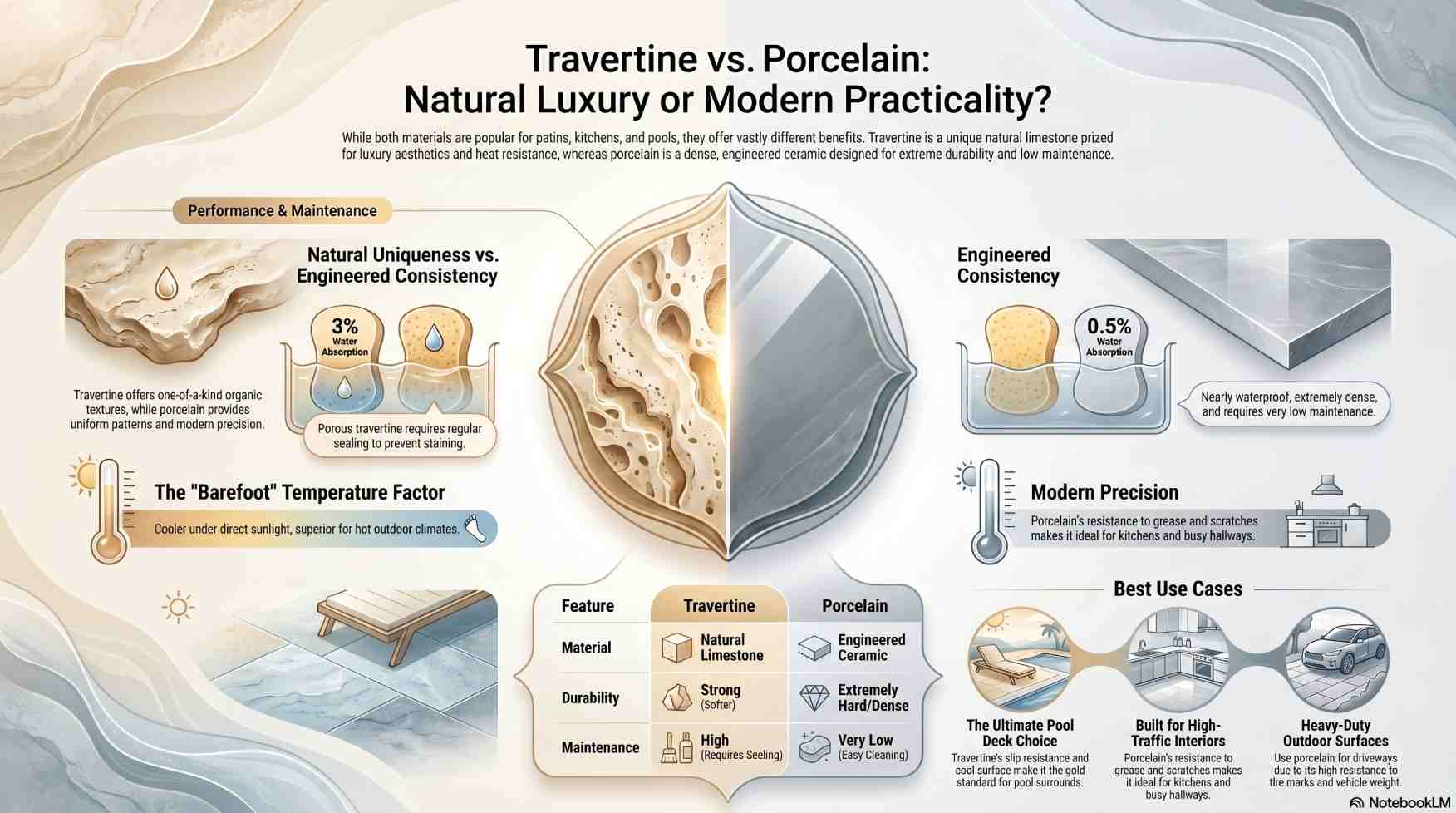
Water absorption is another major difference. Travertine is naturally porous and typically absorbs around 2–3% moisture unless properly sealed. Porcelain has an extremely low absorption rate, usually below 0.5%, which makes it almost waterproof. This is one of the main reasons porcelain performs exceptionally well in bathrooms and wet climates.
Thermal Regulation and Heat Resistance
One area where travertine often outperforms porcelain is thermal comfort. In hot climates, travertine stays significantly cooler under direct sunlight. This makes it highly desirable for pool surrounds and outdoor entertaining areas where barefoot comfort matters.
Travertine vs Porcelain Maintenance Requirements
Maintenance is often the deciding factor for homeowners researching travertine vs porcelain because the long-term care requirements are very different.
Travertine Maintenance and Sealing
Travertine requires more attention because of its porous surface. After installation, the stone usually needs sealing to help protect it against water, stains, oils, and dirt penetration. Depending on the location, resealing may be required every 6 to 12 months or every few years. Travertine also reacts strongly to acidic substances, so pH-neutral stone cleaners are recommended.
Why Porcelain Is Easier to Maintain
Porcelain is considered one of the easiest flooring materials to maintain. Since it is non-porous, it does not require sealing and naturally resists moisture, stains, mold, and most household chemicals. Daily cleaning is usually simple and involves only sweeping and occasional mopping.
Best Applications for Travertine vs Porcelain
- Pool Decks: Travertine is widely considered best because it stays cool underfoot and offers strong slip resistance.
- Driveways: Porcelain often performs better due to its high resistance to tire marks, oil stains, and vehicle weight.
- Kitchens: Porcelain is more practical because it resists grease and food stains extremely well.
- Bathrooms: Travertine creates a spa-like atmosphere for shower floors, while porcelain is often preferred for walls due to ease of cleaning.
Final Verdict on Travertine vs Porcelain
When comparing travertine vs porcelain, there is no universal winner because the right choice depends entirely on your priorities. If your main goal is creating a luxurious, natural, and timeless atmosphere — especially for outdoor areas and pool surrounds — travertine usually delivers the stronger visual impact.
On the other hand, if you want maximum durability, minimal maintenance, and easier long-term care, porcelain is generally the more practical option. Many modern homes now combine both materials strategically, using travertine in outdoor areas for luxury and comfort, while using porcelain indoors for high resistance to wear.