

Travertine is a type of limestone that is created by rapid precipitation of calcium carbonate, known as calcite. Other minerals mix together with the calcite to create unique swirls and movements that give the travertine its distinctive character
Yes, you can place some fire pits on a travertine patio, but the stone should not be treated as a fireproof base. Heat from the bottom of a fire pit, fallen embers and direct flame can mark or damage the paving. The safest arrangement depends on the fire pit’s design, its clearance from the ground, the manufacturer’s instructions and the layers beneath the stone. A suitable raised unit and a heat-rated protective base can reduce risk; a permanent wood-burning pit needs a properly designed, lined structure.
If you are planning a new patio, choose the fire pit location before the paving is laid. If the travertine is already installed, check both the fire pit’s instructions and the condition of the paving before lighting a fire.
Is travertine heat resistant?
Travertine is a natural limestone and does not burn like timber. That does not mean a travertine paver, its sealer, adhesive or bedding can withstand direct flames or prolonged heat without damage. Concentrated heat and sudden temperature changes can cause discolouration, cracking or surface damage, particularly if the stone already has weak spots or moisture is present. The overall installation matters as much as the stone itself.
Heat resistance also differs from how warm a paving surface feels in the sun. For a comparison about daytime foot comfort, read our guide to whether travertine gets hot in the sun.
Can you put a fire pit directly on travertine pavers?
Avoid placing a fire bowl or open flame directly on the pavers. Even a freestanding fire pit with legs can send considerable heat downwards. Follow its specified minimum clearance and use a protective base specifically rated for that fire pit and the paving below. A generic rubber mat, thin decorative tile or sealer is not a substitute for a heat-rated barrier.
| Setup | What to check | Practical approach |
|---|---|---|
| Portable gas fire pit | Heat directed beneath the unit, fuel connections and manufacturer clearance | Use the approved stand or protective base and have gas connections installed or checked by a licensed professional where required. |
| Portable wood-burning fire pit | Radiant heat underneath, sparks, ash and wind | Use a raised design with a suitable heat-rated base; keep embers off the paving and follow the unit’s instructions. |
| Permanent fire pit | Continuous heat, structural base and lining | Have the assembly designed with a heat-rated liner or fire brick and a suitable foundation. Do not use travertine as the unprotected inner firebox. |
What should go under a fire pit on pavers?
Choose a fire pit pad, stand or heat shield approved for the exact fire pit and surface, taking into account the pit’s footprint and the heat it sends downwards. Some permanent constructions need fire brick or a metal liner as part of the designed firebox. A loose layer of ordinary pavers placed beneath the pit is not automatically sufficient: heat can still reach the travertine and the materials below it.
Ask the supplier or installer to confirm the protective assembly, especially for a fire pit over a paved slab, an adhesive installation or a concealed waterproofing layer. Follow the fire pit manufacturer’s instructions if they require a different base or greater clearance.
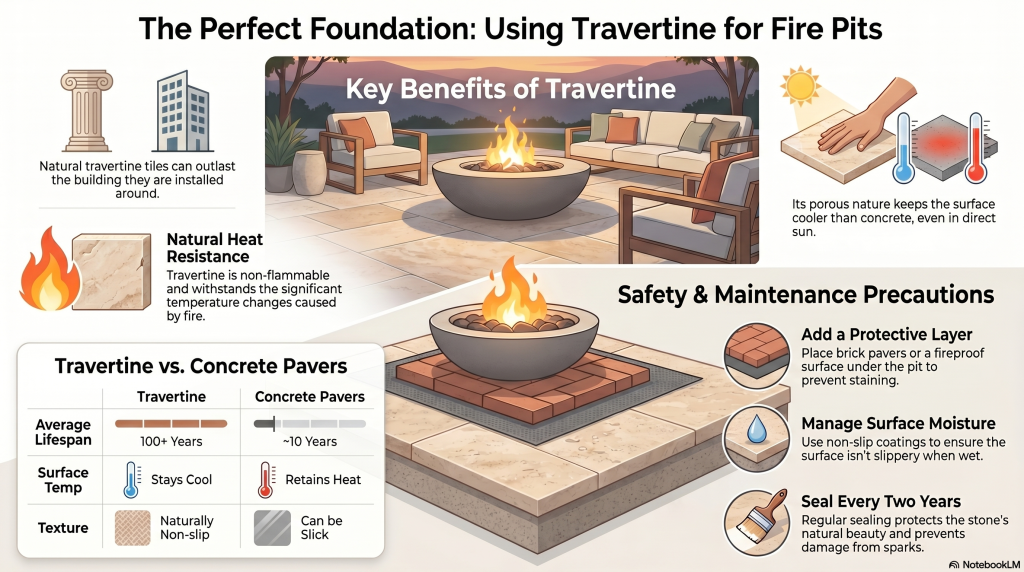
How to protect travertine around a fire pit
- Plan the position. Choose an open, stable location away from overhead branches, plants, furniture and other combustible materials. Use the clearances in the fire pit manual and check local fire rules.
- Keep direct heat off the paving. Use the stand, liner and heat-rated barrier specified for the fire pit. A portable pit should not sit over damaged or loose pavers.
- Control sparks and fuel. Do not overfill a wood-burning pit. Where suitable, use a spark screen and keep dry leaves and other debris away.
- Protect the finish. Remove cool ash and soot promptly with a soft brush. Clean marks with a cleaner suitable for natural limestone and follow the sealer manufacturer’s directions.
- Inspect before each use. Look for cracks, movement, stains or damage to the protective base; stop using the setup if any part appears unsafe.
Sealing can help reduce staining from soot and spills, but it does not make travertine fireproof. See our separate guide to sealing travertine for stone care.
Which pavers are best for a fire pit area?
For the surrounding patio, the right paver depends on the paving system, desired finish, outdoor conditions and how the fire pit will be isolated from the surface. Travertine can be used around a properly designed fire feature, but do not assume that ordinary travertine, concrete or porcelain pavers are suitable for lining the firebox. Products used inside the hot zone need an explicit rating for that application.
If you are still selecting the patio material, explore our travertine pavers and tiles and ask Hunter Pavers about the intended outdoor use, finish and installation. For broader layout choices, see our patio paving guide.
Is a travertine fireplace the same thing as a fire pit?
No. A fire pit on an outdoor paved surface, an indoor fireplace surround and a fireplace hearth have different designs and exposure to heat. This page focuses on outdoor fire pits on travertine paving. For fireplace surrounds and hearth considerations, see our dedicated travertine fireplace guide. A qualified installer should confirm the material and construction requirements for any hearth or firebox.

Check local rules before lighting a fire
Fire rules vary by location and can change with weather and fire danger. In NSW, check current fire bans, local council rules and any permit or approval requirements before using an outdoor fire pit. Never leave a lit fire unattended; follow the manufacturer’s instructions for extinguishing your specific fuel type.
Planning a travertine patio with a fire feature? Contact Hunter Pavers about suitable paving products and finishes, and have the fire pit installation and clearances confirmed by a qualified professional.
Frequently asked questions
Can you put a wood-burning fire pit on travertine?
A raised wood-burning pit may be usable over a travertine patio if its manufacturer permits that surface and you provide the specified clearances and heat-rated protection. Do not light a wood fire directly on the pavers. Sparks and ash can also stain or damage the finish.
Can you put a gas fire pit on travertine?
Some gas units can be used over paving when installed according to their instructions. Check the required clearance underneath, use the specified base and have any permanent gas connection handled by a licensed professional where required.
Are travertine pavers fireproof?
No. Travertine is a non-combustible natural stone, but pavers and the layers beneath them can still be affected by intense or prolonged heat. Do not use ordinary travertine as a firebox lining unless the complete assembly is approved for that purpose.
Will a fire pit crack travertine?
It can, especially if heat is concentrated in one spot, the stone is already damaged or the paving assembly is unsuitable. Proper clearance, a heat-rated barrier and a professionally designed base reduce the risk but cannot guarantee that the stone will never be damaged.
What can I put under a fire pit to protect travertine?
Use a stand, pad or heat shield that is rated for your fire pit and its surface. For permanent fire pits, a contractor may specify fire brick or a metal insert and a separate structural base. Check the unit’s manual before choosing a barrier.
Do I need to seal travertine around a fire pit?
A suitable natural stone sealer may make soot and spills easier to clean, depending on the product. Sealing does not provide heat protection. Follow the sealer manufacturer’s instructions and keep it away from direct flame.
Can travertine be used for a fireplace hearth or surround?
That is a separate installation from an outdoor fire pit patio. Material choice, clearances and construction depend on the fireplace appliance and applicable requirements. Read the fireplace article and consult a qualified installer before selecting a hearth or surround.