


To choose the right paving for your patio, you must weigh four essential elements: the specific function of the space (such as pool-side vs. dining), the demands of the Australian climate, your long-term maintenance budget, and the architectural flow of your home. Whether you prioritize the organic, non-slip texture of natural sandstone or the stain-resistant, modern finish of porcelain, the ideal selection serves as a safe and durable extension of your interior sanctuary. This guide provides the professional specifications and material insights needed to navigate these choices and ensure a successful, high-value installation.
Why Paving is Essential: Protecting Your Structural Investment
Beyond the obvious aesthetic appeal, professional paving serves as a critical structural shield for your property. In the Australian climate, characterized by sudden downpours and intense heat, an unpaved or poorly paved area is a liability. During heavy storms, rainwater can easily wash away the sub-surface sand and soil, leading to significant erosion. This erosion not only damages the surface appearance but also weakens the foundation of the patio and potentially the main building. A compromised foundation poses a major safety risk and can lead to structural cracks that cost a fortune to repair. Professional-grade paving acts as a permanent barrier against these environmental dangers, managing water runoff and protecting the integrity of your home’s exterior design.
| Your Priority / Goal | Recommended Material | Key Reason for Selection |
|---|---|---|
| Ultra-Low Maintenance | Porcelain Paving | Engineered to be non-porous; resists moss, algae, and harsh oil stains without needing sealants. |
| Luxury & Asset Value | Natural Granite or Limestone | Provides an unmatched organic aesthetic that increases property resale value through timeless durability. |
| Pool & Wet Areas | Travertine or Light Porcelain | Offers superior heat dissipation (stays cool in 40°C heat) and meets critical P4/P5 slip-resistance standards. |
| Budget-Conscious Projects | Sandstone or Concrete Slabs | Highly versatile and affordable per square meter, offering a premium look without the high-end price tag. |
Strategic Pillars for Successful Paving Design
A successful paving project is the result of strategic planning rather than just picking a color. First, you must consider Intended Use & Lifestyle Safety. This means defining the primary activity of the space; an “entertainment hub” for barbecues requires a high-density, stain-resistant surface like Granite that won’t absorb grease, whereas a pool deck shifts the priority toward bare-foot comfort and superior slip resistance. A fall on a wet patio is a preventable accident if the correct “P-rating” is selected from the start.
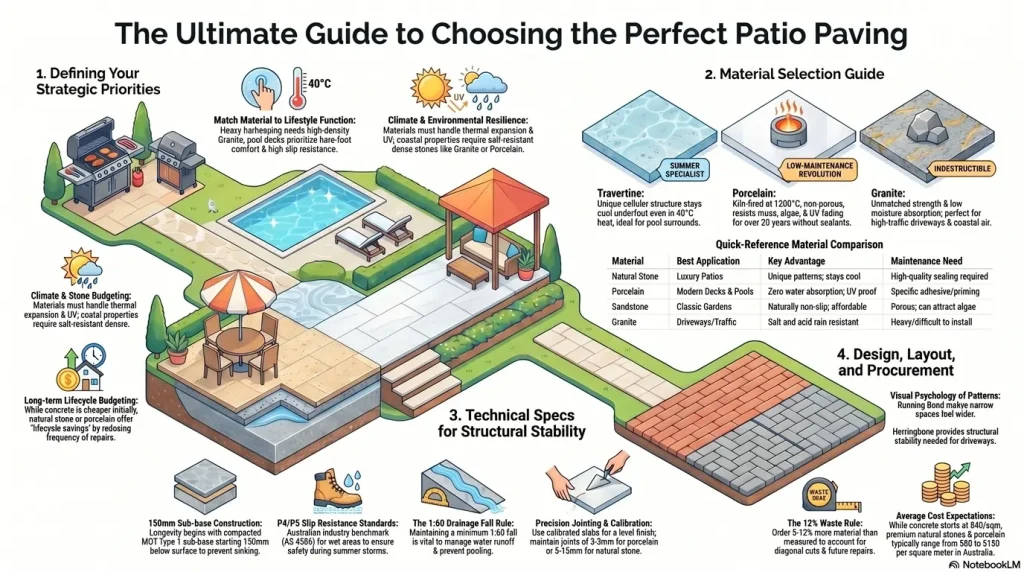
Furthermore, Climate & Environmental Resilience is non-negotiable in the Australian landscape. Paving is subjected to extreme UV exposure and radical temperature shifts, meaning materials must handle thermal expansion—the physical growing and shrinking of the stone—without cracking. For coastal properties, resistance to salt-air corrosion makes dense stones like Granite or Porcelain the preferred choices. This leads into Lifecycle Budgeting, where it is vital to look beyond the initial purchase price. While poured concrete may save money today, it is prone to splitting. Investing in natural stone provides a “lifecycle saving” by reducing repair frequency.
Finally, Architectural Harmony ensures your patio feels like a natural extension of your indoor living room. Large-format, clean-edged grey porcelain slabs typically complement modern architecture, while the warm, earthy tones and hand-dressed edges of Sandstone are perfect for traditional, heritage, or rustic cottage-style homes.
Comprehensive Paving Material Comparison
Understanding the technical trade-offs of each material ensures you won’t regret your decision a few years down the line:
| Material | Best Application | Advantages | Technical Considerations |
|---|---|---|---|
| Natural Stone | Luxury Patios & Paths | Unique natural patterns; stays cool; builds character. | Requires high-quality sealing; porous variants absorb oil. |
| Porcelain | Modern Decks & Pools | Zero water absorption; frost-proof; scratch-resistant. | Requires specific adhesive and priming systems. |
| Travertine | Pool Surrounds | Exceptional heat resistance; soft underfoot. | Highly porous; needs regular sealing to prevent staining. |
| Sandstone | Classic Garden Design | Naturally non-slip; affordable; unique slabs. | Highly porous; can attract algae in shaded areas. |
| Granite | Driveways & High-Traffic | “Virtually indestructible”; ignores acid rain. | High cost; heavy and difficult to cut/install. |
| Slate | Contrasting Borders | Distinctive layered texture; rich dark colors. | Can delaminate (flake) in severe freeze-thaw cycles. |
| Blue Stone | Feature Walkways | Premium “fancy” aesthetic with irregular textures. | Requires professional installation to manage thickness. |
Deep Dive: Choosing the Perfect Stone
Natural Stone: The Organic Legacy
Natural stone is the most versatile paving material available today. Because it is quarried from the earth, no two slabs are identical, providing authenticity that man-made materials cannot replicate. Sandstone remains the backbone of traditional Australian gardens; its natural cleft surface provides excellent grip for pathways that see frequent rain. For those seeking extreme durability, Granite is the ultimate choice for strength. Its low moisture absorption rate makes it naturally resistant to salt air common in coastal regions like Sydney or Perth. Meanwhile, Travertine offers the ultimate luxury for the Australian summer, possessing a cellular structure that stays cool even on 40-degree days. However, one must be cautious with Limestone; while it offers a sophisticated look, it is chemically sensitive and requires immediate cleaning of acidic spills to prevent etching.
Porcelain: The Technological Revolution
Modern porcelain paving has become the top choice for a “resort look” without the maintenance. Kiln-fired at 1200°C, it is harder than most natural stones and offers total resistance to UV fading, ensuring your patio looks new for 20+ years. It is the perfect marriage of modern engineering and aesthetic elegance, providing a surface that is as tough as it is beautiful.
Technical Specifications: Ensuring Stability
The longevity of a patio depends heavily on what lies beneath the surface. Professional Sub-base Construction starts 150mm below the surface with a compacted MOT Type 1 sub-base to prevent sinking. To ensure a level finish, always prioritize Calibration; calibrated slabs are machine-cut to a uniform thickness, preventing uneven joints and trip hazards. For pool decks, Beveled Edges are recommended for bare-foot comfort and safety, while Hand-dressed Edges provide a more rustic, textured look.
Safety must be governed by Slip Resistance Standards (AS 4586). In Australia, a P4 or P5 rating is the industry benchmark for wet areas, ensuring safety during sudden summer storms. This technical precision extends to Drainage & Jointing; maintaining a minimum 1:60 fall is vital to prevent pooling. Joint widths should be carefully managed, typically 3-5mm for porcelain and 5-15mm for natural stone. Finally, be aware of Efflorescence, a natural white salt deposit. Minimizing this requires the use of low-alkali mortar and high-quality sealants upon installation.
Patterns and Visual Psychology
The pattern you choose acts as a visual guide for the eye and can drastically change the perception of space. A Running Bond, for instance, involves staggering stones like bricks; when laid parallel to the house, it can make a narrow garden feel significantly wider. For driveways and heavy-load areas, the Herringbone pattern is superior due to its incredible structural stability, although it requires more diagonal cuts and creates roughly 10% waste.
In more organic garden designs, Circular & Curved layouts break up the rigidity of rectangular spaces, though they often require smaller pavers or setts to navigate the curves effectively. Additionally, the use of Large Format Slabs (e.g., 900x600mm) reduces grout lines, which is a professional trick used to make small Australian backyards appear significantly more expansive and airy.
Planning, Procurement, and Sustainability
Precision in the planning phase prevents costly delays. Following the 12% Waste Rule is standard practice; always order 5-12% more than your measurements to cover diagonal cuts and future repairs. Before the final purchase, Color Sampling is essential. Request at least five samples and view them in different lighting conditions against your house exterior, as natural stone shifts appearance from morning sun to evening shade.
From a Sustainability perspective, natural stone is inherently eco-friendly and fully recyclable. For those concerned with carbon footprints, man-made clay slabs often provide a lower impact than traditional concrete. Choosing quality materials at the start ensures that your patio is a long-term addition to the environment rather than a temporary structure destined for a landfill.
Why Hunter Pavers?
At Hunter Pavers, we don’t just sell stone; we provide the foundation for your family’s outdoor memories. We offer the best quality materials at the most reasonable prices in Australia. From heat-reflective travertine to “indestructible” granite, our collection is curated for the Australian lifestyle. Contact us today for a personalized consultation. Our experts are standing by to help you choose the right paving for your project.