

Granite pool coping is a durable natural-stone finish installed along the top perimeter of a swimming pool. It is especially suitable for projects where wear resistance, precise edge profiles and a premium architectural appearance are priorities. Light grey, silver and white granite can suit bright contemporary pools, while charcoal and black granite create stronger visual contrast.
The stone name alone does not determine poolside performance. Colour, surface finish, dimensions, edge profile, wet-condition slip-test information, installation and maintenance all need to be checked for the exact product. If you are comparing the full range of coping types and materials, start with Hunter Pavers’ complete pool coping guide.
Granite Pool Coping: Quick Summary
| Factor | Granite Pool Coping |
|---|---|
| Primary advantage | High durability and wear resistance |
| Appearance | Premium natural mineral pattern |
| Suitable poolside finish | Usually textured; confirm exact wet-condition test data |
| Heat consideration | Dark colours may become warmer in direct sunlight |
| Maintenance | Routine cleaning; sealing depends on product and exposure |
| Relative cost | Generally premium; fabrication and installation affect total cost |
| Best suited to | High-use, modern and premium pool projects |
What Is Granite Pool Coping?
Granite pool coping consists of specially sized granite pieces installed directly along the upper edge of the pool shell. It caps and protects the pool beam, creates a finished surface for swimmers to grip or sit on and forms the transition between the waterline and surrounding pool paving.
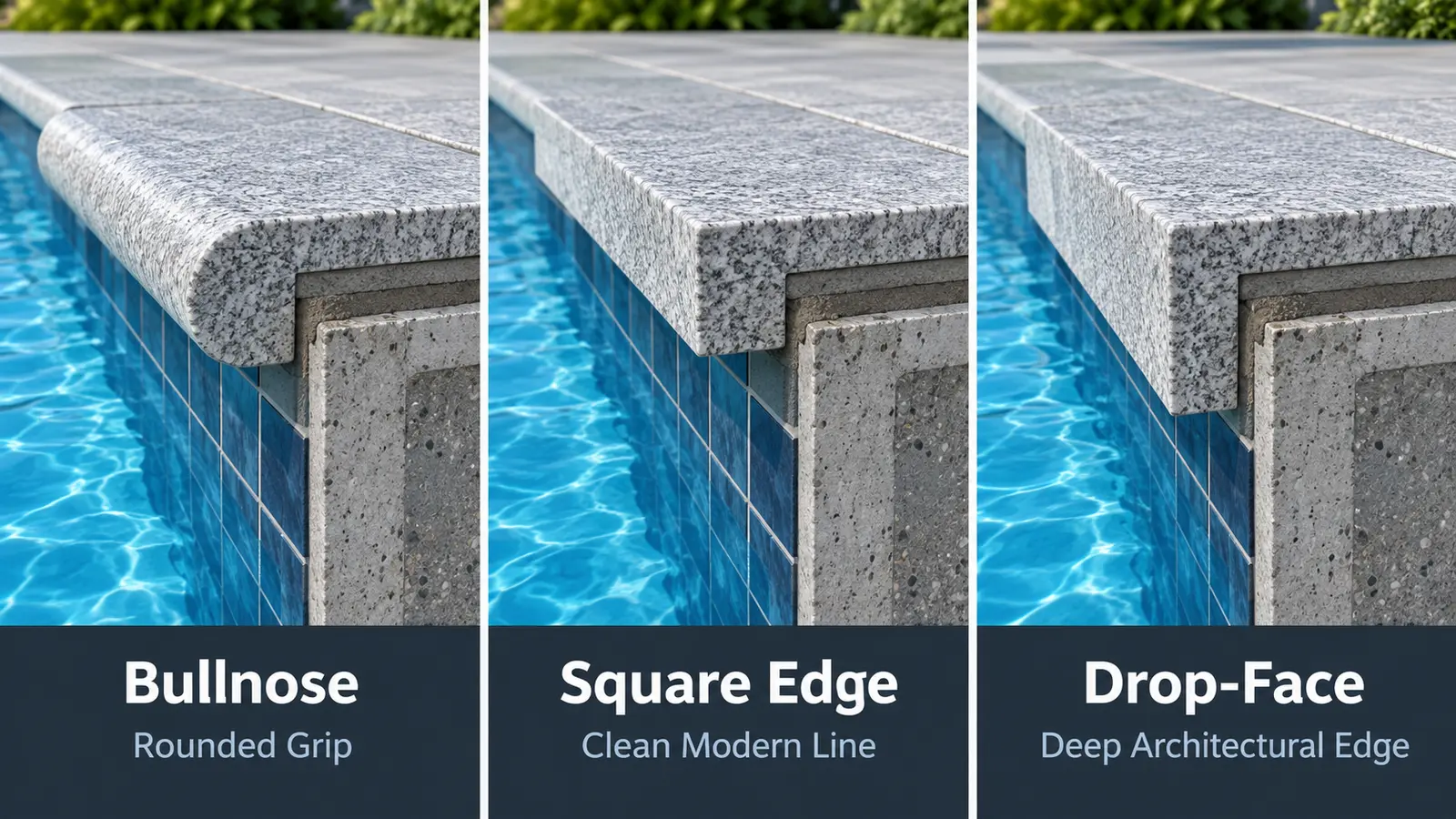
Coping is different from the wider pool deck. The deck covers the surrounding circulation and entertaining area; coping follows the pool perimeter and usually includes a finished exposed edge. Bullnose, square-edge and drop-face formats create different visual and construction details.
Geoscience Australia describes granite as a common igneous rock usually composed of quartz, feldspar and biotite mica or hornblende. Its visible grains are crystals formed as magma cooled slowly underground.
“Granite is made of large crystals that grew slowly as magma cooled deep underground.”
This crystalline composition contributes to granite’s hard-wearing character, but natural variation remains normal. Samples should be reviewed in daylight, and the actual exterior suitability of the selected product should be confirmed before ordering.
Benefits of Granite Pool Coping
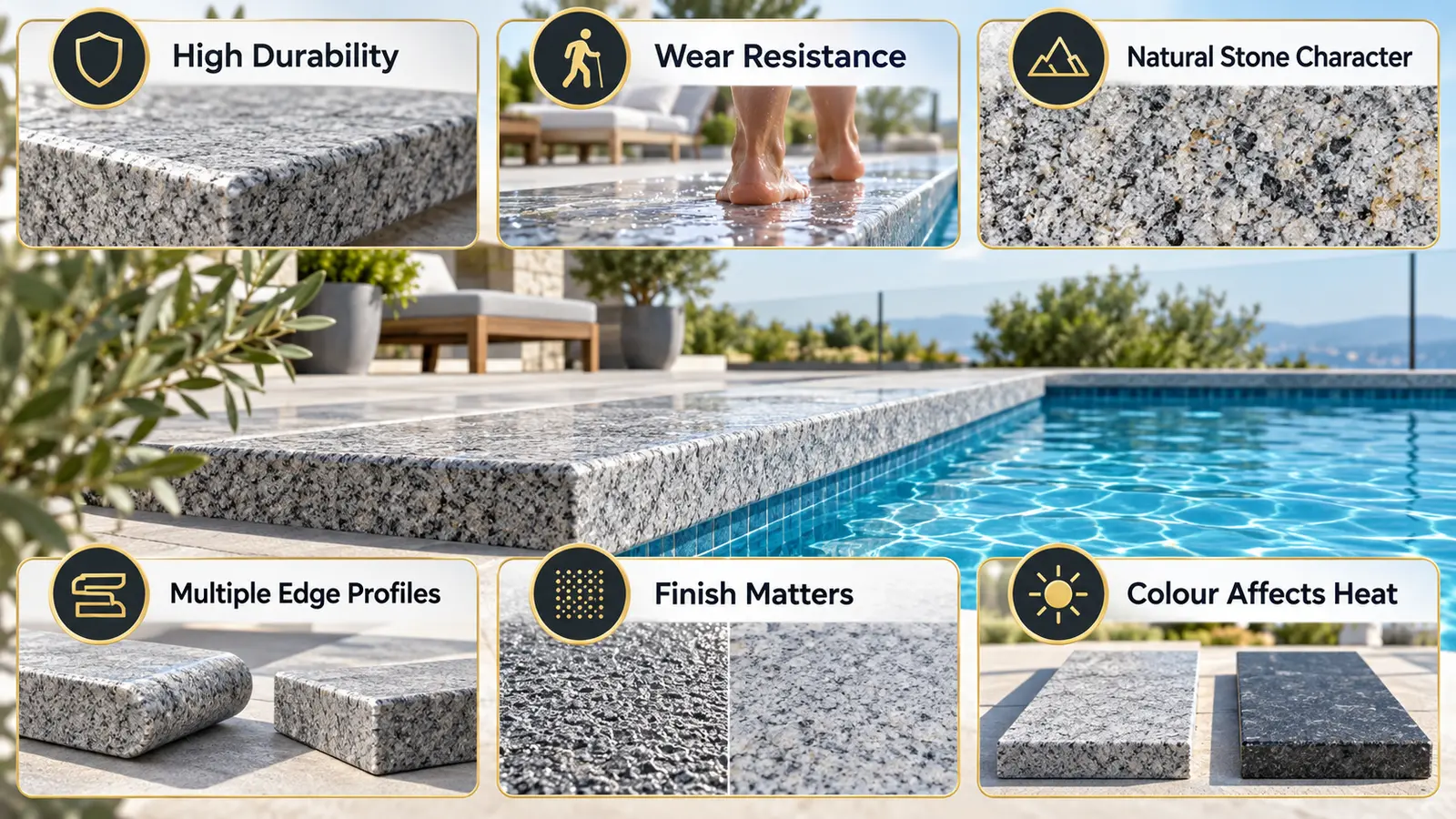
High Durability
Granite is valued where coping will experience regular foot traffic, outdoor furniture, repeated cleaning and everyday poolside use. Its strength makes it a useful option for busy family pools, high-end residential landscapes and commercial-style environments. Long-term performance still depends on sound stone, correct thickness, a stable substrate, appropriate joints and professional installation.
Suitability for Outdoor Exposure
Correctly selected exterior granite can perform well in environments exposed to sunlight, rain and splash water. However, the complete system matters: drainage falls, adhesive compatibility, movement accommodation, joint materials and pool chemistry can influence results. Product-specific advice is especially important around saltwater pools or sites with demanding exposure.
Premium Natural Appearance
Granite contains visible mineral grains and natural tonal variation. Pale granite can create a clean transition between blue water and light paving, mid-grey products suit contemporary architecture and black granite can produce a bold frame around the pool. Matching coping and surrounding granite paving can create continuity; contrasting materials can define the edge.
Precise Edge Options
Granite can be fabricated into familiar bullnose, square-edge and drop-face profiles. This makes it suitable for minimal contemporary pools as well as more traditional rounded edges. Dense stone can require specialist cutting, so custom corners, curves and deep faces should be confirmed before the final order.
Manageable Routine Care
Routine maintenance usually involves sweeping, fresh-water rinsing and cleaning with an appropriate pH-neutral stone cleaner. Depending on the granite, finish, exposure and stain risk, a compatible penetrating sealer may be recommended. Sealing should be based on product guidance and condition rather than one universal timetable.
Explore Granite for Pool Edges
Compare Hunter Pavers’ current granite colours, flamed finishes, coping dimensions and bullnose or drop-edge options, then confirm which format suits your pool construction.
Types of Granite Pool Coping Finishes
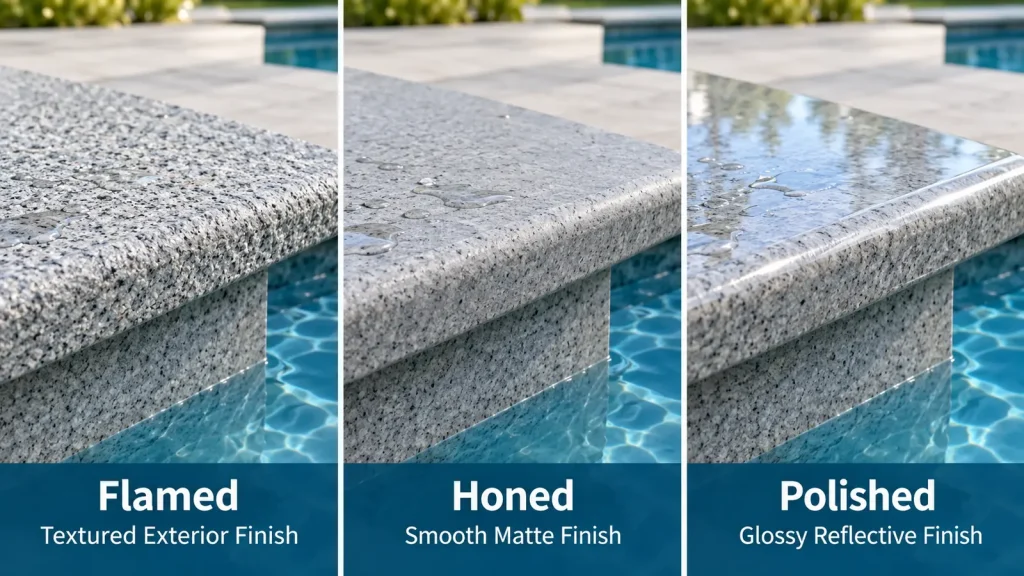
The finish changes how granite looks, feels and performs when wet. Do not choose only from a small dry sample; assess the exact finished product and request relevant slip-test documentation for its intended poolside use.
Flamed Granite Pool Coping
A flamed or exfoliated finish is created by controlled heat treatment that produces a textured surface. It is commonly considered for exterior paving and pool surrounds because it offers more texture than honed or polished granite. Hunter Pavers lists flamed options across its granite range, including light products such as Sesame White Granite and Sesame Grey Granite.
Honed Granite Pool Coping
Honed granite has a smooth matte appearance with limited reflection. It can suit minimalist designs, but the slip performance of honed surfaces varies. A description such as “honed” is not enough to establish poolside suitability; confirm wet-condition testing for the exact product and assess the intended barefoot or footwear use.
Polished Granite Pool Coping
Polishing increases reflectivity and emphasises mineral colour, but a highly smooth surface can be less appropriate in frequently wet walking areas. Polished granite may work as a decorative vertical face or in selected low-traffic details, but it should not be assumed suitable for the top of a pool edge without supporting test information.
“Slip resistance classification of new pedestrian surface materials.”
AS 4586 classifies new pedestrian surfaces using specified test methods. Ask for the report relating to the exact granite and finish being supplied; a generic material claim or rating from a different finish is not sufficient.
Granite Pool Coping Colours and Heat
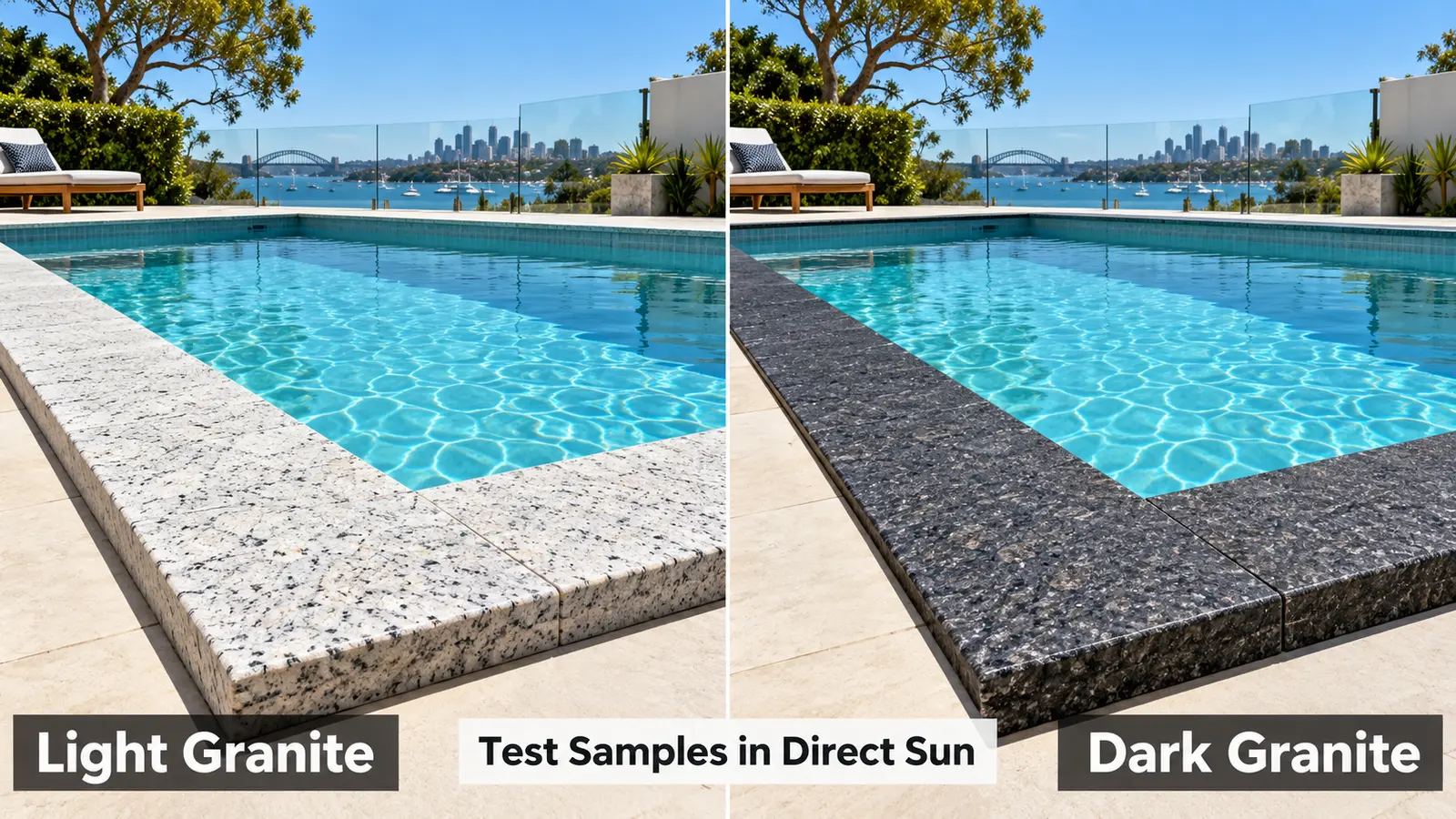
Granite is available in white, silver, light grey, mid-grey, charcoal, black and mixed mineral patterns. Colour affects both design and solar heat absorption. Dark coping can become uncomfortable during strong direct sunlight, so light granite is generally a more sensible starting point for exposed Sydney pool edges.
Sesame White Granite offers a bright surface with grey and black speckling, while Sesame Grey Granite provides a consistent mid-grey direction. Raven Black Granite creates dramatic contrast but requires more careful heat consideration in sunny areas. View wet and dry samples outdoors at the time of day when the pool receives the most sun.
Granite vs Travertine vs Marble Pool Coping
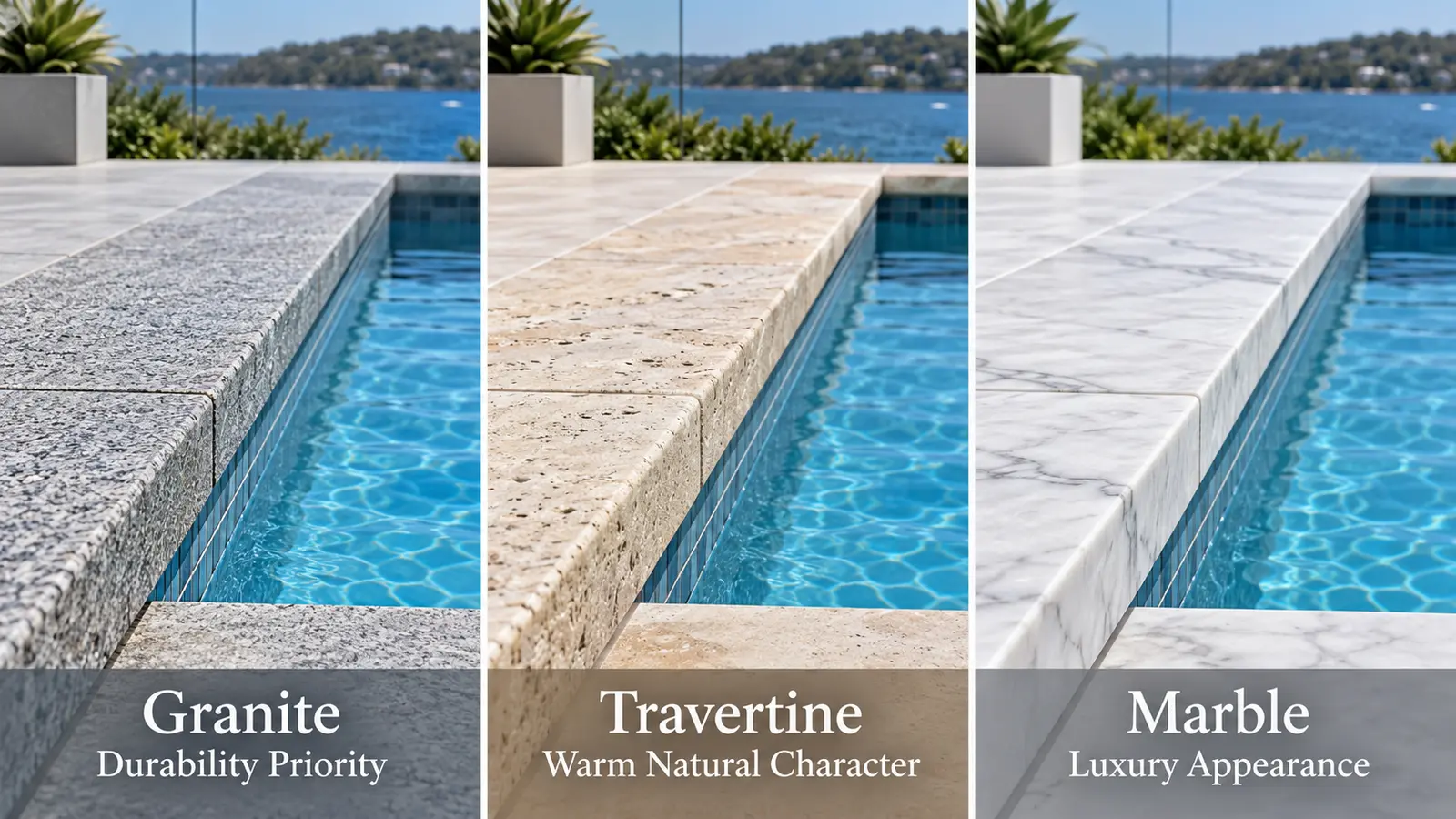
Granite, travertine and marble can all create premium natural-stone pool edges, but they answer different priorities. Granite is strongest where durability and wear resistance lead the decision. Travertine offers warmer natural character and popular pale colours, while marble is selected primarily for distinctive veining and luxury design.
| Factor | Granite | Travertine | Marble |
|---|---|---|---|
| Main strength | Wear resistance | Balanced outdoor appeal | Premium visual character |
| Appearance | Crystalline and structured | Warm and naturally porous | Veined and refined |
| Heat | Dark colours may become warm | Pale colours commonly preferred | Varies by colour and exposure |
| Maintenance | Low to moderate | Moderate | Moderate to higher |
| Fabrication | Dense and harder to cut | Common coping formats available | Careful handling and finish selection |
| Relative price | Premium | Mid-range to premium | Premium |
| Best direction | High-use pools | Residential and resort-style pools | Luxury architecture |
Use the detailed travertine vs granite comparison if those two stones are on your shortlist. You can also review the complete pool coping material comparison before deciding between granite, travertine, marble, limestone, sandstone and porcelain.
Granite Pool Coping Edge Profiles
Bullnose Granite Coping
Bullnose coping uses a rounded exposed edge that feels familiar to hold and softens the line around the pool. Full bullnose and partially rounded profiles may differ, so confirm the physical sample and dimensions rather than relying on the name alone.
Square-Edge Granite Coping
A square edge creates a crisp contemporary appearance and works well with rectilinear pool geometry. The arris should still be finished appropriately so the edge is comfortable and not vulnerable to avoidable chipping.
Drop-Face Granite Coping
Drop-face coping extends vertically down the pool edge, creating the appearance of a deeper slab and concealing part of the pool beam. It can produce a substantial luxury finish but requires accurate fabrication, corner detailing and alignment. Curves and mitred corners can increase cost and lead time.
Granite Products to Shortlist
Hunter Pavers currently lists several granite products with flamed paving finishes and coping-related dimensions. Availability and suitability should be confirmed for the exact project:
- Sesame White Granite — a light direction with listed bullnose and drop-edge formats.
- Sesame Grey Granite — a consistent grey option for contemporary pools and paving.
- Raven Black Granite — a dark statement stone listed for pool surrounds; assess direct-sun heat and the exact finish.
- Veincut Granite — a linear-pattern option for modern architectural projects.
Check current stock, colour variation, dimensions, thickness, finish and edge availability before finalising the design. Order samples and compare them beside the pool in both wet and dry conditions.
Granite Pool Coping Cost
Granite pool coping is generally positioned toward the premium end of the market. The stone colour and grade, thickness, dimensions, surface finish and edge profile all influence supply cost. Dense granite can also require specialist cutting equipment and additional fabrication time.
The complete installed budget depends on the pool perimeter, number of corners, curves, custom pieces, delivery access, substrate preparation, adhesives, joints, sealing and labour. Replacement projects may also require demolition, disposal and repairs beneath the old coping. Use our complete pool coping cost guide to measure quantities and compare equivalent quotation scopes.
Current product pages show broad price ranges across multiple sizes and formats. The displayed range should not be treated as the installed price of one specific coping piece. Request a quote using the exact product, thickness, profile and quantity required.
Granite Pool Coping Installation
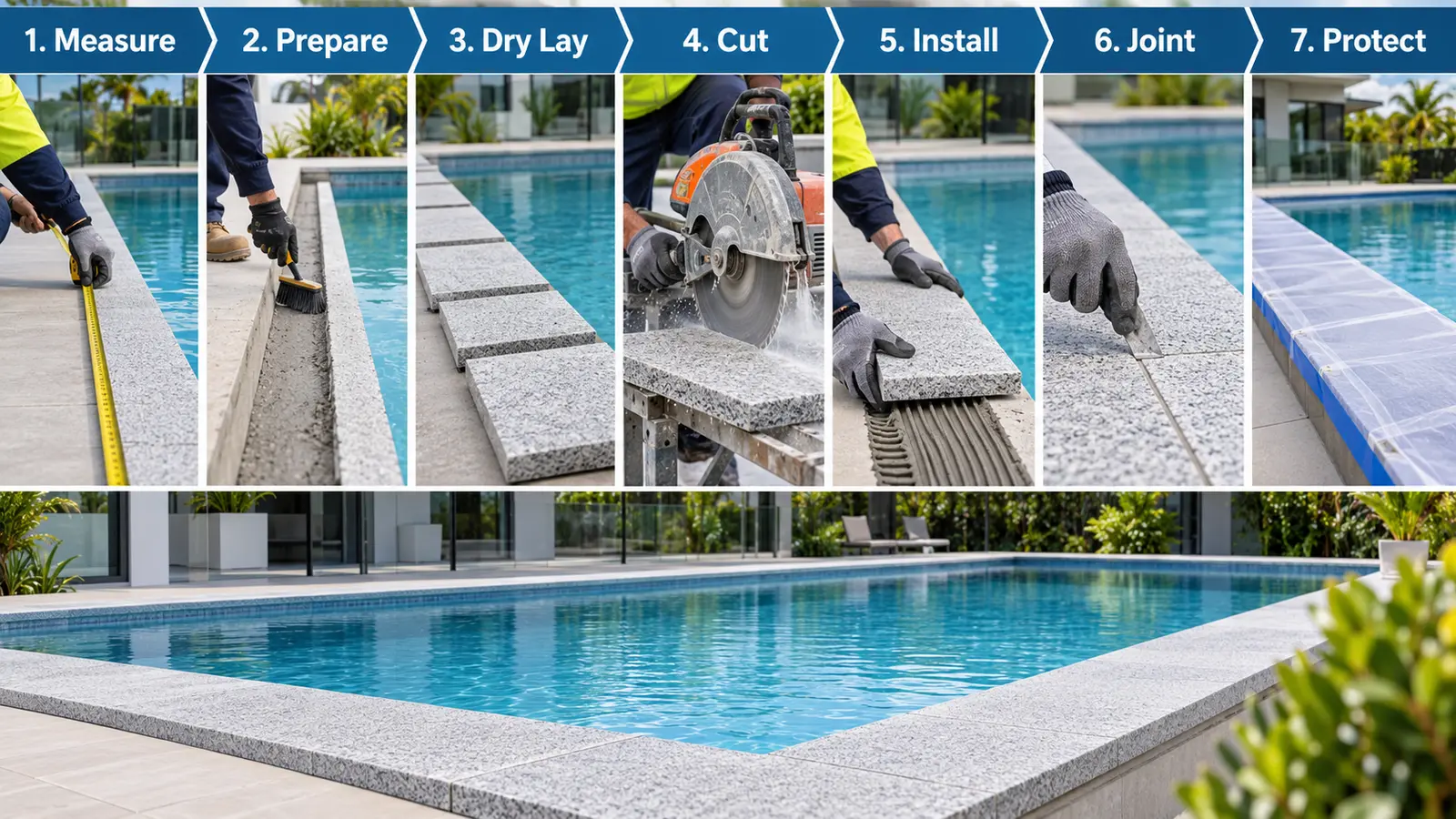
Granite coping requires accurate setting out because small alignment errors become visible around the pool perimeter. A typical process includes:
- Measure and plan: Confirm linear metres, widths, levels, corners, curves, steps and spa edges.
- Check the substrate: Ensure the pool beam is stable, clean, correctly prepared and suitable for the specified installation system.
- Dry lay and sort: Arrange natural colour and mineral variation before fixing.
- Cut and fabricate: Use appropriate equipment for corners, curves, rebates and custom profiles.
- Bond and align: Install with compatible products while maintaining falls, consistent overhang and joint spacing.
- Complete joints: Follow the project specification for jointing and movement accommodation.
- Clean and protect: Remove installation residue using stone-compatible methods and apply sealer if specified.
Because granite is heavy and difficult to fabricate, complex pools are usually better handled by an experienced installer. Confirm that the selected adhesive, grout, movement-joint material and sealer are compatible with the exact granite and pool environment.
How to Clean and Maintain Granite Pool Coping
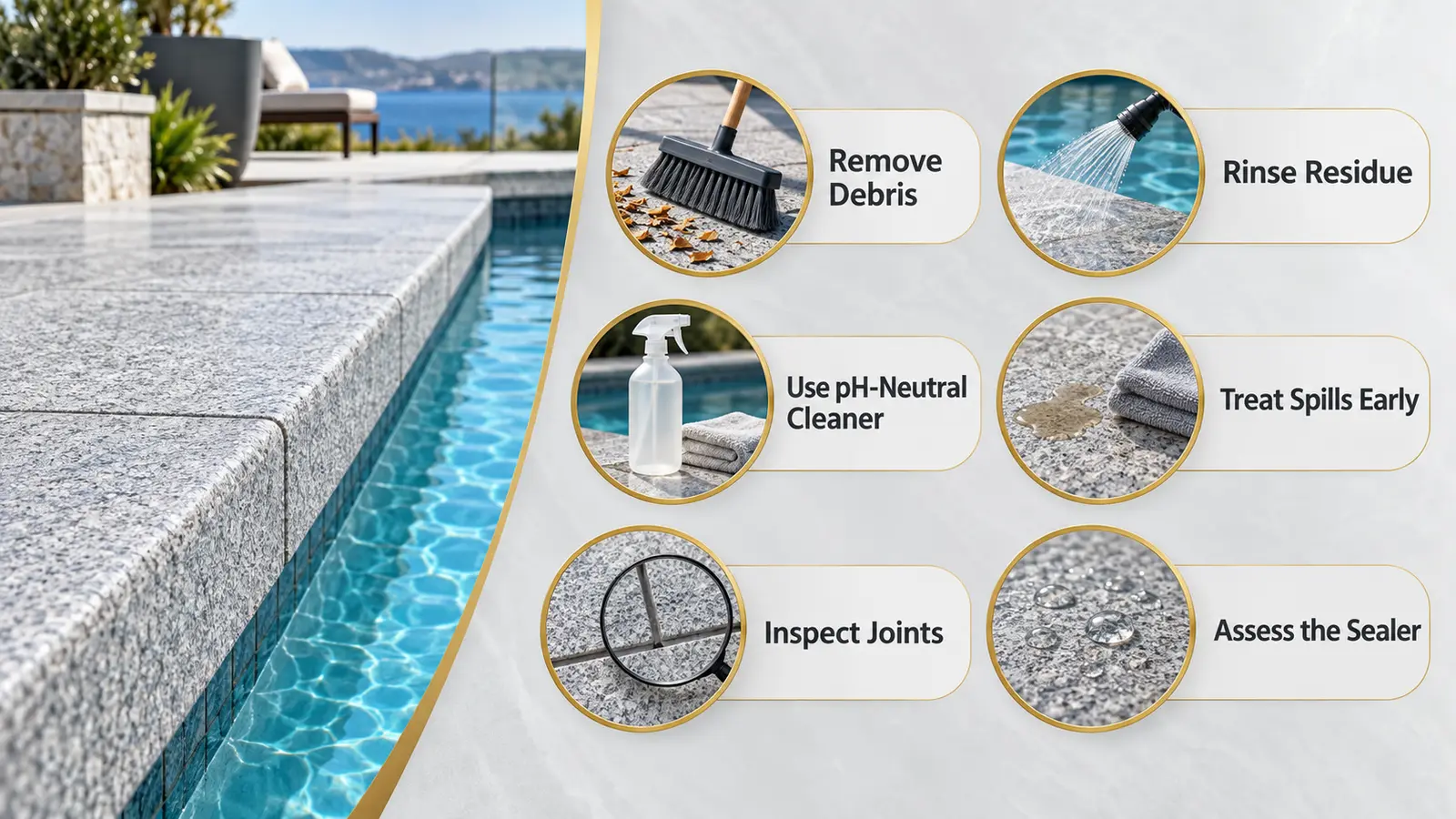
- Remove debris: Sweep leaves, grit and organic material before they stain or abrade the surface.
- Rinse splash residue: Periodically rinse with fresh water, particularly after heavy pool use.
- Use a suitable cleaner: Choose a pH-neutral product intended for natural stone and follow its instructions.
- Avoid harsh acids: Acidic cleaning products can affect stone, joints and nearby materials.
- Treat spills promptly: Remove oils, sunscreen residue, rust sources and coloured organic matter early.
- Inspect joints: Address cracking, failed sealant, movement or loose coping before water enters beneath the installation.
- Assess sealing by condition: Use a compatible penetrating sealer when recommended and reassess performance rather than following an arbitrary annual schedule.
Always test a cleaner or sealer on an inconspicuous spare piece first. A sealer should not create a slippery film or change the finish unexpectedly. Keep several labelled spare pieces from the installed batch for future repairs.
Granite Pool Coping Buyer Checklist
- Exterior suitability: Confirm that the exact granite is recommended for the intended pool environment.
- Wet-condition performance: Request relevant slip-test information for the actual finish supplied.
- Colour and heat: Compare samples in direct sun; favour lighter tones where surface comfort is important.
- Dimensions: Coordinate width, length, thickness and overhang with the pool beam and surrounding paving.
- Edge profile: Confirm bullnose, square edge, drop face, corners and curved fabrication.
- Natural variation: Review multiple pieces rather than selecting from one sample.
- Quantities: Measure the full perimeter and include a suitable allowance for cuts, breakage and spares.
- Installation system: Confirm substrate, adhesive, joints, drainage, cleaning and sealer requirements.
- Current supply: Check stock and lead time before scheduling the installer.
- Complete budget: Compare material, fabrication, delivery, preparation, labour and maintenance—not only the unit price.
Frequently Asked Questions
Is Granite Good for Pool Coping?
Yes. Granite can be an excellent pool coping material when durability, wear resistance and a premium natural appearance are priorities. The exact granite, finish, dimensions and installation system must still be suitable for the pool environment.
Is Granite Pool Coping Slippery?
Slip performance depends mainly on the exact surface finish and test result rather than the word “granite”. Textured flamed granite generally provides more surface texture than polished granite, but buyers should request relevant wet-condition testing for the product being supplied.
What Is the Best Finish for Granite Pool Coping?
A textured exterior finish such as flamed granite is a strong starting point for active pool edges. The best finish must still balance wet-area traction, barefoot comfort, cleaning and design, and should be supported by appropriate product-specific test information.
Does Granite Get Hot Around a Pool?
Granite can become warm in direct sunlight, particularly in black and charcoal colours. Light grey, silver and white granite are generally more sensible choices where surface comfort is important. Test a sample outdoors because colour, density, finish and exposure all affect temperature.
How Long Does Granite Pool Coping Last?
Quality granite coping can remain functional for many years when the stone is suitable for exterior use and is correctly installed and maintained. Service life depends on stone quality, substrate, joints, drainage, pool chemistry, weather exposure and care.
Is Granite Better Than Travertine for Pool Coping?
Granite is generally preferable when maximum wear resistance is the priority. Travertine may be preferred for warmer natural colour, softer visual texture and pale poolside designs. Neither material is automatically better; compare the exact finish, climate, maintenance, budget and design.
Does Granite Pool Coping Need Sealing?
Some granite products benefit from a compatible penetrating sealer, particularly where stain resistance is important. Requirements vary by stone density, finish, exposure and sealer, so follow product-specific guidance rather than applying one fixed schedule to every granite.
How Much Does Granite Pool Coping Cost?
Cost depends on granite selection, dimensions, thickness, finish, edge profile, quantity and fabrication. Delivery, preparation, installation, sealing and any removal work also affect the total. Request a project-specific quote rather than treating a broad product-page range as an installed coping price.
Choose Granite Pool Coping for Your Project
Granite pool coping is a strong choice for Sydney projects requiring durable natural stone, precise finished edges and a premium architectural appearance. Its advantages are greatest when colour, heat exposure, surface finish, test information, dimensions, installation and maintenance are assessed as one complete system.
Find Granite Coping for Your Sydney Pool
Send Hunter Pavers your approximate pool perimeter, preferred granite colour, required dimensions, edge profile and delivery location. The team can help you compare current formats, availability and supply pricing.