


Choosing the best pavers for driveway projects means finding a material that can handle vehicle traffic without compromising your home’s appearance. Unlike patios and garden paths, driveways must withstand concentrated vehicle loads, changing weather conditions and everyday wear.
The best driveway pavers depend on durability, thickness, traffic frequency, driveway slope, slip resistance, drainage, maintenance and budget. Granite and concrete are often practical choices for busy driveways, while suitable limestone, travertine and sandstone products can create attractive natural finishes. This guide compares the main options to help Australian homeowners make an informed decision.
The following comparison highlights the strengths and limitations of popular driveway paving materials. Performance varies according to the specific product, surface finish and installation system.
| Paver Material | Durability | Maintenance | Best For | Appearance | Cost |
| Granite | Very high | Low | Busy and premium driveways | Speckled, modern | High |
| Limestone | Moderate to high | Moderate | Elegant residential entrances | Cream, beige, grey | Medium–high |
| Travertine | Variable | Moderate–high | Decorative, lighter-use driveways | Warm, earthy | Medium–high |
| Sandstone | Variable | Moderate–high | Traditional home designs | Rustic, natural | Medium–high |
| Concrete | High when vehicle-rated | Low–moderate | Everyday family driveways | Versatile colors and shapes | Low–medium |
| Bluestone | High to very high | Low–moderate | Contemporary driveways | Dark, sophisticated | High |
There is no universal winner. A properly installed concrete driveway can outperform an unsuitable natural stone installation. Always assess the complete paving system rather than comparing materials by appearance alone.
What Makes a Good Driveway Paver?
The best pavers for driveways must provide reliable performance under repeated vehicle movement. Five characteristics are particularly important when comparing products.
Durability and Load-Bearing Strength
Driveway pavers need sufficient strength to resist cracking, chipping and wear under vehicle loads. Dense granite and purpose-made concrete pavers are generally strong options, although performance depends on product specifications.
Heavy vehicles, frequent turning and concentrated tyre loads place additional stress on paving. The foundation must support these loads as effectively as the surface material.
Paver Thickness
Paver thickness influences performance, but the required thickness depends on material strength, dimensions, traffic and installation method.
Many residential concrete segmental driveway systems use approximately 60 mm pavers, with thicker units often selected for more demanding applications. Natural stone requirements differ substantially. Some thinner stone products can be suitable over engineered concrete bases, whereas flexible installations may require different specifications.
Never assume patio-grade paving is suitable for cars.
Slip Resistance
Wet driveways can become hazardous, particularly where the surface slopes towards a garage or road.
Textured, flamed, exfoliated and appropriately rough-finished surfaces generally provide better traction than polished stone. Request relevant wet slip-resistance information and consider pedestrian safety alongside vehicle grip.
Stain and Weather Resistance
Oil leaks, tyre marks, moisture and fallen leaves can affect driveway appearance.
Dense, low-absorption materials generally resist staining better than highly porous stones. In coastal areas, salt exposure and moisture management are additional considerations. Suitable sealers can improve stain resistance but cannot compensate for an unsuitable paving product.
Maintenance Requirements
Maintenance needs vary between materials and finishes.
Granite and vehicle-rated concrete usually require relatively straightforward cleaning. Limestone, travertine and sandstone may need more careful stain management, compatible cleaning products and periodic sealing where recommended.
Choose a material that matches the maintenance you’re realistically prepared to undertake.
Best Driveway Pavers: Comparing the Top Materials
Each driveway material offers advantages for different homes and conditions. Understanding these differences helps prevent expensive mistakes.
Granite Pavers
Granite is among the strongest candidates for the best natural stone for driveway installations. Its dense structure, excellent wear resistance and relatively low water absorption make it suitable for many demanding residential applications.
Available in grey, black, white and naturally speckled colours, granite complements both contemporary architecture and traditional homes. Textured finishes can provide useful traction on wet surfaces.
Advantages: Excellent durability, strong wear resistance, relatively low maintenance and premium appearance.
Limitations: Higher purchase costs, potentially hot dark surfaces and the need for appropriate thickness and installation.
Explore Hunter Pavers’ granite pavers to compare natural finishes and colours.
Limestone Pavers
Limestone provides a softer architectural appearance, with neutral cream, beige and grey shades that complement Australian coastal, contemporary and traditional homes.
However, limestone varies considerably in density and strength. Dense, appropriately specified products may suit certain residential driveways, while softer varieties can be vulnerable to vehicle damage.
Advantages: Elegant natural appearance, versatile colours and attractive integration with landscaping.
Limitations: Potential staining, sensitivity to acidic substances and greater variation in strength between products.
When choosing limestone pavers, confirm that the exact product is approved for vehicle use rather than relying on its appearance or thickness alone.
Travertine Pavers
Travertine is recognised for its warm colours, distinctive natural voids and Mediterranean-inspired character. It can create an inviting driveway that complements stone façades, rendered homes and landscaped entrances.
Its suitability for vehicles requires careful assessment. Density, void structure, filling method and paver dimensions all influence durability.
Advantages: Distinctive appearance, natural colour variation and excellent decorative appeal.
Limitations: Possible surface wear, staining, chipping and maintenance of filled or unfilled voids.
Travertine is generally better considered for carefully specified decorative driveways than demanding heavy-traffic surfaces.
Sandstone Pavers
Sandstone is a popular choice for traditional Australian homes and natural landscape designs. Its earthy tones work particularly well with brickwork, established gardens and rustic architecture.
Some dense sandstone products can perform well under appropriate vehicle loads. However, softer varieties may experience surface wear, moisture absorption or staining.
Advantages: Natural texture, warm colours and timeless Australian character.
Limitations: Highly variable strength, potential weathering and greater cleaning requirements.
Request product-specific technical information before selecting sandstone for regular vehicle traffic.
Concrete Pavers
Concrete is one of the most practical and accessible driveway paving options. Manufactured driveway pavers offer consistent dimensions, predictable shapes and a wide choice of colours.
Purpose-made interlocking concrete pavers can provide reliable performance for family vehicles when installed over a correctly constructed base.
Advantages: Competitive pricing, good durability, straightforward replacement and extensive design flexibility.
Limitations: Possible colour fading, tyre marks, staining and movement where base preparation is inadequate.
Concrete is particularly attractive when budget, practicality and ease of maintenance are priorities.
Other Natural Stone Options
Bluestone, basalt and selected dense quartzite products are also worth considering.
Bluestone and basalt offer contemporary dark-grey finishes and strong wear resistance when properly specified. Suitable quartzite can deliver attractive natural variation, although its performance differs by source and product.
The pros and cons of natural stone pavers should always be evaluated at product level. A material’s reputation does not guarantee that every available thickness or finish is driveway-rated.
Explore pavers for driveway
Looking for natural stone driveway paving? Explore Hunter Pavers’ granite and limestone collections, and confirm the appropriate product, finish and installation requirements before ordering.
Natural Stone vs Concrete Driveway Pavers
The choice between natural stone and concrete often comes down to appearance, budget and the expected maintenance commitment.
| Feature | Natural Stone | Concrete |
| Appearance | Unique natural variation | Consistent manufactured finishes |
| Durability | Excellent with suitable dense stone | Reliable with vehicle-rated products |
| Initial Cost | Generally higher | Usually more affordable |
| Maintenance | Depends on porosity and finish | Generally straightforward |
| Design Flexibility | Premium natural character | Extensive shapes and patterns |
| Replacement | Matching can be challenging | Individual units are replaceable |
Natural stone is often preferred for architectural character, while concrete offers an economical solution for larger areas. Neither option is automatically superior: installation quality, drainage and vehicle loading remain essential.
more: crushed limestone vs crushed concrete
Best Pavers for Different Types of Driveways
Different site conditions can change which material provides the best long-term results.
| Type of Driveway | Content |
|---|---|
| Best Pavers for Heavy-Traffic Driveways | Textured granite and heavy-duty concrete pavers are strong candidates for driveways with multiple vehicles and frequent movement. For caravans, delivery vehicles or heavier loads, have the pavement structure professionally assessed. Appropriate sub-base design and load distribution are just as important as material selection. |
| Best Pavers for Sloped Driveways | Sloped driveways need excellent surface traction and effective drainage. Textured granite and suitably rated concrete are practical options. Avoid polished surfaces and ensure the design includes adequate edge restraints and resistance to movement caused by braking and turning. |
| Best Pavers for Low-Maintenance Driveways | Granite and quality concrete pavers are generally among the easiest materials to maintain. Their durability and practical cleaning requirements make them attractive for busy households. However, joints, drainage and occasional staining still require attention. |
| Best Pavers for a Premium Look | Granite, dense limestone and selected bluestone products are attractive choices for premium residential entrances. Granite offers a refined contemporary finish, while limestone creates a softer natural appearance. Consider how the selected color complements your façade, roof and garden. |
| Best Budget-Friendly Driveway Pavers | Vehicle-rated concrete pavers are often the best starting point for budget-conscious homeowners. Their consistent dimensions and widely available patterns can simplify installation. Nevertheless, compare the full installed price, including excavation, drainage, base preparation and labor. |
Best Driveway Paving Patterns
Paver arrangement affects both visual appearance and resistance to movement, particularly in flexible segmental paving systems.
Herringbone
Herringbone is one of the best patterns for rectangular driveway pavers.
Its interlocking arrangement helps resist horizontal forces created by braking, accelerating and turning. Both 45-degree and 90-degree layouts are commonly used for vehicle paving.
Stretcher Bond
Stretcher bond arranges rectangular pavers in staggered rows, producing a clean, traditional finish.
Although visually appealing, it generally provides less interlock than herringbone in flexible installations. Suitability depends on the paving system and traffic conditions.
Stack Bond
Stack bond aligns pavers in straight rows and columns for a modern geometric appearance.
Because it provides limited mechanical interlock, it is generally more appropriate for decorative areas or specially designed rigid installations than conventional flexible driveways.
How Much Do Driveway Pavers Cost?
Driveway paving costs in Australia vary according to material, thickness, finish, driveway size and site accessibility.
Concrete pavers generally offer the lowest initial material costs. Limestone, sandstone and travertine occupy varying price ranges, while premium granite and bluestone can cost more.
However, material pricing is only part of the total investment. Excavation, soil preparation, drainage, concrete foundations, labour, cutting and edge restraints may significantly affect the final quotation.
Compare complete installation quotes rather than simply choosing the cheapest paver per square metre. A properly designed driveway often delivers better long-term value than a lower-cost installation requiring early repairs.
Driveway Paver Installation Considerations
Correct installation determines whether driveway paving performs reliably under everyday vehicle loads.
The process should begin with assessing soil conditions, expected vehicle weight and surface drainage. Contractors can then specify the appropriate excavation depth, compacted base or engineered slab, bedding system, joints and edge restraints.
Following suitable paver installation instructions is particularly important when using natural stone, as installation requirements differ from standard concrete segmental paving.
Drainage and Permeable Driveway Paving
Driveways need adequate falls and drainage to prevent standing water and damage to supporting layers.
Purpose-designed permeable pavers may help manage runoff by allowing water to pass through a specifically engineered pavement system. However, permeable paving requires suitable soil conditions, aggregate layers and overflow management.
Standard natural stone paving is not automatically permeable. Check relevant local council requirements before finalising your drainage design.
How to Maintain Driveway Pavers
Simple preventative care can extend the useful life of driveway paving and preserve its appearance.
- Sweep away dirt, leaves and organic debris regularly.
- Remove oil and grease spills promptly using suitable cleaners.
- Avoid acidic products on limestone, travertine and other acid-sensitive stones.
- Clean with manufacturer-approved methods rather than excessive pressure.
- Inspect joints, edges and drainage points periodically.
- Address loose or uneven pavers before movement becomes extensive.
- Apply compatible sealers when recommended for the material.
Sealing schedules vary according to stone porosity, exposure and product type. Not every driveway requires annual resealing.
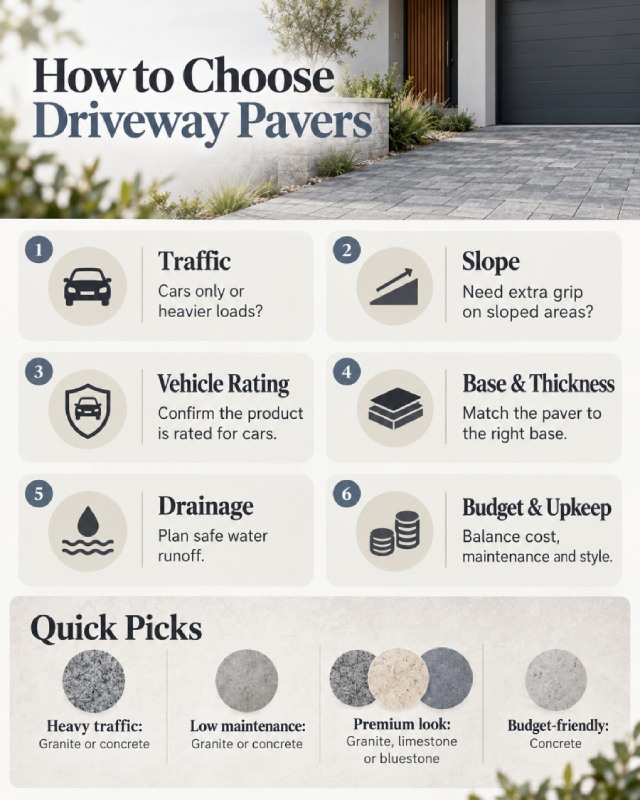
How to Choose the Best Pavers for Your Driveway
Before purchasing driveway pavers, consider these six questions:
- Vehicle traffic: Will the driveway carry passenger cars only, or heavier vehicles?
- Slope: Does the surface require additional traction and movement resistance?
- Material suitability: Is the exact paving product rated for vehicle use?
- Installation: What thickness, bedding and supporting base are required?
- Drainage: How will rainwater leave the driveway safely?
- Budget and appearance: Does the material balance total installed cost, maintenance and your preferred design?
Examine physical samples in natural daylight whenever possible. Colours and textures may change noticeably when stone is wet or sealed.
Conclusion
The best pavers for driveway installations are those that balance strength, safety, maintenance, appearance and overall value.
Granite and vehicle-rated concrete are excellent starting points for demanding residential driveways. Suitable limestone, travertine, sandstone and bluestone products can also deliver impressive results when properly selected and installed.
Rather than choosing solely on appearance, assess the driveway’s traffic, slope, drainage and foundation requirements.
Contact Hunter Pavers to explore natural stone paving options and get assistance identifying appropriate materials, finishes and thicknesses for your Australian driveway project.
Frequently Asked Questions
What are the best pavers for a driveway?
Textured granite and vehicle-rated concrete pavers are among the most reliable all-round options. The best choice depends on traffic, slope, maintenance, installation and budget.
What is the best natural stone for a driveway?
Granite is often one of the strongest choices due to its density and wear resistance. Selected bluestone and other dense stone products can also be suitable.
Are natural stone pavers good for driveways?
Yes, provided the selected product is suitable for vehicle loads and installed over an appropriate foundation. Not all natural stone pavers are driveway-rated.