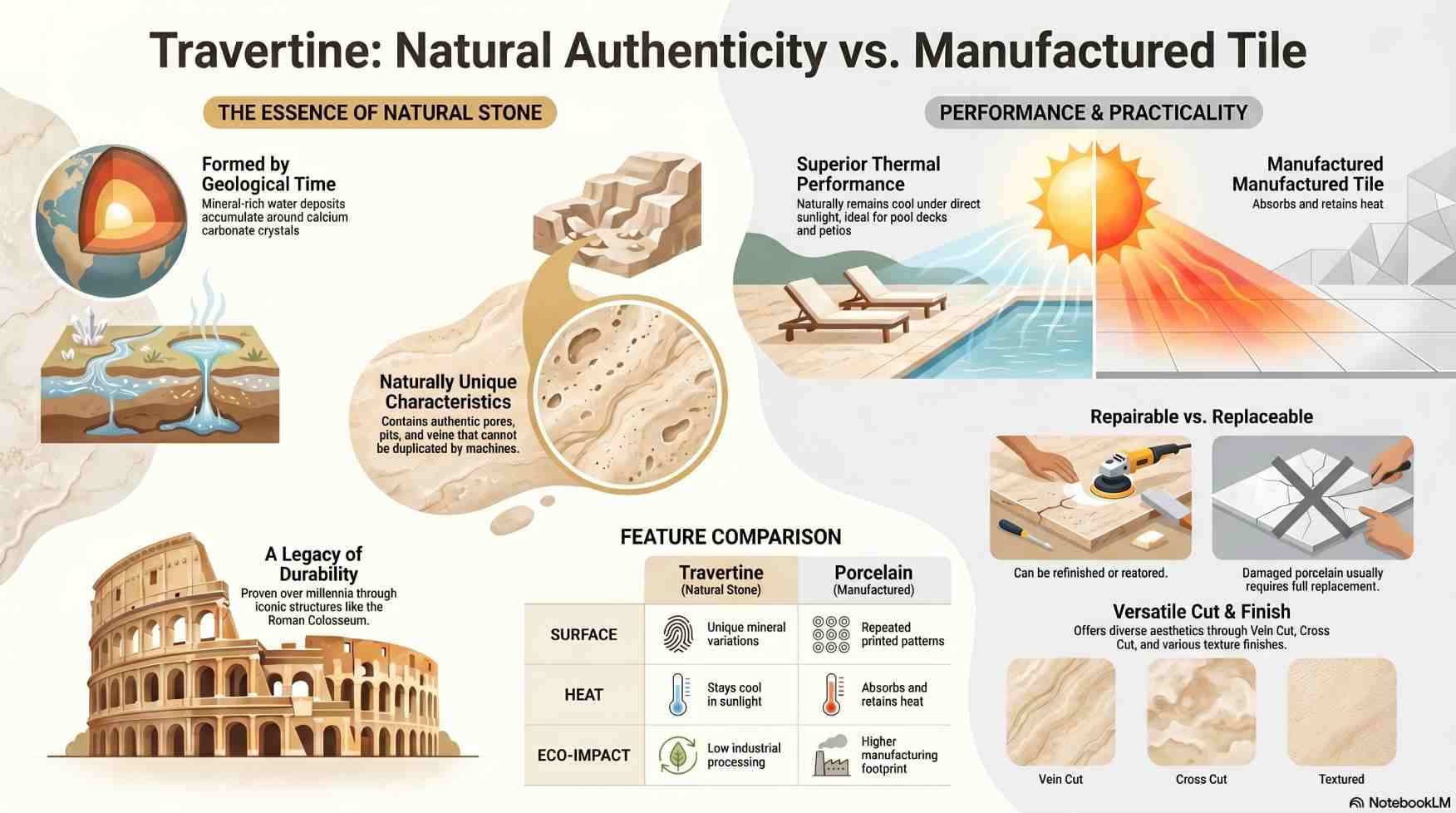
When buyers search for is travertine natural stone, they are usually trying to make a practical decision about flooring, wall cladding, pool decks, or outdoor paving. The answer matters because natural stone performs differently from porcelain or engineered materials in terms of durability, heat resistance, maintenance, and long-term appearance.
Travertine is a genuine natural stone formed through mineral deposits over thousands of years, which means every piece contains natural pores, veins, and color variation that cannot be artificially duplicated with complete accuracy.
Table of Contents
Before choosing travertine tiles, the most important factors to evaluate are finish type, porosity, sealing requirements, and installation location. Honed travertine tiles are often the most practical option for indoor flooring because they combine a smooth appearance with better grip and easier maintenance. For outdoor areas such as patios and pool decks, brushed or tumbled travertine tiles perform better because they remain cooler under sunlight and provide stronger slip resistance.
Feature
Travertine
Manufactured Tile / Porcelain
Material Type
Genuine natural stone formed through geological processes
Factory-made engineered material
Surface Appearance
Natural pores, veins, and unique mineral variation
Repeated printed patterns and uniform texture
Heat Performance
Stays cool under sunlight, ideal for pool decks and patios
Can absorb and retain more heat depending on color
Slip Resistance
Excellent in brushed or tumbled finishes
Depends on surface texture and coating
Maintenance
Requires sealing and pH-neutral cleaning
Lower maintenance overall
Durability
Long-lasting with proper care and maintenance
Highly durable and less porous
Best Applications
Luxury interiors, outdoor patios, pool surrounds, feature walls
High-traffic modern spaces and low-maintenance projects
Design Style
Warm, organic, timeless architectural look
Cleaner and more uniform modern appearance
Repairability
Can often be refinished or restored
Usually replaced if damaged
Environmental Impact
Natural material with low industrial processing
Higher manufacturing and processing footprint
How Travertine is Created Naturally
To answer the question is travertine natural stone, it is necessary to understand how travertine is created. Travertine is a sedimentary stone that forms naturally when mineral-rich water deposits calcium carbonate over long periods of time. This process usually occurs near hot springs, caves, or geothermal areas.
Because travertine develops naturally within the earth, it is classified as a true natural stone rather than an engineered or synthetic material. Every slab or tile contains naturally occurring patterns, pores, veins, and mineral variations created by geological activity. Unlike porcelain tiles that are manufactured in factories, travertine is quarried directly from natural deposits.
Why Travertine Has Holes and Pits
One of the defining characteristics of travertine is its naturally occurring pores and cavities. These holes are created during formation when gas bubbles become trapped inside the stone or when organic material decays and leaves empty spaces behind. These natural voids are one of the strongest indicators that travertine is authentic natural stone.
The Historical Importance of Travertine
Travertine has been used for thousands of years in architecture and monumental construction. Ancient Romans relied heavily on travertine because of its availability, durability, and elegant appearance.
The Colosseum and Roman Architecture
Perhaps the most famous example is the Colosseum, which was constructed largely from travertine blocks. Many iconic Roman landmarks also used travertine extensively, including the Trevi Fountain and St. Peter’s Basilica. The word “travertine” itself originates from the Latin phrase lapis tiburtinus, meaning “stone of Tibur.”
Colors and Natural Beauty of Travertine
Travertine has an appearance that immediately feels authentic, warm, and connected to nature. Unlike manufactured tiles that often look repetitive, travertine contains natural movement and texture formed over thousands of years.
Natural Color Variations include:
Ivory
Beige
Cream
Walnut
Gold
Silver
Rust and Red tones
Vein Cut vs Cross Cut Travertine
Vein Cut Travertine
Vein cut travertine is produced by cutting the stone parallel to its natural sedimentary layers. This reveals long, flowing veins and directional movement, creating a sleek and linear appearance that works well in contemporary architecture.
Cross Cut Travertine
Cross cut travertine is cut perpendicular to the natural layers. Instead of straight veins, this method exposes softer, cloud-like patterns with circular formations, offering a more traditional and organic appearance.
Common Travertine Finishes
Polished: Glossy and reflective, ideal for luxury indoor features.
Honed: Smooth but matte, the most popular choice for indoor flooring.
Brushed: Textured and rustic, providing better grip.
Tumbled: Aged and weathered look, perfect for outdoor patios and pool decks.
Physical Properties and Durability
Travertine typically ranks between 3 and 4 on the Mohs hardness scale, similar to marble. One of its most impressive characteristics is its thermal performance; it remains cool under direct sunlight, making it the premier choice for pool surrounds.
Conclusion
So, is travertine natural stone? Yes, and its natural origin is exactly what gives it long-term architectural value and unique texture. Whether for a luxury villa or a minimalist interior, travertine remains one of the strongest and most reliable choices for those seeking authentic beauty and cooling properties.
Unika is a stone industry specialist based in Australia, with over 10 years of experience in sourcing, designing, and delivering premium natural stone solutions for residential and commercial projects.
Yes, travertine is 100% natural stone. It is a type of terrestrial sedimentary rock formed over thousands of years by calcium carbonate deposits around hot springs and limestone caves. Unlike man-made alternatives like porcelain or ceramic tiles, every single piece of travertine is quarried from the earth, ensuring unique veining, textures, and color variations that cannot be replicated.
The holes and pores on travertine are the defining characteristics of its natural formation. They occur during the geological process when gas bubbles are trapped, or organic materials decay within the sediment. For outdoor pavers, these natural holes are often left unfilled to provide organic texture and excellent slip resistance, while for indoor tiles, they can be filled and honed for a smoother finish.
Travertine is the preferred choice for two main reasons: it stays remarkably cool under direct sunlight, making it comfortable to walk on barefoot, and its textured finishes (like tumbled or brushed) provide excellent slip resistance in wet environments.