

Pool coping is the material installed around the top edge of a swimming pool, creating a safe, durable and visually finished transition between the pool shell and the surrounding deck. The right pool coping can improve grip around wet areas, protect the pool structure, manage splash water and help tie the pool into the overall landscaping and architecture.
There are many pool coping options, from natural stone such as travertine, marble, granite and limestone to modern porcelain. Choosing between them involves more than appearance. Heat exposure, slip resistance, maintenance, durability, pool use and the surrounding paving should all influence the decision.
| Consideration | What to Look For |
|---|---|
| Safety | Slip-resistant finish and comfortable edges |
| Heat | A surface that remains comfortable in direct sunlight |
| Durability | Resistance to water, weather and regular foot traffic |
| Maintenance | Cleaning, sealing and ongoing care requirements |
| Style | Colour, texture and compatibility with the pool area |
| Installation | Edge profile, cutting and substrate requirements |
| Budget | Material, fabrication and installation complexity |
What Is Pool Coping?
Pool coping is the protective material installed along the upper edge of a swimming pool. It normally sits above the pool shell and creates the transition between the waterline and the surrounding paving or deck. Although coping contributes significantly to the appearance of the pool, it also performs several practical functions. It protects exposed pool edges, provides a safer surface for swimmers entering and leaving the pool and can help direct water away from vulnerable parts of the pool structure.
Pool Coping vs Pool Decking
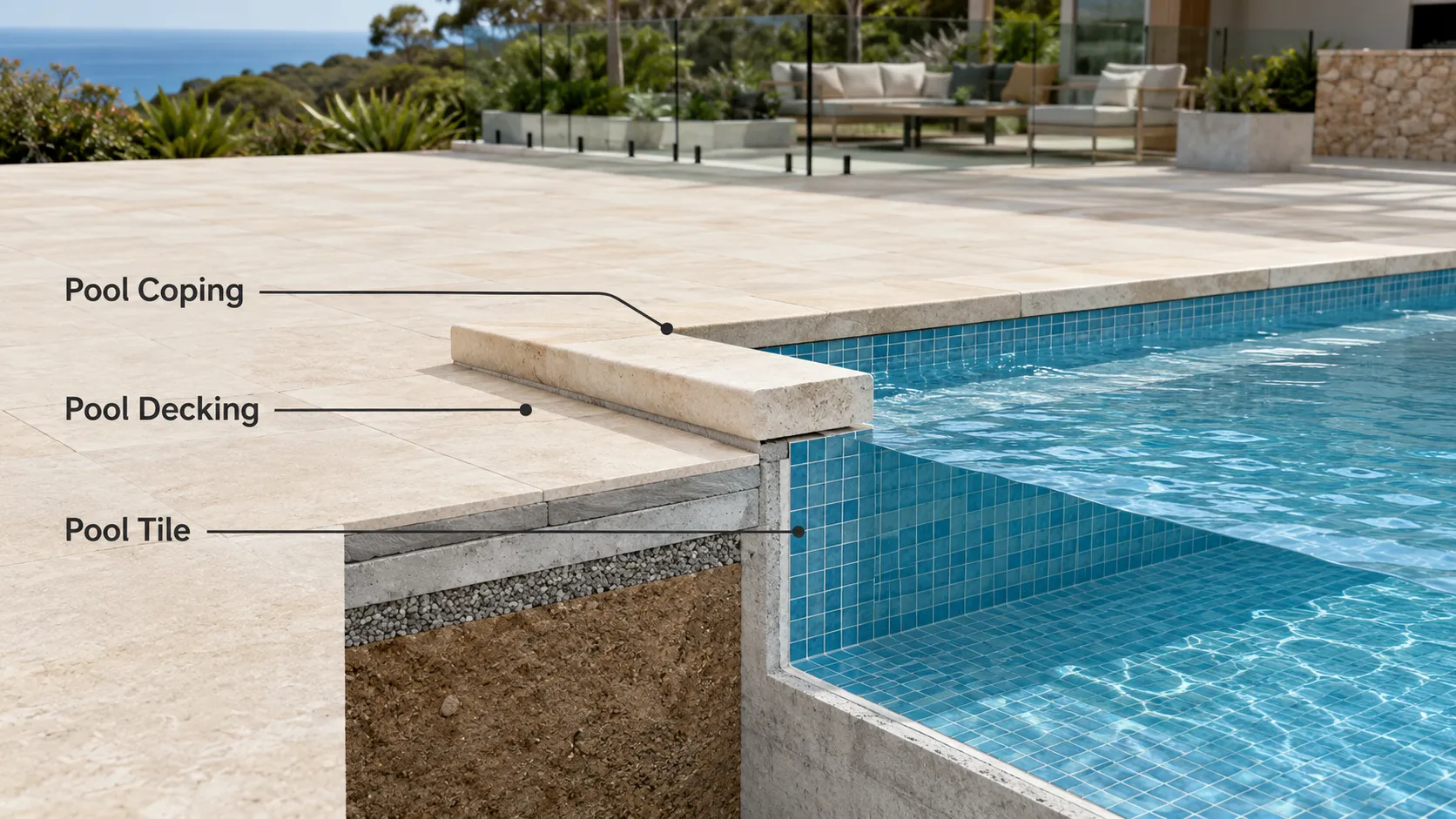
Pool coping is installed directly around the perimeter of the pool, while pool decking refers to the broader walking and entertaining surface surrounding it. The materials can sometimes match. For example, the same stone may be used for both pool edge coping and the surrounding paving. However, coping pieces often require specialised profiles, dimensions or edge treatments that are different from standard paving.
Pool Coping vs Pool Tile
Pool tile is generally installed inside the pool, commonly along the waterline or across larger internal surfaces. Coping is positioned above the pool shell at the perimeter. Pool tile is primarily selected for waterproof finishes, ease of cleaning and visual design inside the pool. Coping must also handle foot traffic, exposure to weather and frequent contact with splash water while providing a comfortable and safe edge.
Why Is Pool Coping Important?
Good swimming pool coping contributes to the safety, durability and overall finish of the pool. Although it may appear to be mainly decorative, it forms an important protective boundary between the pool structure and surrounding outdoor area. The material, edge profile and installation method all affect how effectively the coping performs.
Improves Pool Safety
Areas around swimming pools are regularly wet, so surface grip is an important consideration. A suitable coping material with an appropriate textured or slip-resistant finish can provide better traction when people walk around the pool. Edge profiles can also improve comfort. Rounded bullnose edges, for example, remove sharp corners and provide a smoother surface for swimmers holding onto the edge or climbing out of the pool.
Protects the Pool Structure
The upper edge of a pool is exposed to water, movement, sunlight and changing weather conditions. Properly installed pool coping stones create a protective cap over this area. Coping also helps reduce the amount of water entering vulnerable joints and structural areas. Correct installation, suitable bonding materials and well-maintained joints are particularly important for long-term protection.
Enhances Pool Appearance
Pool coping creates the visible frame around the swimming pool. Its colour, texture, thickness and profile can significantly influence whether a pool looks traditional, contemporary, minimal or luxurious. Matching or coordinating the coping with nearby paving, walls, landscaping and architectural finishes can make the entire outdoor area look more cohesive.
Helps With Water Management
A well-designed coping edge can help direct splash and runoff away from the pool structure. Some profiles and installations incorporate a slight fall away from the pool to improve drainage. Good water management can help reduce pooling around the perimeter and protect surrounding materials from unnecessary moisture exposure.
Types of Pool Coping
The profile of the coping affects both appearance and functionality. Some pool coping options prioritise soft, rounded edges, while others create stronger architectural lines. The most appropriate profile depends on the pool design, material choice, intended aesthetic and how people will use the pool.
Bullnose Pool Coping
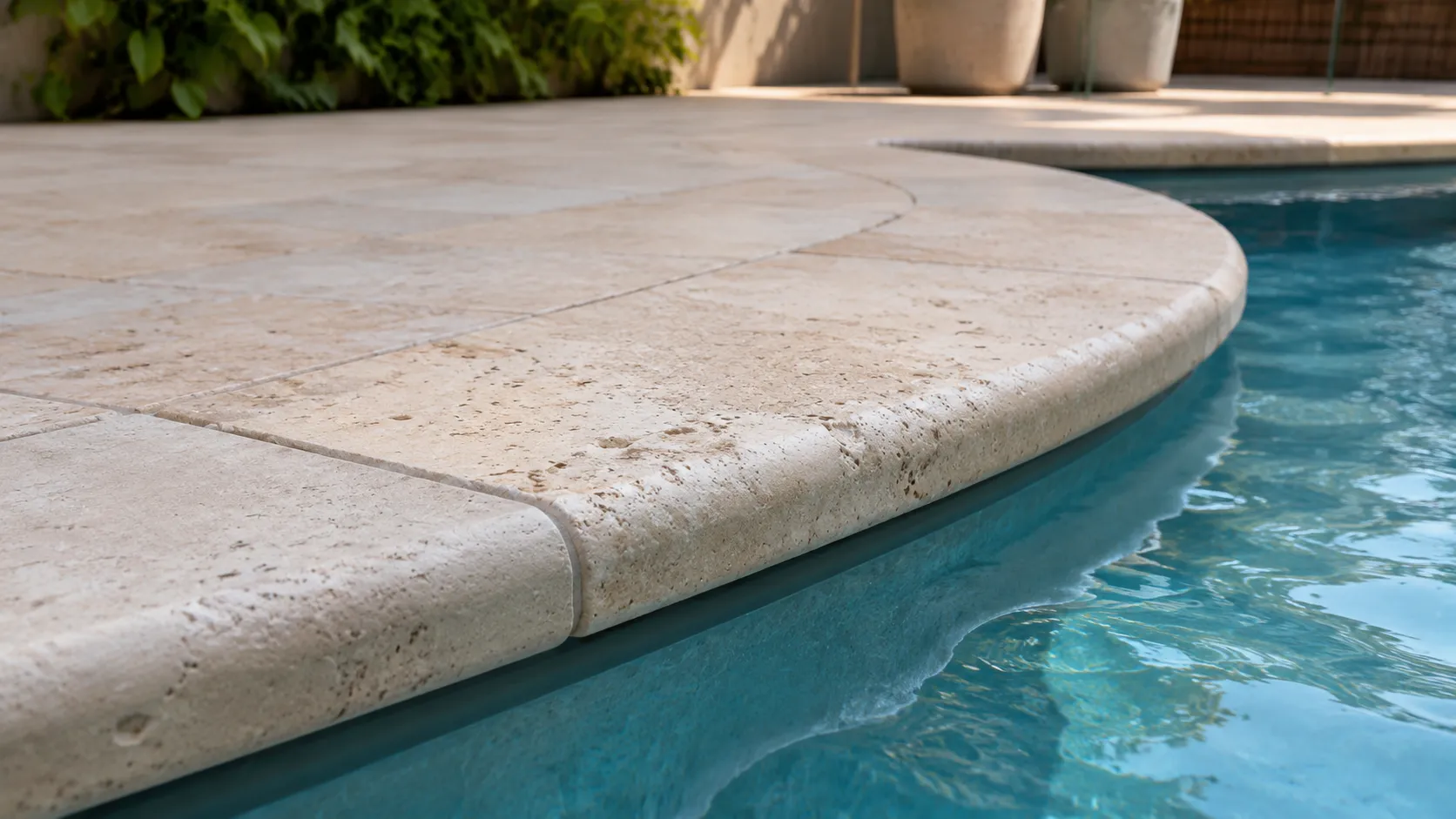
Bullnose coping has a rounded exposed edge. It is one of the most recognisable coping profiles and works with both traditional and contemporary swimming pool designs. The rounded edge feels comfortable under the hands and removes a sharp corner from the pool perimeter. This can make bullnose coping particularly appealing for family pools and areas where swimmers frequently hold onto the edge.
Square Edge Pool Coping
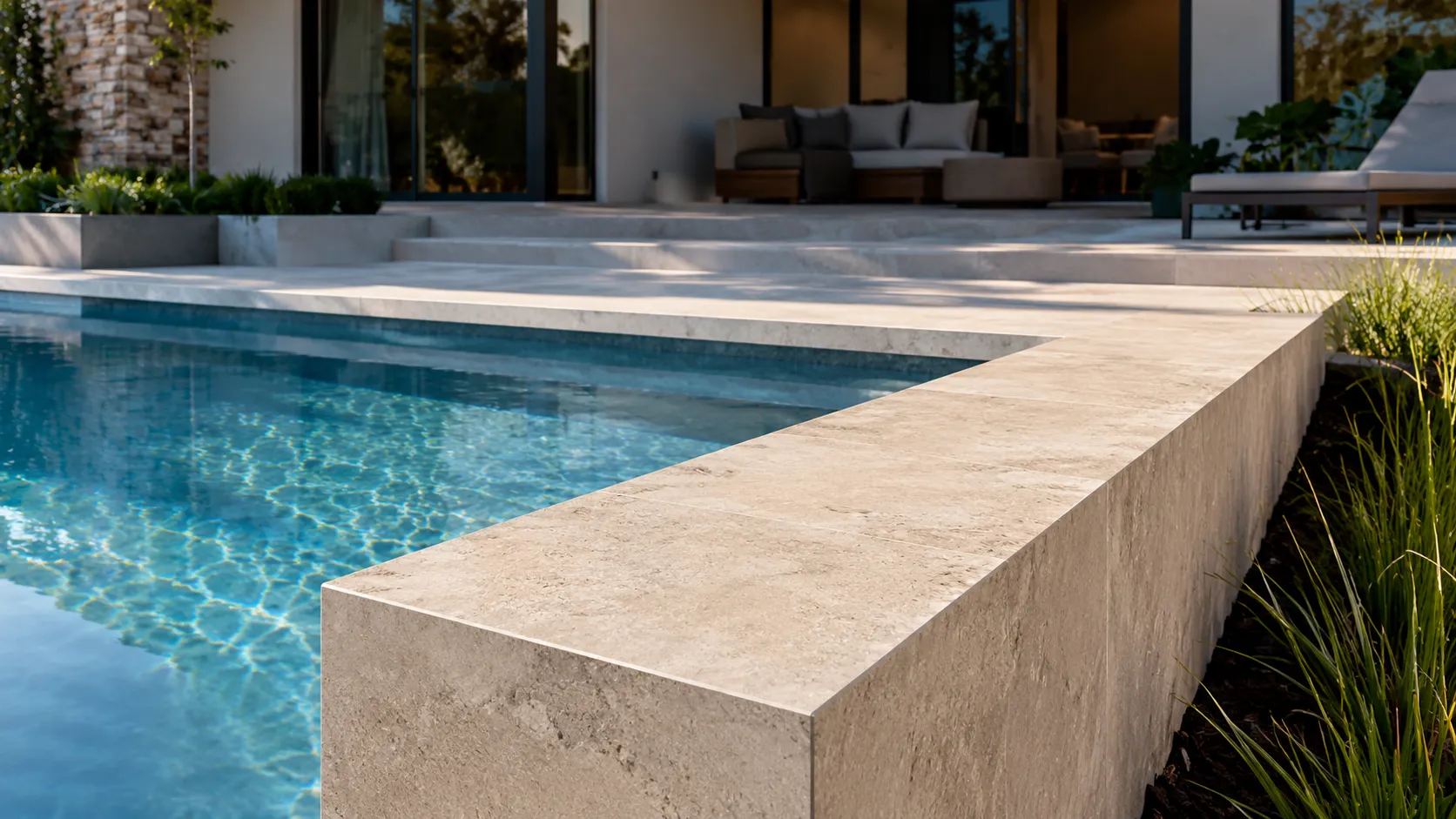
Square edge coping creates a straight, clean perimeter with minimal rounding. It is commonly selected for modern pools where strong architectural lines are part of the design. The profile works particularly well with large-format paving, geometric pool shapes and minimalist landscapes. Edges should still be properly finished so that they remain comfortable and suitable for poolside use.
Cantilever Pool Coping
Cantilever coping extends slightly over the inside edge of the swimming pool. It is commonly associated with concrete pool surrounds and can create a relatively seamless transition between the pool edge and deck. Its continuous appearance suits many contemporary residential pools. Installation needs to account for movement and expansion between the pool structure and surrounding surfaces.
Drop Edge Pool Coping
Drop edge coping has a deeper vertical face that extends down over the pool edge. This creates the appearance of a thicker, more substantial slab even when the surrounding paving is thinner. It is especially popular in contemporary designs where the pool edge is intended to become a strong visual feature. Because drop edge pieces require more material or specialised fabrication, accurate measurements and careful installation are important.
Pool Coping Materials
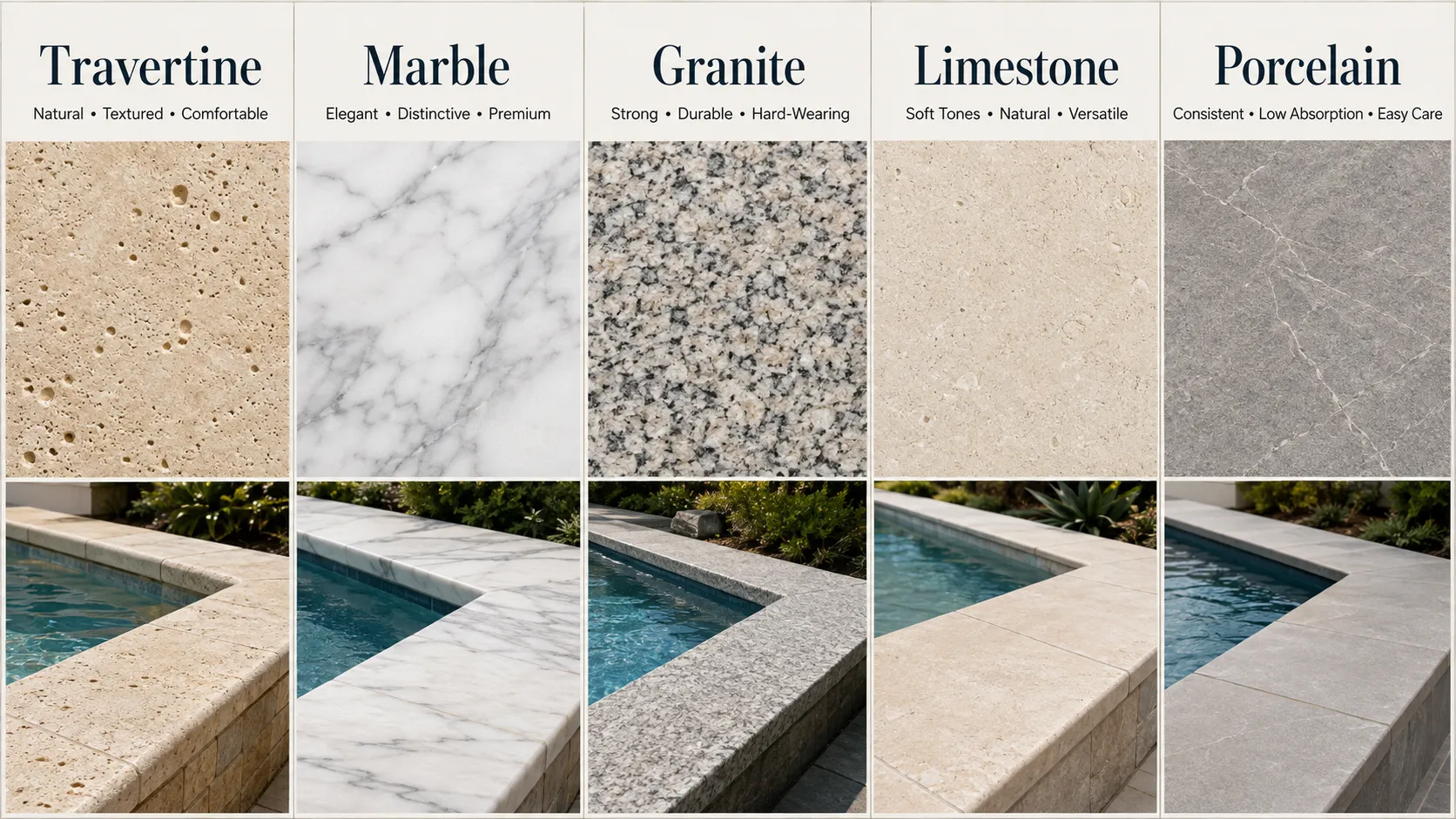
Different pool coping materials offer different combinations of appearance, heat performance, durability, maintenance and slip resistance. Natural stone provides unique colour variation and texture, while manufactured products such as porcelain can offer greater consistency. There is no single material that suits every swimming pool. Climate, exposure, usage and the desired finish should all be considered.
Travertine Pool Coping
Travertine pool coping is popular for its natural appearance and warm, neutral colouring. Its textured finishes can provide useful grip around wet environments, while the stone is often appreciated for remaining relatively comfortable in sunny outdoor areas. For more detail about thermal performance, read does travertine get hot in the sun? Travertine has naturally occurring pores and variation, which contribute to its appearance but also mean correct installation and maintenance are important. Selecting an appropriate finish and sealing the stone where recommended can help protect the surface.
Marble Pool Coping
Marble pool coping offers a refined appearance with natural veining and distinctive colour variation. It is frequently used in premium pool and landscape designs where visual impact is a major priority. Different marble varieties can behave differently outdoors, so suitability should be evaluated based on the specific stone rather than appearance alone. Surface finish, slip resistance, exposure and maintenance requirements should all be considered before installation.
Granite Pool Coping
Granite pool coping is valued for its strength and resistance to wear. Its durability can make it suitable for busy pool areas, commercial environments and residential pools that experience frequent use. Granite is available in different colours and finishes, including textured surfaces suitable for outdoor environments. The guide to common uses of granite stone provides further context for outdoor and pool applications. Because some granite colours can absorb substantial heat in strong sunlight, colour and exposure should be considered during selection.
Limestone Pool Coping
Limestone pool coping provides a soft natural appearance that works well with contemporary, Mediterranean and traditional landscapes. Neutral cream, beige and grey tones can coordinate easily with many paving and architectural materials. As a natural stone, limestone requires appropriate selection and care around swimming pools. Density, porosity, surface finish and compatibility with the pool environment should be assessed before choosing a particular variety.
Porcelain Pool Coping
Porcelain pool coping is manufactured rather than quarried, allowing greater consistency in colour, dimensions and surface appearance. Modern porcelain can reproduce stone, concrete and other textures while offering relatively straightforward maintenance. Porcelain generally has low water absorption and can be a practical choice for homeowners wanting a contemporary surface with less variation than natural stone. If these two materials are on your shortlist, compare travertine vs porcelain. Correct cutting and installation remain important because coping pieces may require specialised tools and edge profiles.
Compare Pool Coping Materials
Explore Hunter Pavers’ natural stone and porcelain ranges, then compare suitable colours, finishes, thicknesses and edge profiles for your pool.
Travertine · Marble · Granite · Limestone · Porcelain
How to Choose the Best Pool Coping Material
The best pool coping material depends on where the pool is located, how it will be used and the amount of maintenance the owner is comfortable performing. Appearance is important, but practical performance should be assessed at the same time. Consider the following factors before making a final choice:
- Climate: Consider intense sunlight, rainfall and freeze-thaw conditions where relevant.
- Surface temperature: Darker and denser materials may become hotter in direct sunlight.
- Slip resistance: Poolside surfaces should provide suitable traction when wet.
- Pool usage: Family and high-traffic pools may require particularly durable, comfortable materials.
- Durability: Check resistance to weather, moisture and regular foot traffic.
- Maintenance: Natural stone may need more specialised cleaning or periodic sealing.
- Colour: Consider how the coping coordinates with the pool interior, deck and landscaping.
- Finish: Honed, textured, brushed and other finishes can perform differently when wet.
- Deck compatibility: Coping should transition cleanly into the surrounding paving or decking.
- Budget: Consider the complete installed system rather than the coping material alone.
Homeowners comparing natural stone and porcelain options can use our best pool coping material comparison to assess durability, heat, slip resistance, maintenance and design before choosing.
Pool Coping Installation Process
Correct pool coping installation is essential because coping sits at an important junction between the pool structure and surrounding surfaces. Poor alignment, unsuitable bonding, insufficient movement allowances or incorrect falls can cause problems even when a high-quality material is used. Installation methods vary between pools and materials, but a typical process includes the following steps.
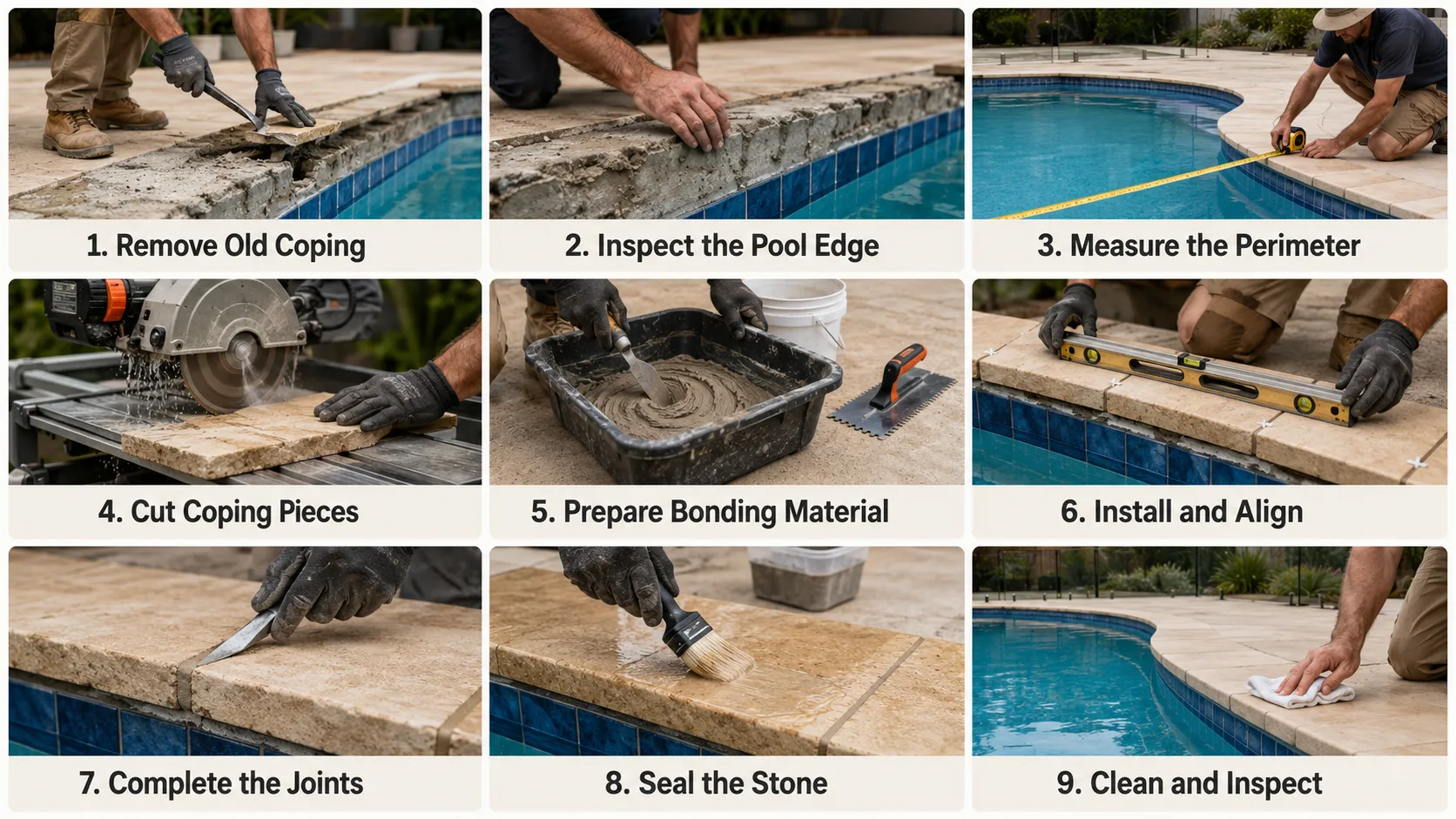
1. Remove Existing Coping if Necessary
For renovation projects, damaged or outdated coping is carefully removed without unnecessarily damaging the underlying pool structure.
2. Inspect and Prepare the Pool Edge
The substrate should be checked for cracks, movement, contamination or deterioration. Problems beneath the coping should be addressed before new materials are installed.
3. Measure the Pool Perimeter
Accurate measurements determine the required quantities and help installers plan corners, curves, joints and specialised coping pieces.
4. Cut Coping Pieces
Pieces may need to be cut around curves, corners, steps or other pool features. Natural stone and porcelain usually require appropriate cutting equipment to achieve clean edges.
5. Prepare the Bedding or Bonding Material
The installation system should be compatible with the coping material, substrate and pool environment. Manufacturer and project-specific requirements should be followed.
6. Install and Align the Coping
Coping pieces are positioned carefully to maintain consistent joints, overhangs and alignment. Falls may also need to be incorporated to support drainage.
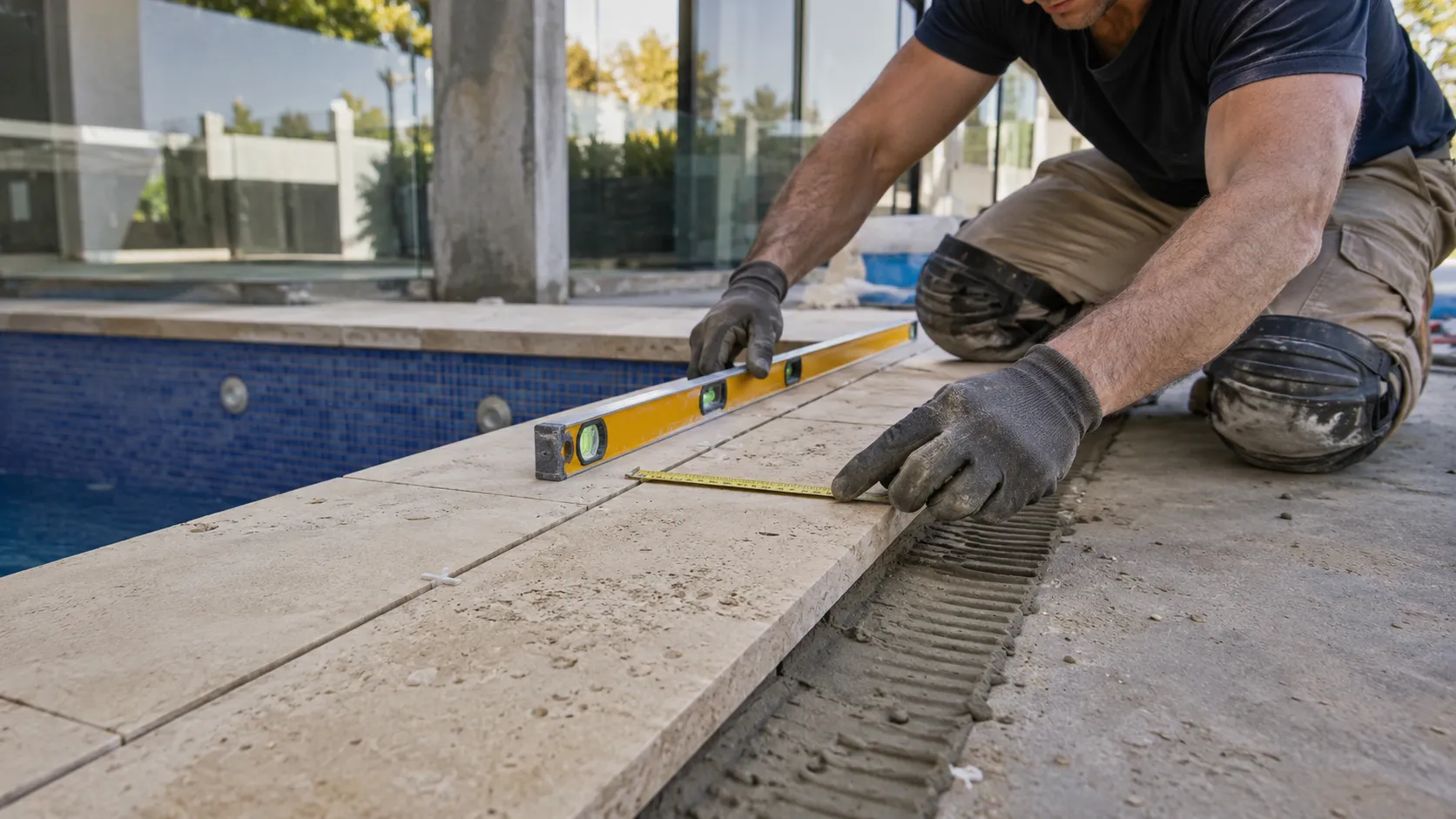
7. Complete Joints and Expansion Areas
Movement joints are important because pools, surrounding paving and other structural elements can expand or move differently. These areas should not simply be treated as standard rigid joints.
8. Seal Natural Stone Where Required
Some natural stone may benefit from an appropriate penetrating sealer. The product should be compatible with both the specific stone and the swimming pool environment.
9. Clean and Inspect the Installation
After installation, residues should be removed using methods suitable for the material. The completed perimeter should then be checked for alignment, movement, damaged pieces and joint quality. Professional installation is often advisable where there are complex curves, drop edges, unusual substrates, significant structural movement or premium natural stone materials.
Planning a New Pool Edge?
Speak with Hunter Pavers before ordering to compare material suitability, available dimensions, finishes and coping profiles for your project.
Pool Coping Replacement: When Do You Need It?
Pool coping replacement may be required when individual pieces or larger sections are no longer secure, safe or capable of protecting the pool edge properly. Cosmetic changes can also justify replacement during a wider pool renovation. Common signs include cracked coping, loose stones, broken corners, deteriorating joints, noticeable movement, uneven surfaces and water entering beneath the coping. Replacement may also be appropriate when:
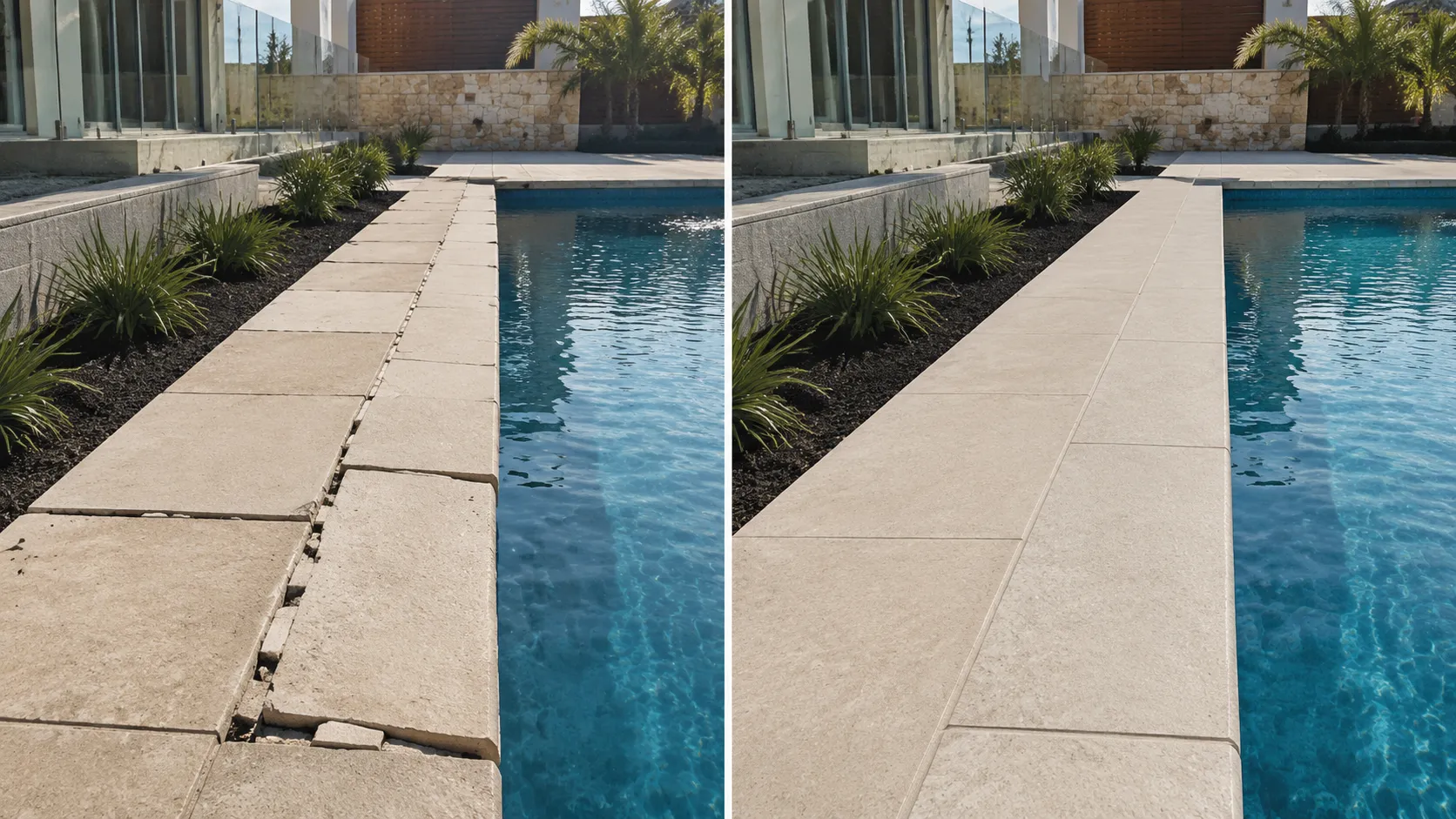
- coping moves when stepped on;
- sharp or broken edges create a safety concern;
- joints repeatedly crack or separate;
- sections have become uneven;
- stains or deterioration cannot be reasonably restored;
- the existing coping no longer suits a renovated pool or landscape.
Before replacing the surface material, it is important to determine why the existing coping failed. Installing new material over unresolved substrate or movement problems may cause the same issue to return.
Pool Coping Maintenance Tips
Regular pool coping maintenance can help preserve appearance and identify small problems before they become larger repairs. Maintenance requirements vary between natural stone, porcelain and other materials. Routine care should generally include removing dirt and organic debris, cleaning spills promptly and checking the perimeter for cracks, loose pieces or deteriorating joints. For a material-specific routine, see this travertine pool deck cleaning checklist.
Use Suitable Cleaning Products
Avoid assuming that a cleaner suitable for one material is safe for every coping surface. Some strong acidic or alkaline cleaners can damage natural stone, sealers or joint materials. Products should be selected according to the coping material and manufacturer or supplier recommendations.
Consider Sealing Natural Stone
Some natural stone coping may benefit from sealing to reduce moisture and stain absorption. Sealing does not make stone maintenance-free, and the appropriate product and reapplication schedule depend on the specific material and exposure.
Inspect Joints and Movement Areas
Joints should be checked periodically for cracking, separation or missing material. Movement areas deserve particular attention because failure can allow water penetration or create stress around the coping.
Address Damage Early
A slightly loose coping stone can become a larger problem if water repeatedly enters underneath it. Early repairs may reduce the risk of damage spreading to adjacent sections.
Pool Coping Cost: What Affects the Price?
Pool coping cost varies considerably because the final price involves more than the cost of the coping material itself. Pool dimensions, material choice, edge profile and installation complexity can all affect the project. Rather than relying on a generic fixed price, it is more useful to compare the complete requirements of the individual pool.
Material
Natural stone species and grades vary in price, while specialised porcelain products may have different supply and fabrication costs.
Pool Perimeter
A larger perimeter requires more coping pieces, bonding material, jointing products and labour.
Coping Dimensions
Large-format or unusually thick coping can cost more to supply, handle, transport and install.
Edge Profile
Standard square or bullnose profiles may differ in price from custom profiles such as large drop edges.
Custom Fabrication
Curved pools, unusual corners and custom dimensions may require additional cutting or factory fabrication.
Removal of Existing Coping
Renovation projects can involve demolition, waste removal and preparation before new coping is installed.
Installation Difficulty
Access limitations, curved layouts, complicated substrates and detailed alignment can increase labour requirements.
Sealing and Finishing
Natural stone sealing, specialist joint systems and other finishing work can add to the complete installed cost. For an accurate pool coping cost, compare quotes based on the same material, thickness, finish, profile and installation scope rather than comparing material prices alone.
Get a Project-Specific Pool Coping Quote
Send Hunter Pavers your approximate pool perimeter, preferred material, dimensions and edge profile for relevant product and pricing guidance.
Pool Coping vs Pool Tile: What Is the Difference?
Although both are installed around swimming pools, coping and tile have different positions and functions.
| Feature | Pool Coping | Pool Tile |
|---|---|---|
| Location | Top perimeter of the pool | Usually inside the pool or at the waterline |
| Main purpose | Protects and finishes pool edge | Provides internal finish and waterline surface |
| Safety role | Important walking and gripping surface | More limited role in poolside foot traffic |
| Common materials | Natural stone, porcelain, concrete | Porcelain, ceramic, glass and stone |
| Design role | Frames pool and connects to deck | Defines internal pool and waterline appearance |
| Exposure | Sun, weather, foot traffic and water | Constant or regular pool-water exposure |
A coordinated design does not require the materials to be identical. Contrasting pool edge coping and tile can create visual definition, while closely matched materials can produce a more seamless appearance.
Frequently Asked Questions
What Is Pool Coping?
Pool coping is the material installed along the top perimeter of a swimming pool. It covers and protects the upper edge of the pool shell while creating a finished transition between the pool and surrounding deck.
Why Is Pool Coping Important?
Pool coping improves safety, protects the pool edge, supports water management and contributes to the overall appearance of the swimming pool. The right material can also provide a more comfortable and slip-resistant surface around wet areas.
What Is the Best Material for Pool Coping?
There is no single best pool coping material for every project. Travertine, marble, granite, limestone and porcelain each have different advantages. Climate, heat exposure, slip resistance, maintenance, design and budget should determine the most suitable choice.
Is Travertine Good for Pool Coping?
Travertine can be an excellent pool coping option because of its natural appearance, textured finishes and suitability for many outdoor environments. The specific stone, finish, installation method and maintenance requirements should still be evaluated before selection.
How Long Does Pool Coping Last?
The service life of coping depends on the material, installation quality, climate, pool chemistry, movement and maintenance. Durable materials that are correctly installed and maintained can remain functional for many years.
Can Pool Coping Be Replaced?
Yes. Pool coping replacement is common when existing coping becomes cracked, loose, uneven, damaged or outdated. The underlying substrate and joints should also be inspected before replacement to identify any structural or installation problems.
How Much Does Pool Coping Cost?
The cost depends on material, pool perimeter, coping dimensions, edge profile, fabrication, demolition, labour, installation difficulty and finishing requirements. A project-specific quote is more useful than a general price because pools vary substantially in size and design.
Is Pool Coping the Same as Pool Tile?
No. Pool coping is installed along the top edge of the pool, while pool tile is normally installed inside the pool or around the waterline. Coping also has a greater role in protecting the pool perimeter and providing a safe edge for swimmers.
What Type of Pool Coping Is Safest?
Safety depends on both material and surface finish. Coping with good wet-area slip resistance and comfortable edge treatment is generally preferable. Rounded bullnose profiles can also reduce sharp corners around frequently used pool edges.
Does Natural Stone Pool Coping Need to Be Sealed?
Some natural stones benefit from sealing, but requirements differ between materials. Porosity, finish, exposure and pool conditions should be considered, and a sealer should always be suitable for the specific stone and swimming pool environment.
Choosing the Right Pool Coping for Your Project
The right pool coping should combine practical performance with a finish that complements the swimming pool and surrounding landscape. Start by considering safety, climate, heat exposure, durability and maintenance, then compare colours, textures and profiles that suit the overall design.
Whether you are considering travertine, marble, granite, limestone or porcelain pool coping, reviewing samples and discussing installation requirements before purchasing can help avoid compatibility and design problems later.
Find the Right Pool Coping for Your Project
Explore Hunter Pavers’ natural stone and porcelain ranges or contact the team for help comparing material, finish, thickness and edge-profile options.