
Granite stone
Granite stones are considered as appealing slabs among customers and that is because of their natural look, and ass natural stones they are environmentally safe

Granite is used for paving, driveways, flooring, stairs, pool surrounds, wall cladding, façades, monuments, road aggregate and selected kitchen and bathroom surfaces. Its strength, range of finishes and natural colour variation make it useful in both residential and commercial construction.
This guide explains what granite is used for, why it performs well in demanding areas and how to choose the right granite product for a home or landscaping project. If you are ready to compare colours, formats and finishes, browse the granite tiles and pavers collection.
| Granite Feature | What It Means | Common Uses |
|---|---|---|
| Durability | Suitable granite can tolerate abrasion, foot traffic and substantial loads when correctly specified and installed. | Driveways, pathways, paving, flooring, stairs and public spaces |
| Finish Options | Flamed, sandblasted, honed and other finishes create different appearances and surface characteristics. | Wet areas, pool surrounds, interiors, patios and commercial paving |
| Natural Variation | Colour, grain and pattern vary from piece to piece, producing a distinctive natural-stone surface. | Feature areas, façades, floors and landscape design |
| Outdoor Performance | The stone, thickness, finish and installation system can be selected for the expected weather, traffic and load. | Driveways, patios, paths, steps and pool areas |
| Maintenance | Routine cleaning is generally simple. Some products benefit from an appropriate impregnating sealer. | Indoor floors, bathrooms, kitchens and outdoor paving |
| Long-Term Value | Granite offers a timeless appearance and can serve for many years when correctly chosen and maintained. | Residential renovations and commercial projects |
| Cost Factors | Price depends on the granite, format, thickness, finish, quantity, delivery, preparation and installation. | Residential and commercial project budgeting |
Granite is a common igneous rock formed as magma cools slowly beneath the ground. It is commonly composed of quartz, feldspar and minerals such as biotite mica or hornblende. The slow cooling process produces visible crystals and the granular appearance associated with natural granite. This geological description is supported by Geoscience Australia.
After extraction, granite blocks are cut and finished into slabs, tiles, pavers, coping, step pieces and other formats. Performance is not identical across every granite product: mineral composition, natural structure, thickness, finish, fabrication and installation all influence where a particular product should be used.
The most common uses of granite include outdoor paving, driveways, patios, paths, pool surrounds, flooring, stairs, façades, wall cladding, monuments and construction aggregate. It is also used for selected countertops, vanities and architectural features.
Granite pavers are widely considered for driveways because of their strength and resistance to wear. A driveway product must still be selected for the expected vehicle load. Paver thickness, unit size, base preparation, edge restraint, bedding and installation method should be confirmed with the supplier and installer rather than chosen by appearance alone.
Light and mid-grey granite can create a clean contemporary driveway, while darker products provide stronger contrast. View Sesame Grey Granite, Sesame White Granite and Raven Black Granite for different design directions.
Granite paving is used in patios, garden paths, courtyards, entrances and outdoor entertaining areas. Textured finishes can improve grip, while accurate sizing can support clean joints and contemporary layouts. The required slip performance should be confirmed for the actual environment, especially where the surface will regularly become wet.
Granite can be used around pools when the product, finish and edge detail are suitable for wet conditions. Pool surrounds require more than a general claim that granite is “non-slip”: the selected surface should have appropriate test information, comfortable edge profiles and compatibility with the pool environment. Bullnose or drop-face pieces may be used to finish pool edges and steps.
Granite floor tiles can suit entrances, hallways, living areas and other high-use spaces. Honed or polished finishes can create a refined interior appearance, while textured finishes may be more suitable where additional grip is needed. Before installation, consider moisture exposure, foot traffic, substrate movement, finish, cleaning requirements and transitions to adjoining floors.
Granite flooring can also help connect indoor and outdoor spaces when related colours and formats are used across an alfresco threshold. Browse the complete granite flooring and paving range to compare available options.
Granite is commonly used for kitchen countertops, splashbacks, floor tiles and outdoor kitchen surfaces. Its natural pattern can create a premium focal point, and properly specified stone can perform well in a busy kitchen. However, granite is not completely stain-proof or damage-proof. Spills should be cleaned promptly, and hot cookware should be placed on a trivet to protect both the stone and any resin, sealer or joint material used in the installation.
Granite can be installed on bathroom walls, vanity surrounds and suitable floors. The original surface should not be described as universally non-porous: absorption differs between stones, and wet-area performance depends on the selected granite, finish, waterproofing, drainage, installation products and maintenance.
For bathroom floors, select a finish appropriate for wet-foot traffic rather than relying on polished appearance alone. Large-format granite can reduce the number of joints on walls, while smaller units can help accommodate falls on shower floors.
Granite is used on exterior façades, feature walls, columns and building entrances because it provides a strong architectural appearance and can perform in exposed locations when correctly engineered. Large-format façade stone requires an appropriate support and anchoring system; product thickness and fixing details should be designed for the building and site conditions.
Granite is used for stair treads, risers, landscape steps, path edging and kerbs. These applications benefit from durable edges and a finish selected for the expected traffic. Step nosings and exposed edges should be fabricated and installed to reduce chipping and support safe movement.
Granite has a long history in monuments, memorials, public buildings, bridges, kerbs and setts. Crushed granite is also used as aggregate and fill in civil and landscaping work. These applications demonstrate the breadth of granite use, although their engineering requirements differ substantially from residential tiles and pavers.
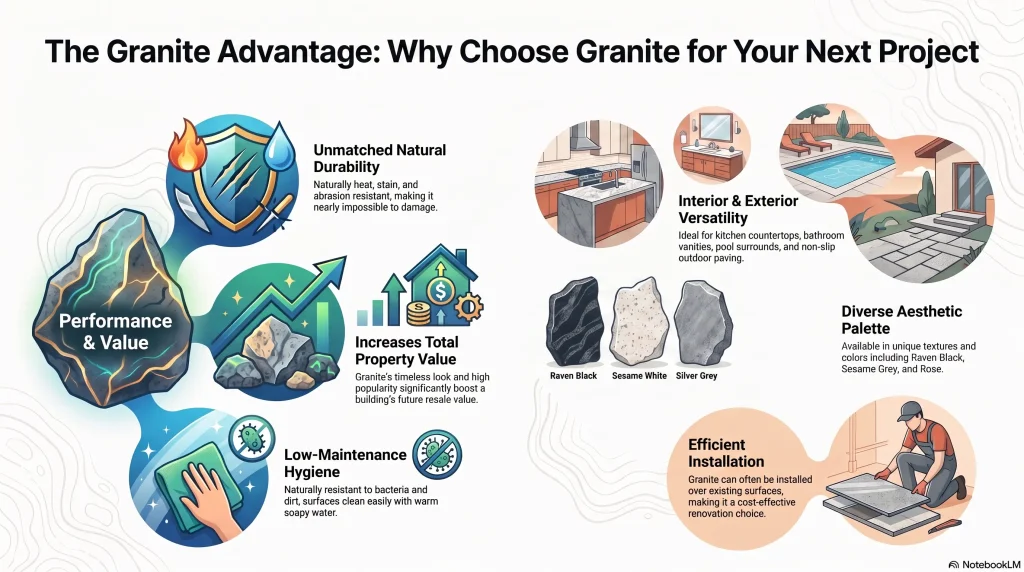
Granite is useful because it combines natural appearance, strength, finish options and application versatility. It can be fabricated into thin tiles, substantial pavers, coping and architectural pieces. However, a product should be judged using technical information relevant to its intended use, not simply because it carries the name “granite”.
The Natural Stone Institute identifies separate tests for absorption and density, compressive strength, flexural strength, abrasion and slip resistance. For a demanding driveway, commercial floor or wet area, request the relevant data for the specific stone and finish.
| Project | Selection Priorities | Suggested Direction |
|---|---|---|
| Driveway | Load, thickness, base, abrasion and edge restraint | Textured granite pavers specified for vehicles |
| Pool Surround | Wet slip performance, edge profile and pool compatibility | Textured pavers with suitable coping |
| Patio or Path | Foot traffic, drainage, colour and joint layout | Flamed or sandblasted granite paving |
| Interior Floor | Finish, substrate, cleaning and transitions | Honed or polished tiles where appropriate |
| Façade | Engineering, anchors, thickness and exposure | Architecturally specified granite cladding |
Granite cost varies with the stone type, colour, source, format, thickness, finish, edge profile and quantity. Delivery, site access, base preparation, cutting, sealing and professional installation also affect the total project price. Compare complete installed requirements rather than only the advertised unit price.
For a current product price or project quote, view the granite tiles and pavers for sale or contact Hunter Pavers with your area, application, measurements and preferred colour.
Clean granite with a neutral stone cleaner, stone soap or mild detergent and warm water. Avoid abrasive products and cleaners containing hydrofluoric acid. The Natural Stone Institute’s care guidance explains that impregnating sealers improve stain resistance but do not make stone stain-proof, and that some stones may not require sealing.
Do not apply a fixed “every 1–2 years” rule to every granite installation. Follow the supplier and sealer manufacturer’s instructions, observe how the surface performs and use a product compatible with the specific stone and finish.
Need help choosing granite? Browse all granite tiles and pavers or request product and pricing advice from the Hunter Pavers team.
Granite is commonly used for driveways, paving, patios, paths, pool surrounds, floors, stairs, façades, wall cladding, countertops, monuments and construction aggregate.
Granite combines strength, abrasion resistance, natural appearance and multiple finish options. The exact product should still be tested and specified for its intended structural, traffic or wet-area requirements.
Yes. Granite tiles are used for interior and exterior flooring. Choose the thickness and finish according to traffic, moisture, substrate and required slip performance.
Granite can be an excellent driveway material when the paver thickness, size, finish, base and installation method are designed for vehicle loads.
Yes. Granite can be used on bathroom walls, vanity surrounds and suitable floors. Correct waterproofing, drainage, installation and wet-area finish selection remain essential.
No. Sealing requirements vary by stone, finish, application and exposure. An impregnating sealer can improve stain resistance, but it does not make granite stain-proof.
Use a pH-neutral stone cleaner, stone soap or mild detergent with warm water. Avoid abrasive cleaners and unsuitable acidic or chemical products.
Consider traffic, vehicle loads, thickness, slip performance, drainage, weather exposure, colour, finish and installation. Ask for technical information relevant to the exact product and use.