


Choosing between travertine vs sandstone pavers can be challenging because both offer natural beauty, distinctive textures and excellent design possibilities for Australian outdoor spaces. However, they differ in appearance, composition, maintenance requirements, cost and suitability for particular applications.
Whether you are renovating a patio, designing a pool surround or upgrading a garden pathway, understanding these differences will help you make a confident decision. This guide compares travertine and sandstone across the factors that matter most, including durability, heat, slip resistance, staining and installation.
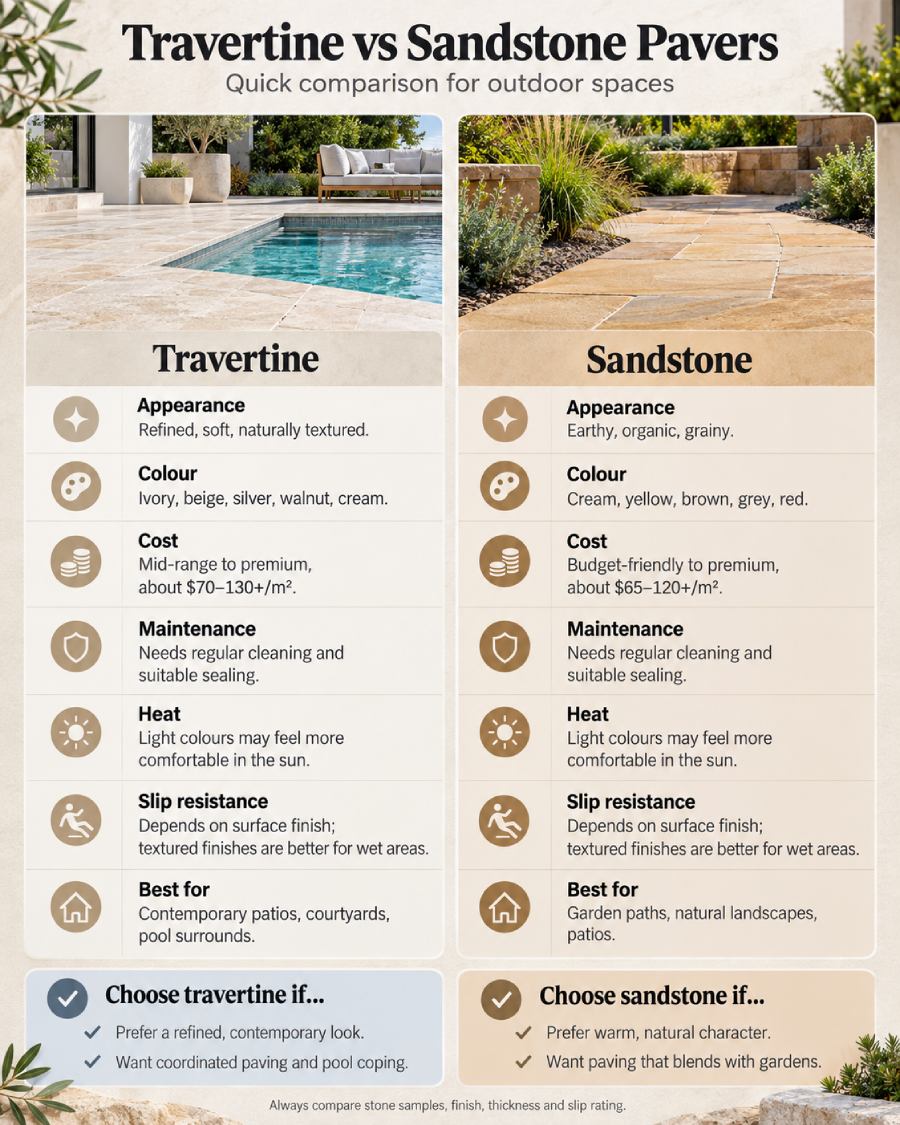
Both materials can perform well outdoors when properly selected and installed. The following comparison highlights their general characteristics.
| Factor | Travertine Pavers | Sandstone Pavers |
| Appearance | Refined, soft and naturally textured | Earthy, organic and grainy |
| Cost | Mid-range to premium | Budget-friendly to premium |
| Durability | Varies by density, grade and installation | Varies significantly by sandstone type |
| Maintenance | Regular cleaning and appropriate sealing | Regular cleaning and appropriate sealing |
| Heat | Light colours may offer better comfort | Light colours may offer better comfort |
| Slip Resistance | Depends on surface finish | Depends on surface finish |
| Colour Options | Ivory, beige, silver, walnut and cream | Cream, yellow, brown, grey and red |
| Porosity/Staining | Natural pores may absorb moisture and stains | Absorption varies by stone composition |
| Installation | Requires suitable preparation and substrate | Requires suitable preparation and substrate |
| Best For | Contemporary patios, courtyards and pool surrounds | Garden paths, natural landscapes and patios |
Quick takeaway: Travertine often appeals to homeowners seeking a sophisticated, consistent design, while sandstone suits those who prefer natural variation and earthy character. Neither is universally stronger, cooler or easier to maintain.
What Are Travertine Pavers?
Travertine is a natural limestone formed through calcium carbonate deposits, typically associated with mineral-rich water. Its distinctive pores, subtle veining and soft colour variations create an elegant appearance suitable for modern and traditional landscapes.
Available in finishes such as tumbled, honed and sandblasted, travertine pavers are commonly used for patios, pool surrounds, courtyards and garden pathways.
Benefits of Travertine Pavers
- Elegant appearance with soft, neutral colours.
- Available in different sizes, patterns and surface finishes.
- Suitable for various outdoor applications when correctly specified.
- Light-coloured options may improve barefoot comfort in sunny areas.
- Can complement contemporary indoor-outdoor designs.
Limitations of Travertine Pavers
Travertine contains natural pores and is sensitive to acidic substances, which may cause surface etching. Its durability also depends on stone quality, thickness and installation.
Some finishes may require additional attention around wet areas, and sealing may be recommended to help reduce staining.
What Are Sandstone Pavers?
Sandstone is a sedimentary rock composed primarily of sand-sized mineral grains bonded together by natural cementing materials. Its texture, strength, colour and porosity can vary considerably depending on its geological origin.
Natural sand stone pavers are frequently selected for Australian gardens, courtyards, pathways, patios and outdoor entertaining spaces.
Benefits of Sandstone Pavers
- Warm, earthy colours that blend with natural surroundings.
- Distinctive grain patterns and organic surface character.
- Various finishes and formats for landscaping projects.
- Suitable for traditional, coastal and contemporary gardens.
- Options available across different price categories.
Limitations of Sandstone Pavers
Some sandstone varieties have relatively high water absorption or lower resistance to surface wear. These characteristics depend on the stone’s composition and density rather than sandstone as a category.
Colour variation, staining and weathering should also be considered, particularly in exposed or heavily used areas.
Travertine vs Sandstone Pavers: Key Differences
When comparing sandstone vs travertine pavers, the most important differences involve appearance, physical properties and intended use.
Appearance and Colour
Travertine generally features soft, flowing patterns and neutral shades such as ivory, beige, silver and walnut. It works particularly well with minimalist architecture, rendered walls and contemporary landscaping.
Sandstone often has more pronounced grains, layered patterns and earthy colours. Yellow, cream, brown and reddish shades can create a natural connection with gardens and traditional Australian homes.
Durability
Both stones can provide durable outdoor paving, but their performance varies.
Travertine quality depends on factors such as density, natural voids and structural integrity. Sandstone durability is influenced by its mineral composition, cementation and absorption characteristics.
For either material, selecting the correct thickness, substrate and installation method is essential. Manufacturer specifications should determine suitability for demanding applications.
Cost
Travertine and sandstone are both available in standard and premium product ranges.
Sandstone can be an economical option in certain formats, while selected travertine products may be competitively priced. However, premium sandstone can cost more than standard travertine.
Comparing equivalent grades, thicknesses and finishes provides a more useful indication of value.
Maintenance
Both materials benefit from regular sweeping, gentle washing and prompt stain removal.
Travertine should be cleaned using suitable pH-neutral products because acidic cleaners can damage its calcium carbonate surface. Sandstone also requires stone-compatible cleaning products, with care depending on its mineral composition.
Sealing requirements vary by product, exposure and intended use.
Heat
Neither material is automatically cooler under the Australian sun.
Surface temperature depends on colour, sunlight exposure, surface finish, thermal properties and environmental conditions.
Light-coloured travertine and sandstone may feel more comfortable than darker alternatives under comparable conditions. Testing samples in direct sunlight is useful when barefoot comfort is a priority.
Slip Resistance
Both materials are available with textured outdoor finishes that may provide suitable traction.
Tumbled or sandblasted travertine and appropriately textured sandstone are worth considering for wet environments. However, texture alone does not guarantee slip resistance.
For pool surrounds and other wet areas, request relevant test results, including applicable AS 4586 classifications, and confirm the required performance for your project.
Staining and Porosity
Travertine and sandstone can absorb moisture and staining substances, although absorption levels vary between individual products.
Travertine’s natural pores may require filling or other finishing treatments. Sandstone porosity depends on its grain structure and cementing minerals.
Appropriate sealing can help reduce absorption, but no sealer makes natural stone completely stain-proof.
Installation
Installation quality is essential for both materials.
Proper excavation, substrate preparation, drainage, joint spacing and suitable bedding materials help prevent movement, cracking and moisture problems.
Different thicknesses and installation systems may be required depending on pedestrian traffic, vehicle loads and site conditions.
For practical guidance, review Hunter Pavers’ Paver installation instructions.
Explore your options: Compare Hunter Pavers’ travertine and sandstone collections to find suitable colors, finishes and sizes for your outdoor project.
Travertine vs Sandstone Pavers price
The travertine vs sandstone cost comparison should consider the complete project rather than material prices alone.
Australian supply-only prices vary by stone origin, grade, finish, thickness and supplier. As a broad indication, standard sandstone pavers may fall around 65–120+ per square metre, while common travertine outdoor products may fall around 70–130+ per square metre. Premium varieties of either material can exceed these ranges.
These figures are indicative rather than confirmed quotes.
Additional project expenses may include:
- Site preparation and drainage.
- Bedding materials, adhesives and grout.
- Professional installation.
- Sealing and ongoing maintenance.
- Cutting, wastage and delivery.
A lower material price does not always deliver a lower overall project cost. Request itemised quotations using equivalent specifications before deciding.
Which Is Better for Patios?
When comparing a travertine vs sandstone patio, the choice often comes down to design preferences and everyday use.
Travertine is particularly appealing for modern alfresco areas where homeowners want softer colours, subtle textures and a coordinated appearance. Large-format pavers can create a spacious, refined finish.
Sandstone works beautifully in landscaped patios surrounded by greenery, timber or natural garden features. Its colour variation adds warmth and character.
Both materials can work in covered and exposed patios. Consider drainage, furniture use, maintenance expectations and surface finish before selecting a product.
Best choice: Travertine for a refined, contemporary look; sandstone for a more rustic or naturally landscaped setting.
Which Is Better for Pool Areas?
For a travertine vs sandstone pool comparison, slip resistance, water exposure and barefoot comfort should take priority over appearance alone.
Travertine is popular for pool surrounds because its neutral colours complement water features and modern outdoor designs. Matching travertine pool coping can also create a coordinated edge.
Sandstone offers a warmer, more organic appearance and can suit tropical gardens, resort-inspired pools and traditional landscapes.
Both materials require careful assessment of:
- Wet-surface slip resistance.
- Stone absorption and staining characteristics.
- Pool chemicals or saltwater exposure.
- Surface finish and edge profiles.
- Installation, drainage and sealing requirements.
Best choice: Either can be suitable when the specific product meets the project’s technical requirements. Do not assume one stone is inherently non-slip or more resistant to pool chemicals.
Which Is Better for Driveways?
Driveways create different demands from patios and pathways because paving must withstand vehicle loads, turning forces and repeated movement.
Neither standard travertine nor sandstone patio pavers should automatically be considered suitable for vehicle traffic.
Certain thicker, appropriately specified natural stone pavers may work for residential driveways when supported by a correctly designed substrate.
Before choosing either material, confirm load-bearing requirements, stone strength, thickness and installation recommendations.
For more information, explore the best pavers for driveway options based on vehicle use and project conditions.
Travertine vs Sandstone Pavers Pros and Cons
Understanding the advantages and limitations of each material makes the decision easier.
| Material | Pros | Cons |
| Travertine | Elegant neutral colours, versatile finishes, coordinated pool and patio designs | Acid sensitivity, natural pores, potential sealing requirements |
| Sandstone | Earthy appearance, natural colour variation, attractive garden integration | Variable porosity, possible surface weathering, differences in strength between varieties |
Neither stone should be selected solely because it is described as premium or durable.
A high-quality sandstone with suitable technical properties may outperform a poorly specified travertine product in a particular application, and the reverse can also be true.
Which Should You Choose?
The right decision depends on your project’s appearance, budget, exposure and maintenance requirements.
Choose travertine if:
- You prefer soft, neutral colours and an elegant finish.
- You want coordinated paving and pool coping.
- Your design features contemporary architecture.
- You are prepared to follow natural stone care recommendations.
Choose sandstone if:
- You prefer warm, earthy colours and organic textures.
- You want paving that blends with garden landscaping.
- Natural variation is an important design feature.
- You find a suitable product that meets your performance and budget requirements.
Before ordering, compare physical samples under natural light. Ask the supplier about water absorption, surface finish, thickness and suitability for your intended location.
Where relevant, request product-specific slip resistance and strength information rather than relying on general claims about the stone type.
Conclusion
The decision between travertine vs sandstone pavers is not about finding one universally superior material. Travertine offers refined colours and versatile design possibilities, while sandstone provides earthy textures and natural landscaping appeal.
Both can be excellent choices for Australian outdoor spaces when stone quality, finish, installation and maintenance are properly considered.
Explore the natural stone collections at Hunter Pavers to compare available products, or contact the team for assistance with selecting suitable pavers for your patio, pool surround, courtyard or landscaping project.
Frequently Asked Questions
Is travertine better than sandstone?
Not necessarily. Travertine is often preferred for refined contemporary designs, while sandstone suits natural and earthy landscapes. Performance depends on the selected stone and application.
Is sandstone cheaper than travertine?
Some sandstone products are cheaper than comparable travertine options, but premium sandstone can cost more. Compare products with similar specifications and include installation costs.
Which lasts longer, travertine or sandstone?
Both can last for many years when properly specified, installed and maintained. Their actual service life depends on stone quality, environmental exposure and usage.
Is travertine or sandstone better around a pool?
Both can be suitable. Choose a product with appropriate wet-area slip resistance, acceptable water absorption characteristics and a suitable finish.