

Pool coping cost depends on the material, total pool perimeter, coping dimensions, edge profile, fabrication, delivery, installation and condition of the existing pool edge. A rectangular new pool using standard pieces is normally more economical than a curved renovation requiring demolition, substrate repairs and custom-cut stone.
There is no single installed price that applies to every project. The useful way to budget is to compare the same scope across every quotation: material and finish, linear metres, edge profile, cutting, preparation, installation, sealing, delivery and waste. If you are still deciding what coping does or which profiles are available, begin with our complete pool coping guide.
Pool Coping Cost Summary
The table below shows how each part of a project generally affects the final budget. These are relative cost impacts, not fixed quotations.
| Cost Component | Typical Impact | What Changes the Cost? |
|---|---|---|
| Material | Low to very high | Stone species, grade, thickness, finish and availability |
| Pool perimeter | Medium to high | Total linear metres, corners, steps, spa edges and raised sections |
| Edge profile | Low to medium | Standard bullnose or square edge versus drop-face or custom fabrication |
| Installation | Medium to high | Access, substrate, cutting, curves, alignment and joint details |
| Replacement work | High | Demolition, disposal and repairs beneath the old coping |
| Finishing | Low to medium | Sealing, jointing, cleaning and final protection |
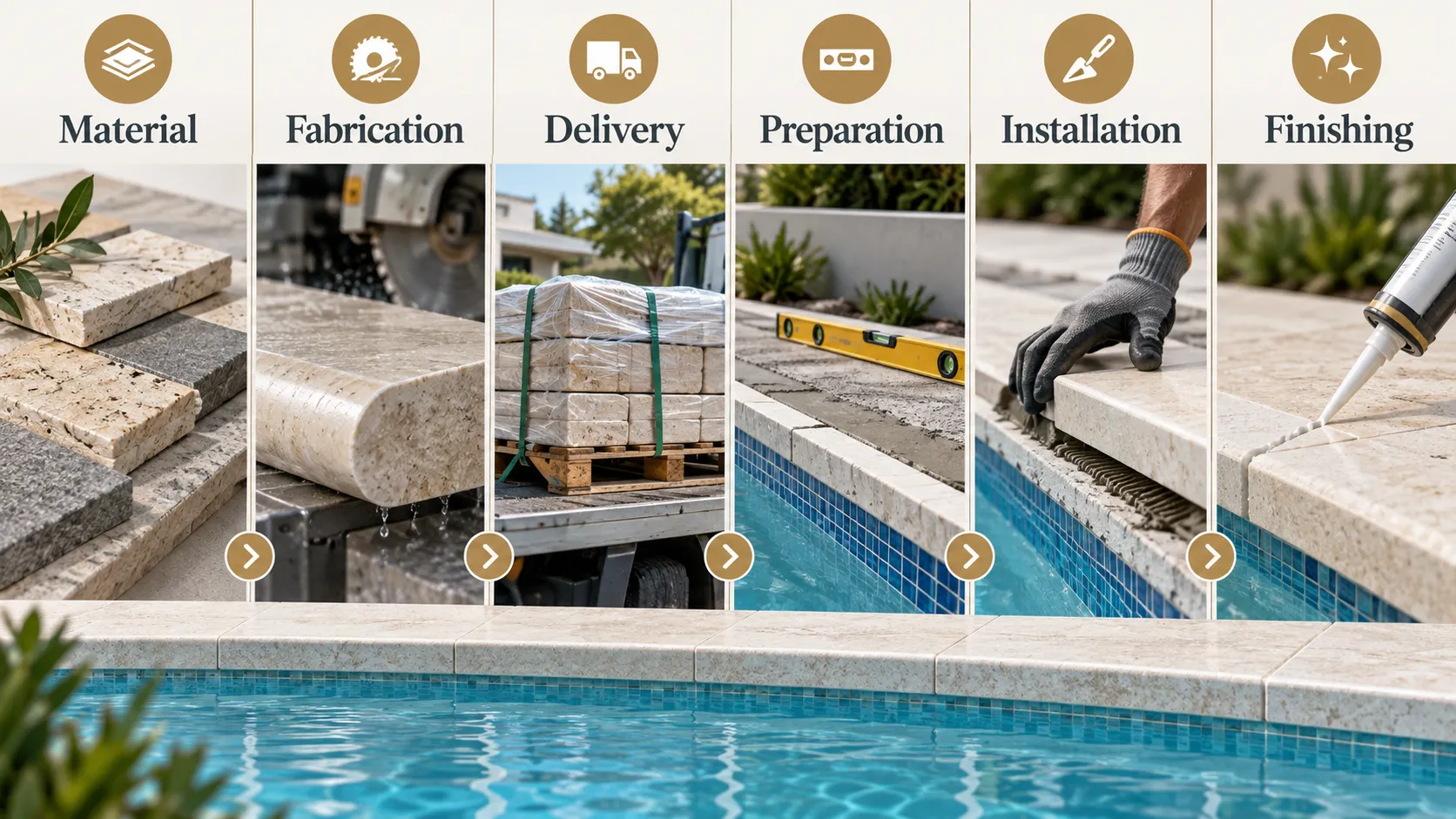
How Is Pool Coping Cost Calculated?
A complete estimate normally combines several components:
Total project estimate = coping material + fabrication + delivery + preparation + installation + finishing + removal and disposal where required
Material may be advertised per piece, per square metre or as a price range covering several dimensions. Coping itself is measured around the pool perimeter, so unit dimensions must be converted into the number of pieces needed. The purchase price shown for general pavers should not automatically be treated as the installed pool coping rate.
Hunter Pavers’ live listings show that prices vary across product dimensions and finishes. Review Premium Travertine and the porcelain range as product-level reference points, but confirm the current price for the exact coping format. Coping dimensions, profiles, stock, fabrication and installation remain project-specific.
Check Current Coping Prices and Formats
Compare live product ranges, then send Hunter Pavers the pool perimeter, preferred material, required thickness and edge profile for relevant availability and pricing guidance.
What Factors Affect Pool Coping Cost?
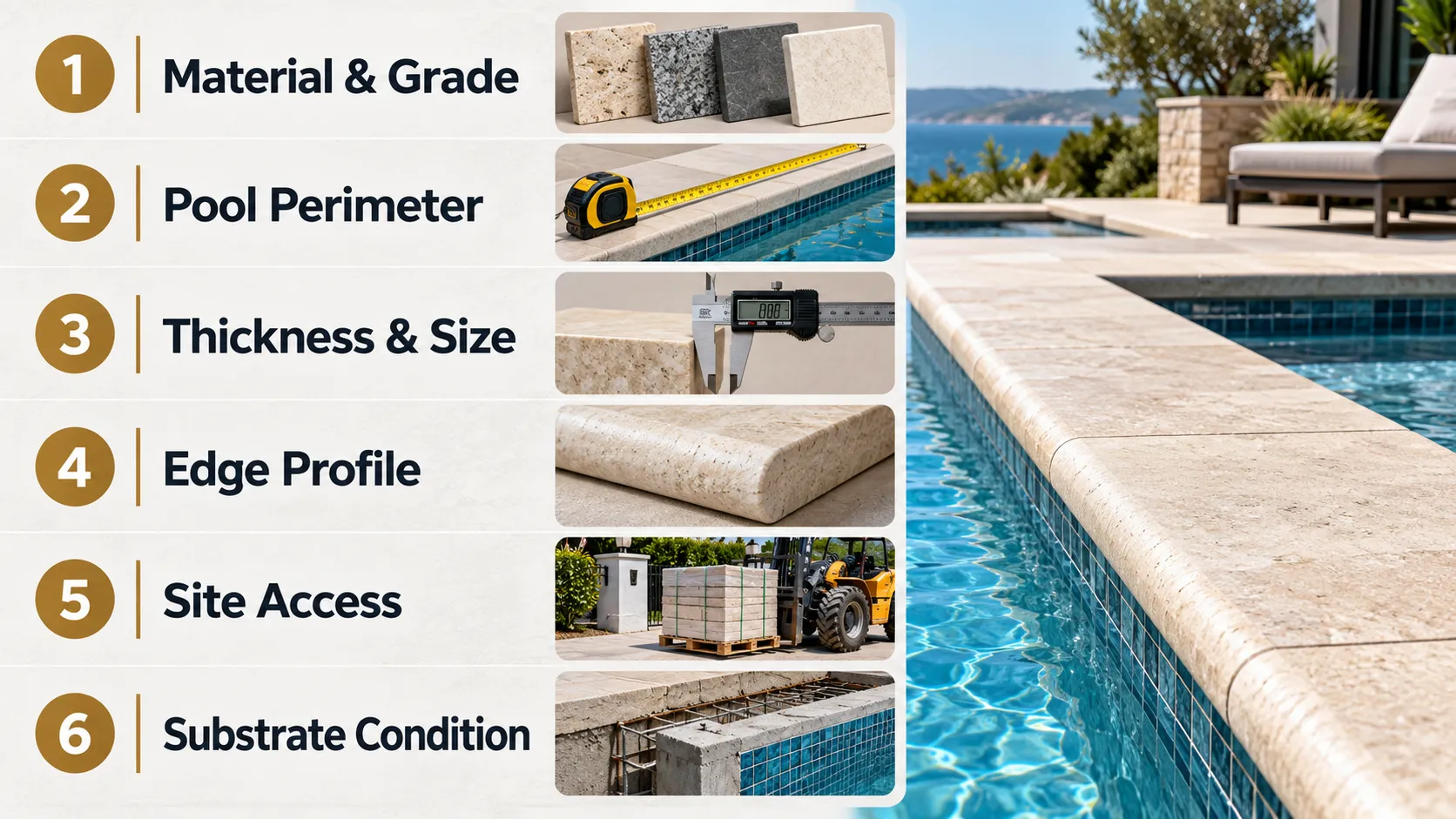
Two pools of similar size can have very different coping budgets. The following factors explain most of the variation.
Material Type and Grade
Concrete is generally positioned toward the budget end, while selected natural stone and specialised porcelain may cost more. Within one material category, colour, origin, grade, density, consistency and availability can create a wide price range. Premium selection may reduce unwanted variation, but it normally increases the purchase price.
Pool Perimeter and Shape
Coping runs around the pool edge, so total linear metres matter more than the water surface area. Long straight sides are efficient to set out and cut. Freeform curves, tight radii, raised spas, steps and water features require more measuring, cutting and fitting and may create additional wastage.
Coping Thickness and Dimensions
Thicker and larger pieces contain more material and are heavier to transport, handle and install. The selected coping dimensions also need to coordinate with the pool beam, waterline tile and surrounding paving build-up. Buying a cheaper but unsuitable thickness can create expensive installation changes later.
Edge Profile and Surface Finish
Standard square-edge and bullnose pieces may require less fabrication than a deep drop-face, rebate or custom profile. Surface treatments such as tumbling, honing, sandblasting or flaming also involve different processing. A polished finish should not be selected purely for appearance because wet-area suitability and slip performance must also be considered.
Access, Delivery and Stock
Delivery distance, site access, manual handling and the number of separate deliveries can affect the budget. Confirming stock from the same batch can also help avoid delays and excessive variation. Large-format or heavy coping may require more careful handling from delivery through installation.
Substrate and Preparation
A stable, clean and correctly prepared pool edge is essential. Levelling, waterproofing interfaces, repairs and movement-joint details can add labour and materials. These costs are often more significant in renovations because the condition beneath the old coping is not fully visible until removal begins.
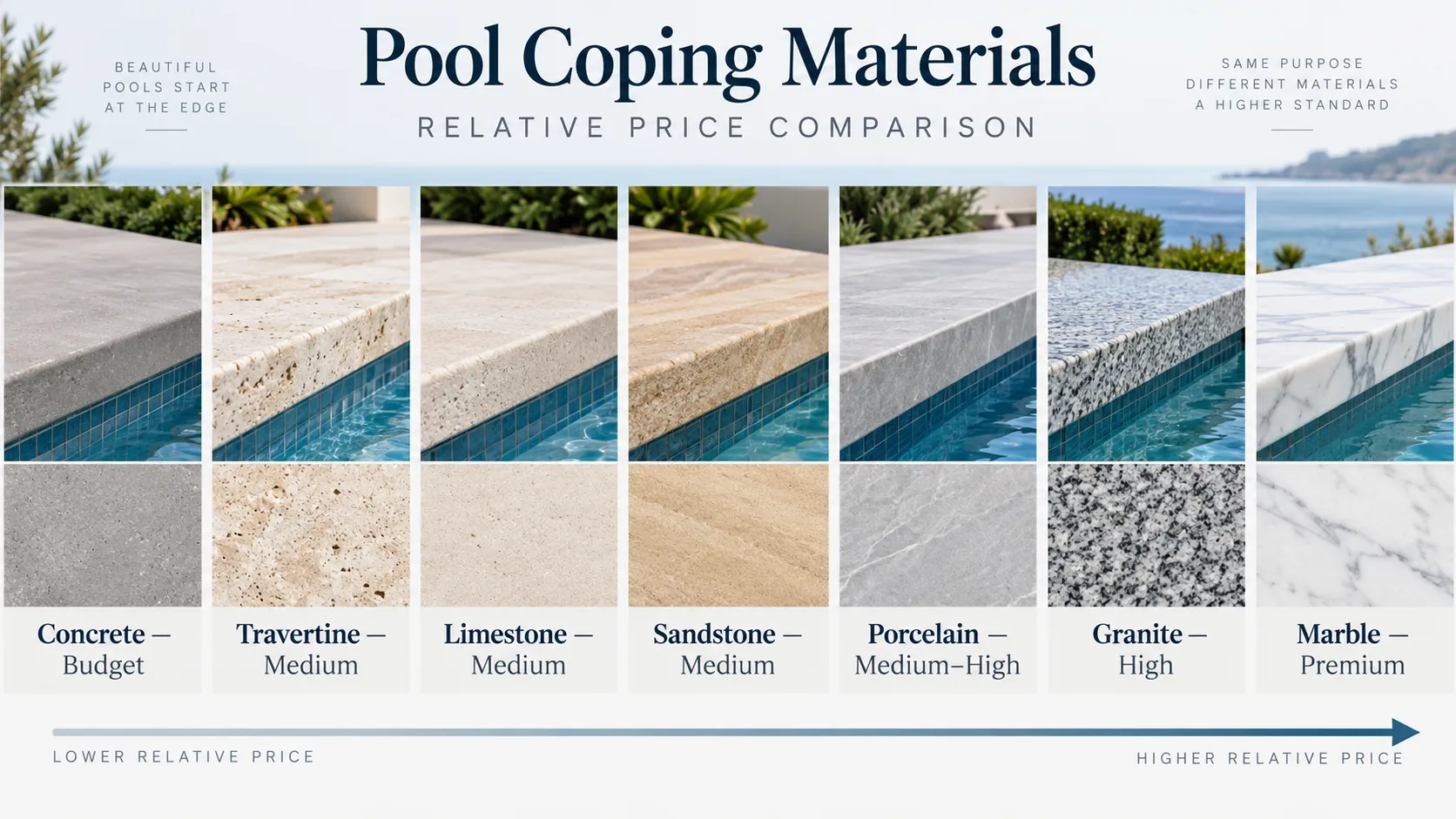
Pool Coping Cost by Material
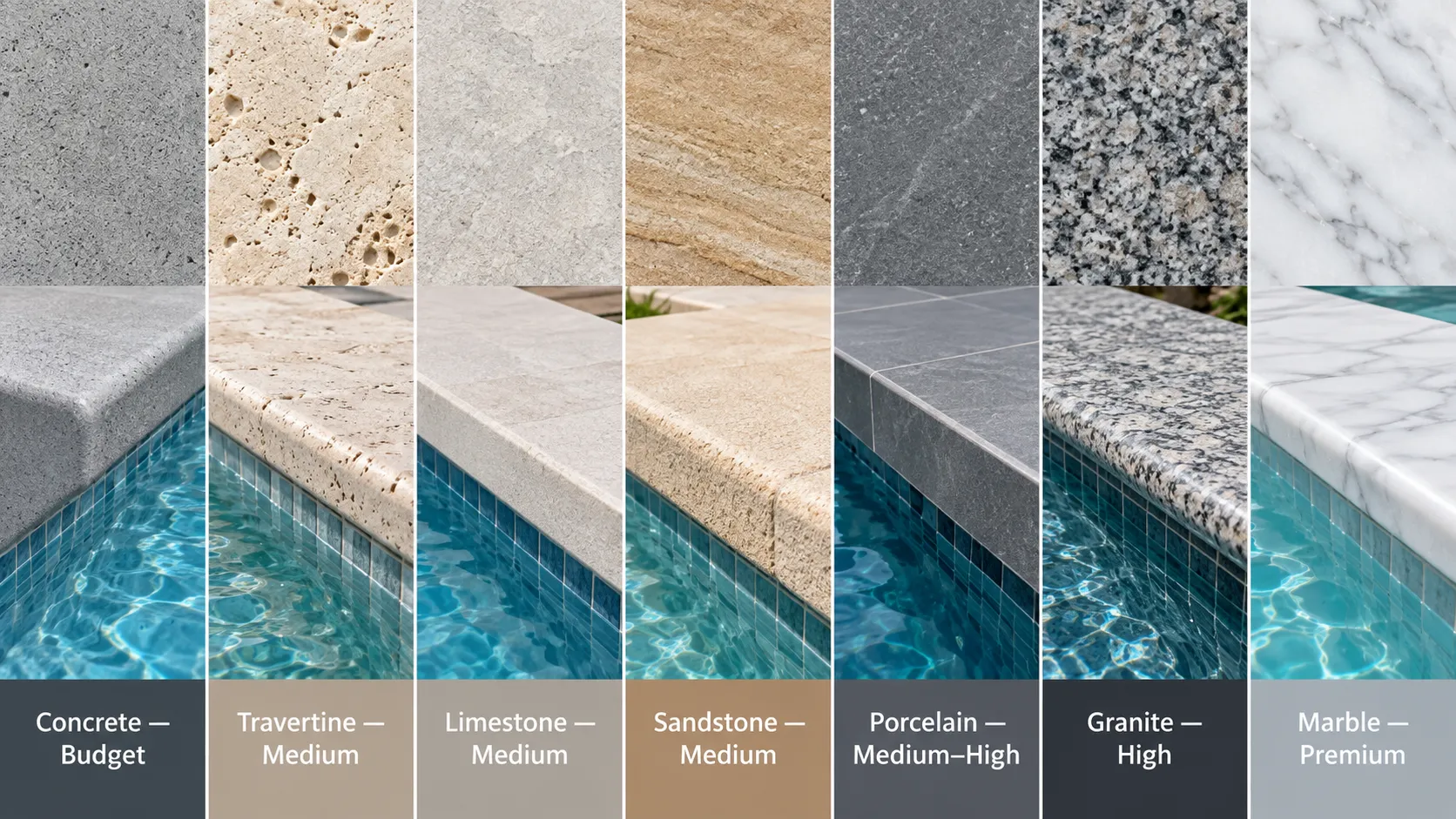
The following comparison positions common materials by relative price level. Exact figures depend on the product, dimensions and profile, so use this table to shortlist options rather than as a quotation.
| Material | Relative Price Level | Ongoing Cost Consideration | Often Chosen For |
|---|---|---|---|
| Concrete | Budget | Cleaning and repairs vary by finish | Cost-conscious projects |
| Travertine | Medium | May require sealing and suitable stone care | Residential pools |
| Limestone | Medium | Sealing needs vary by limestone | Refined landscaped pools |
| Sandstone | Medium | Porosity and maintenance require attention | Natural and rustic designs |
| Porcelain | Medium to high | Generally low routine surface maintenance | Modern low-maintenance pools |
| Granite | High | Durability can support long-term value | High-traffic pool areas |
| Marble | Premium | Careful sealing and cleaning may be required | Luxury architectural pools |
Travertine Pool Coping Cost
Travertine pool coping often provides a useful balance between natural-stone character and overall project cost. Pricing changes with grade, colour, thickness, finish and profile. Standard tumbled formats around rectangular pools are normally easier to budget than custom drop edges or numerous curved pieces. Compare current options in the travertine collection.
Granite Pool Coping Cost
Granite pool coping is generally positioned higher because the stone is dense and specialist cutting can require more time and suitable equipment. The higher initial cost may be justified where wear resistance and longevity are priorities, particularly around high-use residential or commercial-style pools.
Marble Pool Coping Cost
Marble pool coping is usually a premium choice. Variety, veining, selection consistency, thickness and fabrication all affect cost. Budget should also account for an appropriate outdoor finish, sealing where required and cleaning products compatible with the selected stone.
Limestone and Sandstone Pool Coping Cost
Limestone and sandstone commonly occupy the middle of the natural-stone market, but individual varieties differ. Their colour, finish, density, porosity and edge availability should be assessed alongside purchase price. Sealing and future maintenance form part of their lifetime cost.
Porcelain Pool Coping Cost
Outdoor porcelain coping can range from medium to high depending on thickness, finish, manufacturer and edge system. Low water absorption can reduce routine surface-maintenance requirements, but fabrication and installation need suitable blades, adhesives and methods. Our pool coping material comparison can help you assess cost alongside safety, heat, durability and care.
How to Measure Pool Coping Before Requesting a Quote
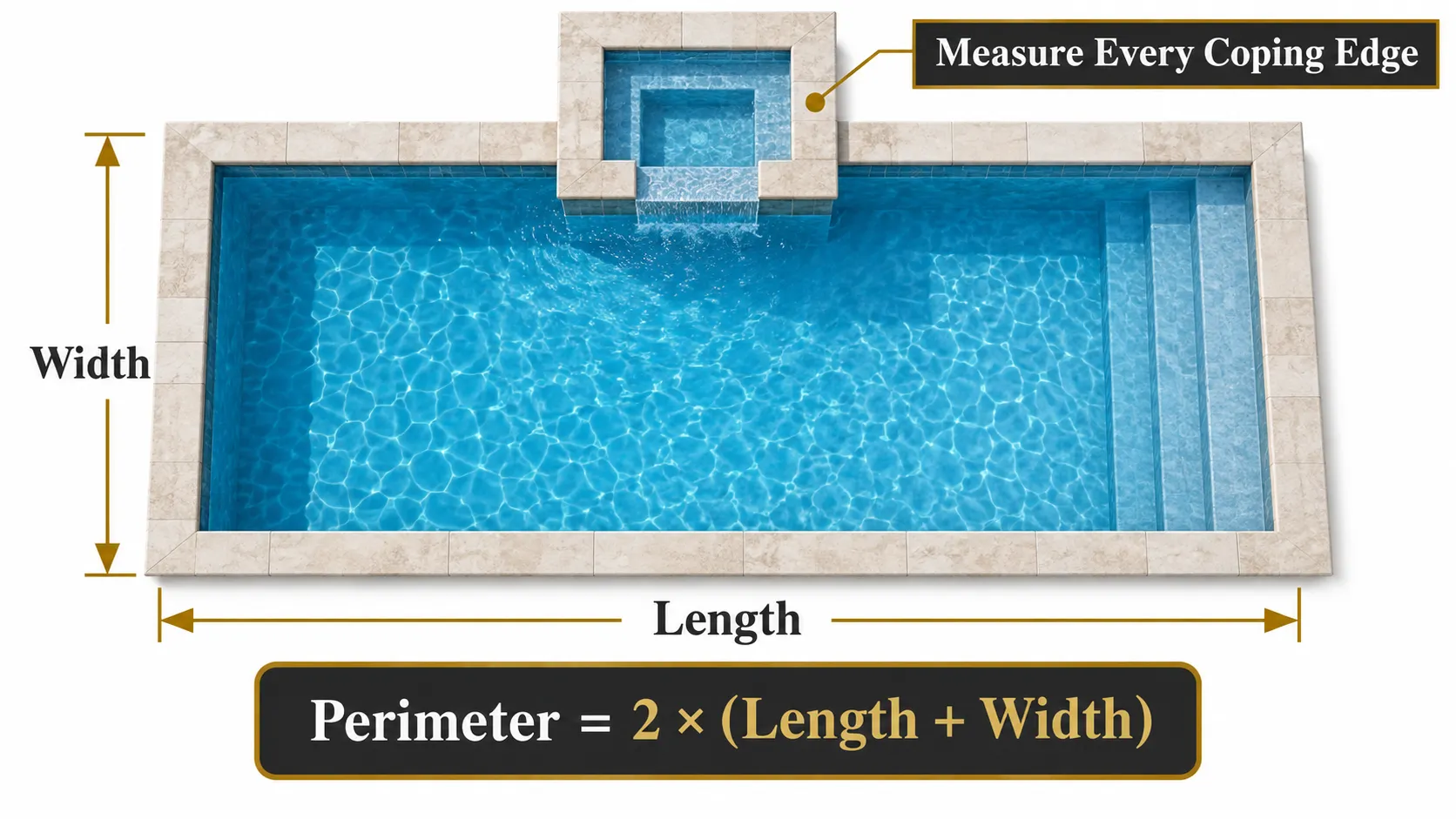
Measure the complete pool perimeter in linear metres, including spa edges, steps, raised walls and separate features that require coping. Then record every external and internal corner, curved section and change in level. Suppliers also need the required width, thickness and edge profile.
For a simple rectangular pool, use:
Pool perimeter = 2 × (length + width)
Example: an 8 m × 4 m rectangular pool has a 24 m perimeter. If each coping piece covers 600 mm along the edge, the starting quantity is 40 pieces before allowing for cuts, breakage, corners or spare material.
A suitable waste allowance should be confirmed with the supplier or installer. Curves, diagonal cuts, pattern matching and fragile or heavily varied stone may require more allowance than long straight runs. Do not order from perimeter alone if corners or custom pieces use different dimensions.
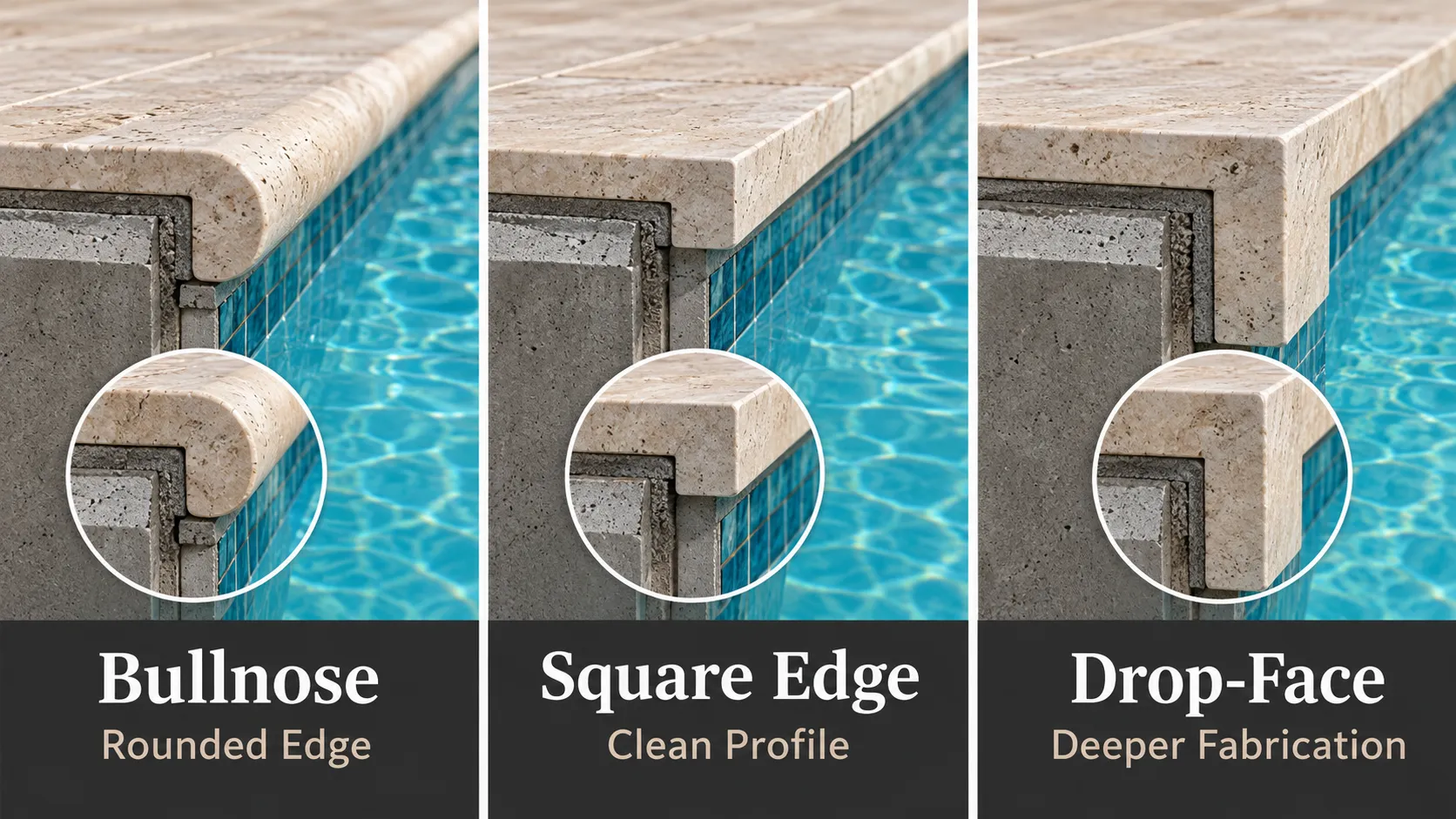
How Does the Edge Profile Change the Cost?
The profile affects both material processing and installation. A bullnose edge has a rounded exposed face, while a square edge creates a cleaner contemporary line. Drop-face coping extends down the pool face and may require deeper pieces, mitred fabrication or careful corner detailing. Rebated and custom profiles add another manufacturing step.
Before selecting a profile, compare the price of the finished coping unit rather than the base paver. Also ask whether external corners, internal corners and curved sections are standard stocked pieces or must be fabricated for the project.
Pool Coping Installation Cost
Installation is a separate and sometimes substantial part of the project budget. A complete scope may include:
- Site inspection, measurement and setting out.
- Substrate cleaning, levelling and repair.
- Cutting straight pieces, corners and curves.
- Bonding and aligning the coping to the pool edge.
- Installing joints and accommodating movement details.
- Cleaning and sealing natural stone where specified.
- Removing waste and protecting the completed work.
Quotes should state which of these items are included. A low headline labour rate may exclude preparation, cutting or sealing, making it difficult to compare with a more complete quotation.
“Gain quotes from at least three builders.”
NSW Government — Building a pool: your rights and obligations
The NSW Government advises comparing quotations that cover the same equipment and scope of work. It also states that residential building work over $5,000 including GST requires a written contract, while pool construction or renovation over $20,000 including GST requires Home Building Compensation Fund cover. The maximum deposit is 10% of the contract price. Confirm how the current rules apply to the complete project and check the contractor’s licence before work begins.
Pool Coping Replacement Cost
Replacement normally involves more labour and uncertainty than installing coping on a prepared new pool. The existing coping must be removed without avoidable damage to the pool shell, waterline tiles or surrounding paving. The exposed substrate then needs to be checked for loose mortar, cracks, movement, water damage and uneven levels.
A replacement quotation should separate demolition and disposal, substrate repairs, new coping, fabrication, installation and finishing. If the existing paving meets the coping, confirm whether it can remain or must also be lifted and reinstated. Hidden damage may require a clearly defined variation process in the contract.
How to Reduce Pool Coping Costs Without Sacrificing Quality
- Choose for the application: Pay for performance characteristics the pool actually needs rather than appearance alone.
- Use standard formats: Stocked sizes and profiles can reduce fabrication and lead time.
- Simplify the layout: Repeated dimensions and planned joints reduce difficult cuts and material waste.
- Coordinate early: Align the coping, waterline tile and surrounding paving before installation begins.
- Measure accurately: Under-ordering can cause delays and batch variation; excessive ordering ties up budget.
- Compare equal scopes: Check preparation, cutting, adhesives, sealing, delivery and disposal in every quote.
- Keep spare pieces: A small quantity from the same batch can make future repairs easier.
Long-term value matters as much as the purchase price. The Australian Government’s YourHome guidance defines lifecycle cost as:
“Initial cost + discounted cost for operation, maintenance and end of life.”
Applied to pool coping, this means comparing initial supply and installation with sealing, cleaning, repair risk and eventual replacement. A cheaper product is not automatically better value if it requires unsuitable installation shortcuts or more frequent intervention.
What Should a Pool Coping Quote Include?
- Exact material, colour, grade, finish and batch expectations.
- Coping dimensions, thickness, edge profile and quantity.
- Price basis: per piece, linear metre, square metre or total supply.
- Custom corners, curves, rebates and drop-face fabrication.
- Delivery, unloading and access requirements.
- Removal and disposal of existing coping where applicable.
- Substrate preparation and clearly identified repair allowances.
- Adhesives, jointing materials, movement details and sealers.
- Installation labour, final cleaning and site protection.
- GST, exclusions, lead time, payment stages and variation procedure.
Frequently Asked Questions
How Much Does Pool Coping Cost?
Pool coping cost varies with the material, total perimeter, dimensions, edge profile, fabrication, delivery, preparation and installation. Replacement also includes removal and possible substrate repairs. A measured project-specific quote is more reliable than a generic average.
What Is the Cheapest Pool Coping Material?
Standard concrete coping is generally positioned toward the budget end of the market. The lowest purchase price is not necessarily the lowest lifetime cost, so compare durability, installation, maintenance and future repair requirements as well.
Is Travertine Pool Coping Expensive?
Travertine is commonly a mid-range natural-stone option. Grade, colour, thickness, finish and edge profile determine the actual price. Standard tumbled formats can provide a strong balance of appearance, performance and project cost for residential pools.
Does Pool Coping Installation Cost Extra?
Usually, yes. Product pricing and installation are separate unless the quotation clearly states that it is an installed price. Labour may include preparation, cutting, bonding, alignment, jointing, sealing and cleaning, so confirm the complete scope.
How Much Does It Cost to Replace Pool Coping?
Replacement typically costs more than installation on a prepared new pool because the old coping must be removed and disposed of. Substrate repairs, protection of adjacent finishes and reinstatement of surrounding paving may add further cost.
Which Pool Coping Material Offers the Best Value?
Travertine, limestone and quality porcelain can all offer good value depending on the project. Granite may justify a higher initial price where maximum durability is important. The best value comes from matching the material and finish to climate, use, maintenance expectations and installation conditions.
How Do I Calculate How Much Pool Coping I Need?
Measure every section of the pool perimeter in linear metres, then divide by the length covered by each coping piece. Add corners, curves, steps and raised sections separately and confirm an appropriate allowance for cuts, breakage and spare pieces with the supplier or installer.
Does Pool Coping Cost Include Surrounding Pavers?
Not automatically. Coping finishes the pool edge, while surrounding pavers cover the adjacent deck or landscape area. A quotation should clearly state whether it includes coping only, surrounding paving, waterline tiles or any associated preparation.
Get an Accurate Pool Coping Estimate
The most accurate estimate begins with the pool perimeter, photographs or plans, preferred material, coping dimensions, edge profile and details of whether the project is new or replacement work. Comparing total scope and lifetime maintenance gives a clearer result than selecting from the lowest advertised material price.
Plan Your Pool Coping Budget with Hunter Pavers
Send the team your measurements, preferred stone or porcelain, required profile and delivery location. Hunter Pavers can help you compare current product formats, availability and supply pricing for your Sydney pool project.