


The primary difference between Travertine vs. Marble lies in their formation and ideal environment. Marble is a dense, metamorphic rock best suited for luxurious indoor surfaces like entryways and master bathrooms due to its elegant veining and high-gloss potential. On the other hand, Travertine is a porous, sedimentary stone and the superior choice for outdoor areas like pool decks and patios. While Marble offers timeless prestige, Travertine provides natural slip resistance, stays cool under direct sunlight, and is generally more affordable, making it the practical choice for high-traffic exterior spaces.
Natural stone has remained the gold standard for prestige for millennia. When you choose marble, you follow in the footsteps of the artisans who crafted the ethereal beauty of the Taj Mahal. On the other hand, selecting travertine connects your home to the rugged, everlasting strength of the Roman Colosseum. In modern design, these stones balance permanence with prestige, but understanding their technical differences is the key to choosing a material that fits your lifestyle, not just your mood board.
| Feature | Travertine | Marble |
|---|---|---|
| Geological Origin | Sedimentary (Formed in Hot Springs) | Metamorphic (Recrystallized Limestone) |
| Visual Style | Rustic, Earthy, and Pitted | Luxurious, Elegant, and Veined |
| Heat Retention | Stays cool under direct sunlight | Absorbs heat (can become hot) |
| Slip Resistance | Naturally high (Excellent for wet areas) | Low (Slippery when polished) |
| Best Application | Pool decks, patios, and outdoor walkways | Indoor floors, countertops, and entryways |
| Maintenance | Requires frequent sealing due to porosity | Requires periodic sealing to prevent etching |
| Relative Cost | Generally more affordable | Premium/High-end investment |
Geological Origins: How Formation Defines Character
The “personality” and performance of a stone are written in its geological DNA. While both are members of the calcium carbonate family, their “birth” determines how they handle the elements today.
Marble: The Metamorphic Masterpiece
Marble is a metamorphic rock that begins its life as limestone. Over millions of years, tectonic activity subjects it to intense heat and pressure, causing the minerals to “recrystallize.” The result is a dense, interlocking structure. When these stones are crafted into marble tiles, they showcase the iconic flowing veins the material is famous for, while maintaining a high density of approximately 2.71 g/cm³.
Travertine: The Sedimentary Solution
Travertine is a sedimentary rock formed by the rapid precipitation of calcium carbonate, primarily around hot springs. During its formation, carbon dioxide bubbles escape through the stone, leaving behind a porous structure. This unique process ensures that travertine tiles are characterized by tiny holes, troughs, and pits, resulting in a lighter, more breathable product with an average density of approximately 2.52 g/cm³.
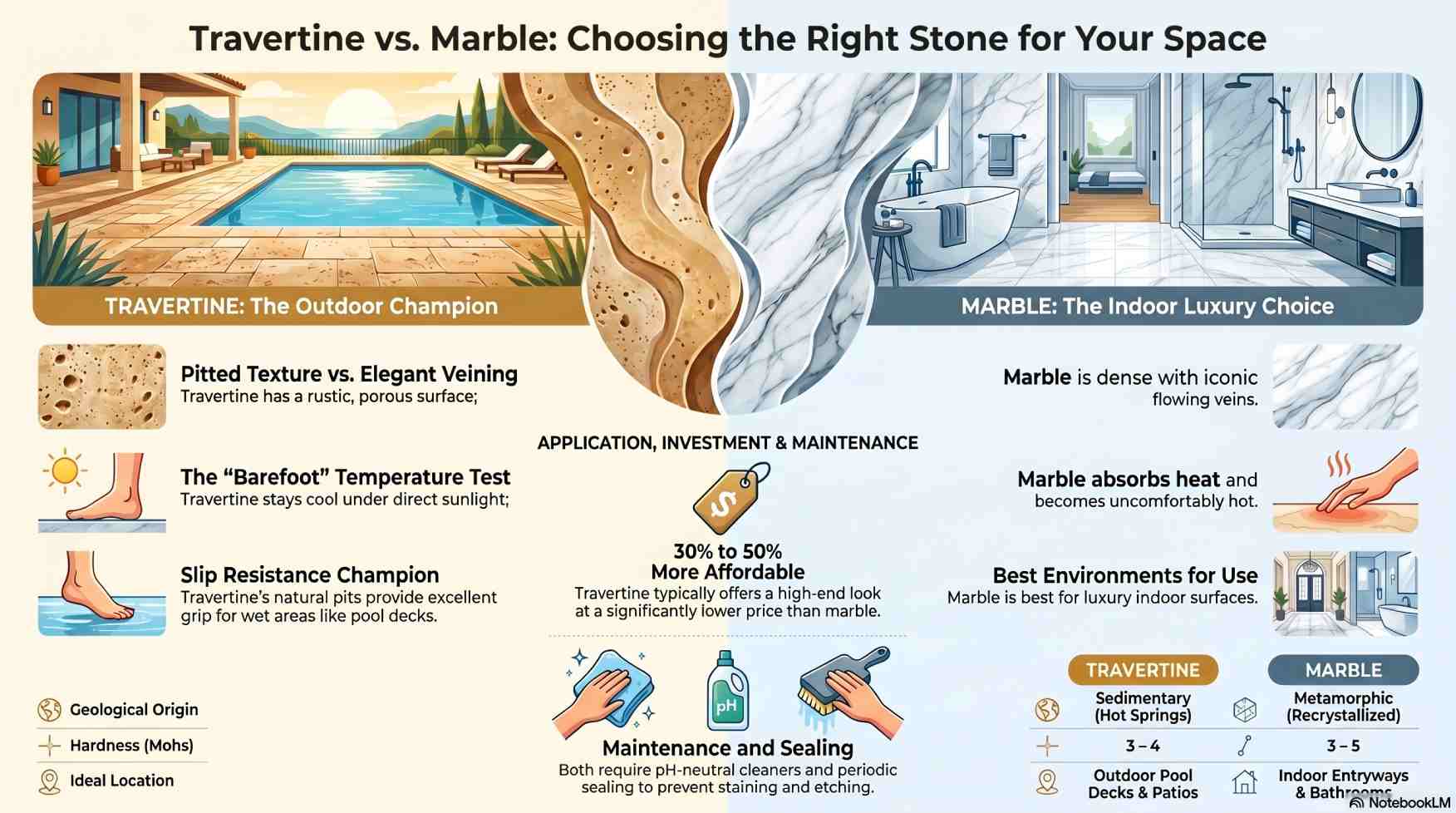
Visual Aesthetics: Veining vs. Pitted Textures
The visual “language” of these stones defines the atmosphere of a room or landscape.
- Marble (The Formal Choice): Known for a vast color spectrum, including brilliant whites, deep greens, and dramatic blacks. It is defined by its striking, contrasting veins and a reflective surface that takes a high-gloss polish exceptionally well, making it ideal for a “sharp,” luxurious look.
- Travertine (The Organic Choice): Known for a warm, earthy palette of beige, tan, walnut, and silver-blue. It has a rustic, textured appearance. It can be “honed and filled” for a smooth finish or left “unfilled” to highlight its natural, ancient character, perfect for a Mediterranean or relaxed aesthetic.
Popular Finishes: From Polished to Tumbled
The surface treatment of natural stone dramatically changes its performance and look. Understanding these finishes is key to picking the right material for your project:
- Polished: This is the signature look for Marble. It creates a mirror-like shine that highlights the stone’s natural veining. However, it is very slippery when wet.
- Honed: A smooth, matte finish that is popular for both stones. It provides a contemporary look and is more scratch-resistant than a polished surface, making it ideal for indoor flooring.
- Tumbled: Exclusive to Travertine, this finish involves rotating the stones in a drum to create rounded edges and a weathered, “ancient” look. This provides maximum slip resistance.
- Filled vs. Unfilled: Since Travertine has natural holes, it can be “filled” with color-matched resin for a smooth finish or left “unfilled” for a raw, organic texture.
Durability and Technical Specifications
Hardness and the Mohs Scale
Hardness determines how well a stone resists scratches from everyday life. On the Mohs Scale, Marble typically rates between 3 and 5, making it resilient against heavy surface wear. Travertine is slightly softer, usually rating between 3 and 4. While both are durable, Marble’s higher density (approximately 2.71 g/cm³) compared to Travertine (2.52 g/cm³) gives it a slight edge in structural strength for indoor flooring.
Porosity and Water Absorption
Travertine is highly porous by nature. Because of its internal voids, it is more absorbent than marble, making high-quality professional sealing a non-negotiable requirement. Marble has lower porosity due to its dense structure, but it remains chemically “thirsty” and requires protection against staining and chemical “etching.”
Safety and Practicality: Slip Resistance and Heat
- Slip Resistance: Travertine is the undisputed champion of safety. Its natural pits provide excellent grip, even when wet. This makes it the premier choice for pool surrounds. Polished marble, conversely, is dangerously slick when wet and often requires specialized treatments to be safe for flooring.
- The “Barefoot” Test: Travertine is a heat-reflective stone. Even on a 100°F (38°C) day, its air pockets prevent it from soaking up solar heat, allowing you to walk comfortably with bare feet. Marble, while cool to the touch indoors, lacks this thermal resistance and can become uncomfortably hot under direct summer sunlight.
The Kitchen Challenge: Countertops and Backsplashes
When choosing between Travertine and Marble for the kitchen, performance matters as much as style. Both stones are calcium-based and sensitive to acids (like lemon juice or vinegar), but their physical structures lead to different recommendations:
- Marble for Kitchens: It is the best stone for kitchen countertops, especially for bakers, because the stone remains naturally cold. However, you must be prepared for “etching” (dull spots) and professional sealing is required annually.
- Travertine for Kitchens: While beautiful, Travertine is rarely recommended for primary countertops because its natural pores can trap bacteria and food particles. It is, however, an excellent and popular choice for backsplashes, where it adds warmth and texture without the heavy wear of a countertop.
Best Applications: Finding the Perfect Location
Indoor Sophistication (Best for Marble)
Marble is the premier choice for high-end interior applications where you want a “wow factor.” It is ideal for grand entryways, bathroom wall cladding, luxury fireplace surrounds, and statement kitchen islands.
Outdoor Resilience (Best for Travertine)
Travertine is the “workhorse” of outdoor luxury. Its durability against the elements and built-in safety features make it the definitive choice for pool decks, garden walkways, and unshaded outdoor entertainment areas.
Maintenance and Long-term Care
Both stones are calcium-based and share a chemical vulnerability to acids (lemon, vinegar, wine), which cause “etching”—a reaction that dulls the surface permanently.
- Sealing: Travertine acts like a sponge and requires sealing every 6 to 12 months to prevent moisture damage. Marble is denser and usually requires sealing every 12 to 24 months.
- Cleaning Protocol: Only use pH-neutral stone cleaners. Avoid abrasive pads or any cleaner containing acidic components that will eat away at the stone’s luster.
Cost Analysis: Budgeting for Natural Stone
Marble is generally the more expensive investment. The cost is driven by the rarity of specific quarries (like Carrara or Calacatta) and the labor-intensive polishing process. Travertine can often cost 30% to 50% less than marble, offering a high-end natural stone look for a more accessible investment, especially for large-scale outdoor projects.
Conclusion: Which Stone Should You Choose?
The choice depends on your environment and lifestyle. Choose Marble if you want a sleek, high-gloss, and formal indoor atmosphere that prioritizes aesthetic grandeur. Choose Travertine if you need a budget-friendly, rustic, and slip-resistant material that thrives in the outdoors and remains cool under the sun. Both stones will significantly increase your property’s resale value, making either choice a “permanent” premium upgrade.