



Premium Marble Tiles & Pavers in Sydney: The Ultimate Stone Choice
Choosing the right marble for your project means balancing natural beauty, practicality and long-term maintenance. At Hunter Pavers, our collection of marble tiles and pavers offers options for indoor flooring, outdoor entertaining areas, patios, pathways and selected poolside applications. With distinctive veining, natural colour variations and a timeless appearance, marble complements both contemporary and traditional Australian properties.

Whether you’re renovating a home, upgrading an outdoor space or planning a commercial project, explore our range to compare marble sizes, colors and finishes. If you’re looking for marble tiles Sydney homeowners and builders can consider for different applications, check individual product specifications to find the right option for your project.
Quick Comparison: Marble Tiles vs. Marble Pavers
| Marble Option | Common Applications | Typical Thickness | Indicative Material Price* |
| Marble Tiles | Indoor floors, walls, covered areas | 10–20mm | Approx. $80–$130+/m² |
| Marble Pavers | Patios, courtyards, pathways | 20–30mm | Approx. $80–$120+/m² |
| Pool-Surround Marble | Pool surrounds and outdoor wet areas | 20–30mm | Approx. $80–$130+/m² |
| Premium/Specialty Marble | Feature areas and architectural projects | Varies | $120+/m² |
*Prices are an indicative guide only. Marble Tiles Price and Marble Pavers Price vary according to stone variety, size, thickness, finish, quantity, availability and delivery location. Check individual products for current pricing.
Why Choose Marble for Flooring and Outdoor Spaces?
Marble is a natural metamorphic stone valued for its distinctive veining, varied colours and refined appearance. White, cream, grey and darker marble varieties can complement timber, concrete, brick and other architectural materials.
Read our guide to marble vs tiles to understand the differences in appearance, durability, maintenance and cost.
For homeowners planning marble flooring, natural stone offers a distinctive alternative to manufactured surfaces. It can create an elegant finish in living areas, entryways and other suitable interior spaces. Marble can also be used across selected indoor and outdoor areas to create a coordinated design, provided each product is appropriate for its installation environment.
When selecting marble, consider the following:
- Natural appearance: Each stone can feature different veins, patterns and colour variations.
- Versatile finishes: Honed, polished and textured options create different visual effects.
- Design flexibility: Marble can complement classic, contemporary and minimalist spaces.
- Maintenance: Appropriate cleaning, installation and sealing can help protect the stone.
Marble Pavers Price & Cost Guide
The Marble Tile Cost depends on more than the stone’s appearance. Thickness, tile dimensions, surface treatment, stone grade and required quantity can all affect the final price. Larger-format pieces, specialised finishes and selected premium marble varieties will generally cost more than standard options.
When comparing Cheap Marble Tiles or Affordable Marble Tiles, price per square metre should not be the only consideration. Check whether the product is appropriate for the intended application, particularly for outdoor areas. Installation materials, sealing, freight, wastage and professional labour can also contribute to the total project cost.
While marble may have a higher upfront cost than some manufactured alternatives, quality natural stone can provide excellent long-term value when properly selected, installed and maintained. For larger landscaping, building or commercial projects, requesting a project-specific quote can also make it easier to calculate the overall Marble Pavers Price accurately
Marble Tiles vs. Marble Pavers: What Is the Difference?
Although both products are made from natural marble, tiles and pavers are designed for different applications.
Marble tiles are commonly used for interior floors and walls, where the substrate and fixing method must suit the selected stone. Marble pavers are generally thicker products intended for suitable external paving applications.
| Application | What to check before buying |
|---|---|
| Indoor flooring | Surface finish, thickness and substrate |
| Walls and feature areas | Weight, fixing system and stone finish |
| Patios and courtyards | Paver specifications, drainage and base preparation |
| Pool surrounds | Slip resistance and suitability for wet environments |
| Driveways | Vehicle-load suitability and installation requirements |
There is no single thickness or installation method suitable for every marble product. Always follow the manufacturer’s specifications and seek professional advice for demanding applications.
Marble Tiling: Choosing the Right Finish
The finish affects the appearance, feel and maintenance requirements of marble.
- Polished marble: Features a glossy surface that highlights the stone’s natural veining. It is often selected for interior floors and decorative applications, but can become slippery when wet.
- Honed marble: Offers a smooth, matte appearance that suits a range of contemporary and traditional interiors.
- Tumbled marble: Has softened edges and a more weathered appearance, making it a popular style for selected outdoor designs.
- Brushed or textured marble: Provides a different surface texture that may be appropriate for certain outdoor applications.
When planning marble tiling, consider the room or outdoor area, expected foot traffic, exposure to water and ongoing maintenance. For pool surrounds and other wet areas, check the actual slip-resistance performance of the specific product rather than relying on its finish name alone.
| Outdoor application | Benefits and considerations |
|---|---|
| Patios and courtyards | Marble pavers create an elegant, natural-stone finish for outdoor entertaining areas. |
| Pool surrounds | Choose marble specifically suitable for wet environments, with an appropriate surface texture and slip resistance. Check compatibility with pool conditions and any recommended sealer. |
| Pathways and garden areas | Marble can add a refined look to outdoor walkways. Select a finish suitable for the expected foot traffic and exposure. |
| Coastal properties | In coastal suburbs, consider exposure to salt spray and environmental wear. Confirm the selected marble’s suitability for the site conditions. |
| Hot, sunny areas | Lighter-colored marble is often chosen for its appearance, but surface temperature varies with color, finish, sunlight and weather. |
| Driveways and vehicle-access areas | Do not assume standard marble pavers can withstand vehicle loads. Confirm the required strength, thickness and installation specifications before use. |
| Marble pavers in Sydney | Our marble pavers Sydney selection offers options for creating sophisticated outdoor spaces. Check each product’s specifications to ensure it suits your intended application. |
Explore our guide to marble pavers for pool decks for more information about choosing marble for poolside applications.
Caring for Marble Tiles and Pavers
Marble requires suitable care to preserve its appearance. Regularly remove loose dirt and use a pH-neutral cleaner formulated for natural stone. Avoid acidic cleaning products, including vinegar-based solutions, which can etch marble.
Sealing may help reduce liquid absorption and staining, depending on the stone, finish and application. Follow the product manufacturer’s recommendations to determine whether sealing is required and how often it should be repeated.
For outdoor installations, appropriate drainage and correct installation are also important. If staining, etching or damage occurs, consult a natural-stone professional about the safest treatment.
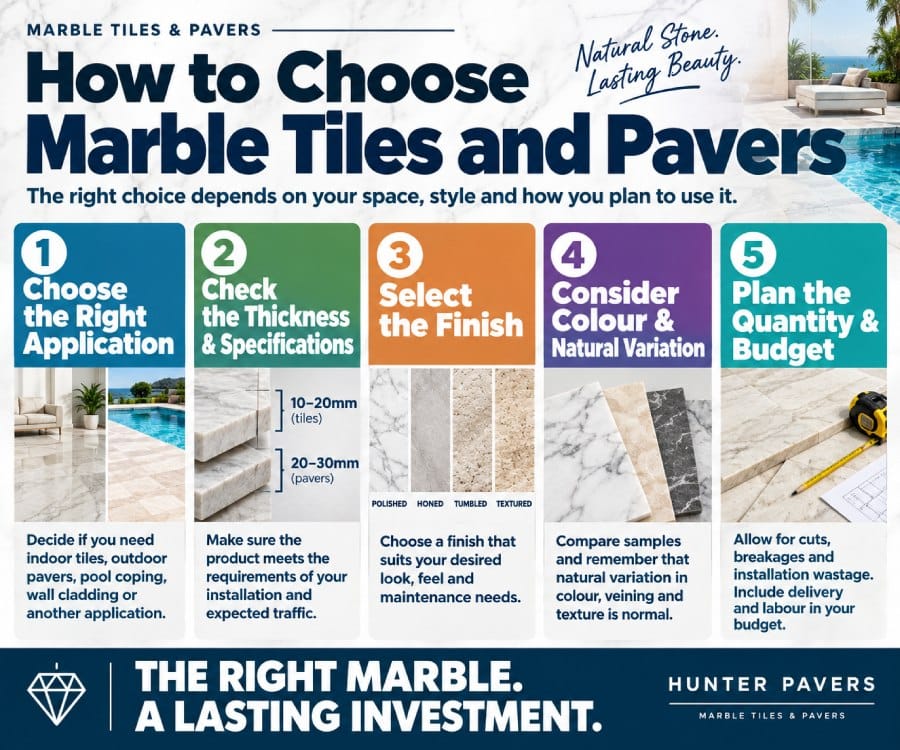
How to Choose Marble Tiles and Pavers
Not every marble product performs the same way in every environment. When comparing Marble Pavers for Sale, start by considering where the stone will be installed and the conditions it will face.
Choose the Right Thickness
Thinner Marble Tiles Australia customers purchase are commonly suited to applications where the stone is installed over a suitable prepared substrate. Thicker Marble Pavers Australia projects require may be more appropriate for external paving and other demanding applications.
The correct thickness ultimately depends on the installation system, substrate, expected loads and manufacturer recommendations.
Consider the Surface Finish
Finish has a significant influence on both appearance and practicality. Honed marble offers a smooth, understated appearance, while tumbled or textured finishes can provide a more relaxed and natural look that works particularly well outdoors.
For pool surrounds and other areas exposed to water, confirm that the selected product and finish provide suitable slip performance for the intended application.
Think About Colour and Natural Variation
Marble is prized for its natural variation. Greys, creams, whites and other subtle tones can all contain distinctive veining and movement. Consider surrounding walls, landscaping, pool colours and architectural finishes when choosing your stone.
Ordering samples before committing to a larger quantity can help you understand how the marble will look under the natural light conditions of your project.
Allow for Wastage and Future Repairs
Ordering slightly more material than the exact measured area allows for cuts, breakages and installation wastage. Keeping spare tiles or pavers can also be useful for future repairs because a later batch of natural stone may not perfectly match the original material.
Ordering a sample where available can help you assess the stone’s colour and texture under your project’s lighting conditions. Keeping spare pieces may also be useful for future repairs, as natural stone batches can vary.
Explore Marble Pavers for Sale at Hunter Pavers
If you’re comparing marble pavers for sale, start by identifying the application and the finish you prefer. Review the product dimensions, thickness, surface characteristics and installation requirements before making your selection.
Compare available marble products according to their specifications, rather than assuming all varieties offer the same performance. For outdoor projects, also account for drainage, base preparation, maintenance and the conditions the stone will experience.
Whether you’re renovating a residential property or sourcing materials for a larger project, Hunter Pavers can help you explore available options. Confirm current pricing, stock availability and delivery arrangements before placing your order.
Frequently Asked Questions About Marble Tiles & Pavers
1. Do marble pavers get hot in the Sydney summer sun?
No. One of the greatest advantages of natural marble pavers is their high thermal mass. Unlike concrete or darker porphyry stones, light-colored marble reflects a significant amount of solar heat, remaining remarkably cool and comfortable for bare feet even during peak Australian summer temperatures.
2. What is the difference between a marble tile and a marble paver?
The primary difference lies in thickness and application. Marble tiles are typically 10mm to 15mm thick, designed mainly for indoor flooring or wall cladding using adhesive on a solid concrete base. Marble pavers are 30mm or thicker, providing the structural strength needed for high-traffic outdoor areas like driveways, patios, and pool surrounds using a wet bed or compacted sand installation.
3. Are marble pavers slippery around pools?
Polished marble is slippery when wet and should be restricted to indoor areas. However, for outdoor pool surrounds, we supply marble pavers with specialized high-grip finishes—such as tumbled, brushed, or sandblasted—which achieve excellent slip resistance ratings (P4 or P5) compliant with Australian safety standards.
4. How often do I need to seal outdoor marble pavers?
To protect your stone from organic stains, salt spray, and moisture, we highly recommend sealing marble pavers immediately after installation. In typical New South Wales coastal or suburban conditions, applying a high-quality, penetrating water-based sealer every 12 to 24 months will preserve the stone’s vibrant look and integrity.
5. Can I use marble pavers for a residential driveway?
Yes, provided you choose the correct thickness and installation method. Driveway applications require minimum 30mm thick marble pavers laid over a reinforced concrete base with commercial-grade adhesive or a stable mortar bed to ensure the stone withstands the weight and shifting forces of passenger vehicles.