


Choosing between ceramic tile vs marble tile becomes easier when you look beyond appearance and focus on how each material performs in daily life. Ceramic tile is usually the better choice for busy homes, wet areas, rental properties, and budget-conscious renovations because it is durable, easy to clean, and available in many styles. Marble tile, on the other hand, is chosen for its natural beauty, luxury appeal, and unique veining, but it needs more care and a higher budget.
Before making a decision, think about where the tile will be installed, how much foot traffic the space receives, and how much maintenance you are willing to handle. A kitchen, bathroom, hallway, or mudroom may need a practical surface like ceramic, while a master bathroom, formal foyer, or statement wall can benefit from the premium look of marble. This guide compares ceramic tile vs marble tile in terms of durability, design, water resistance, maintenance, cost, installation, and long-term value.
| Feature | Ceramic Tile | Marble Tile |
|---|---|---|
| Best for | Busy kitchens, bathrooms, mudrooms, family homes, high-traffic areas | Luxury bathrooms, formal foyers, feature walls, statement rooms |
| Main advantage | Affordable, durable, low maintenance, water-resistant | Natural beauty, unique veining, premium and timeless appearance |
| Main drawback | Less prestigious than natural stone | Expensive, porous, softer, needs sealing and careful cleaning |
Marble vs Ceramic Tile: Detailed Comparison
The quick summary above gives the overall direction. The table below adds the key buying considerations that were covered on the older page and brings them into this main comparison guide.
| Comparison Point | Ceramic Tile | Marble Tile |
|---|---|---|
| Material origin | Manufactured mainly from clay and minerals fired at high temperatures. | Natural metamorphic stone formed from limestone under heat and pressure. |
| Appearance | Consistent colours and patterns with a wide range of manufactured designs. | Natural veining, colour movement and variation that make each piece unique. |
| Surface options | Available in glazed and unglazed formats, with many textures and printed looks. | Commonly supplied in finishes such as polished, honed, tumbled or other stone-specific finishes. |
| Maintenance | Generally straightforward, especially for glazed ceramic. | Needs stone-safe cleaning and may benefit from sealing depending on the stone and application. |
| Moisture | Glazed ceramic is commonly chosen for wet areas because of its practical surface performance. | Natural marble is moisture-sensitive and should be specified, installed and maintained correctly. |
| Replacement | Standard manufactured tiles can often be easier to match if spare stock is available. | Exact visual matching can be harder because natural veining and colour vary between pieces and batches. |
| Cost position | Usually the more budget-friendly choice. | Usually positioned as a premium natural-stone option. |
| Design character | Predictable, flexible and available in many manufactured styles. | Natural, distinctive and valued for one-of-a-kind visual character. |
Ceramic Tile vs Marble Tile: What Are They Made Of?
The first major difference between ceramic tile vs marble tile is their origin. Marble is a natural stone, while ceramic is a manufactured tile. This difference affects almost everything: appearance, strength, maintenance, price, installation, and even resale value.
Marble tile is made from natural metamorphic stone. It begins as limestone and slowly transforms under intense heat and pressure over thousands or even millions of years. After it is extracted from quarries, it is cut into slabs or tiles and polished, honed, or finished in different ways. Because marble comes directly from the earth, every piece has its own pattern, colour movement, and veining.
Ceramic tile, on the other hand, is man-made. It is produced from natural clay and other minerals, shaped into tiles, and fired at very high temperatures in kilns. Many ceramic tiles are glazed, which means they have a protective surface layer that gives them colour, texture, shine, and water resistance. This controlled manufacturing process makes ceramic more consistent, predictable, and easier to match across large areas.
This is why marble feels more organic and exclusive, while ceramic feels more practical and controlled. Marble brings natural variation. Ceramic brings design consistency.
Ceramic Tile vs Marble Tile in Appearance and Style
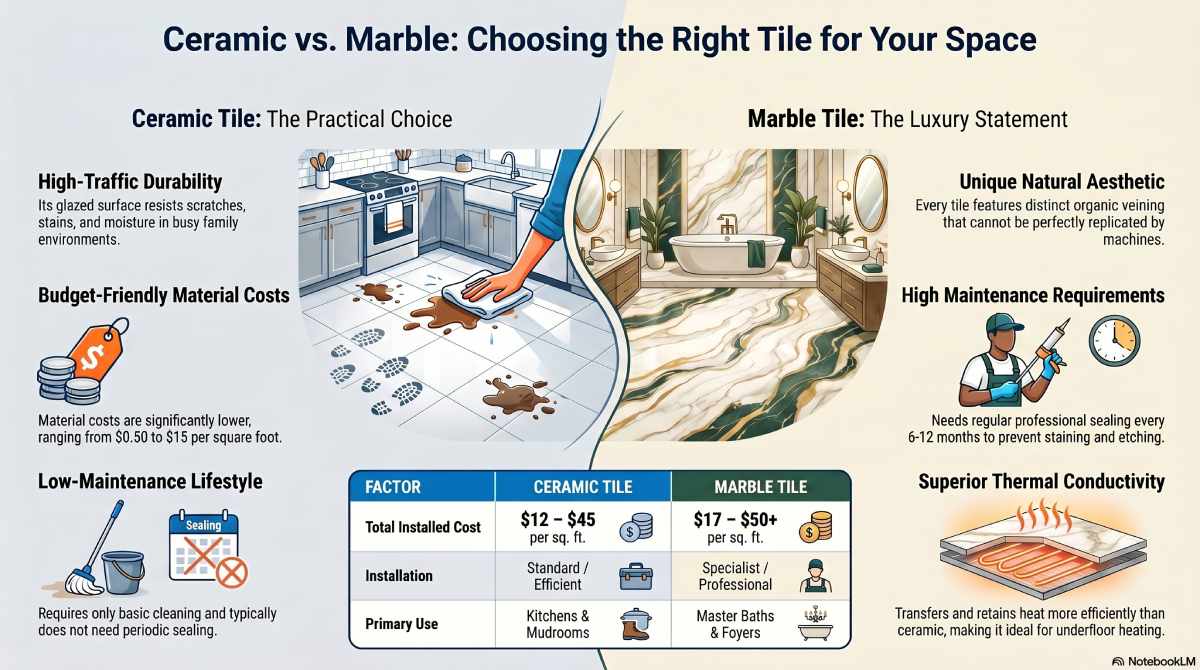
In terms of appearance, ceramic tile vs marble tile is mainly a comparison between natural luxury and design flexibility. Marble has a rich, elegant look because of its organic veining and natural colour variation. No two marble tiles are exactly the same, which gives each space a more exclusive feeling.
Ceramic tile offers more control over style. It can be produced in many colours, patterns, textures, and finishes. Modern ceramic can also imitate marble, wood, concrete, and stone very realistically, making it a practical choice for people who want a stylish look with a more uniform finish.
Design Versatility: Which One Gives More Options?
Ceramic is the more versatile option in terms of design. It can be glossy, matte, textured, patterned, colourful, neutral, rustic, modern, minimal, or decorative. You can use small ceramic tiles for backsplashes, large-format tiles for modern floors, patterned tiles for feature walls, or textured tiles for bathrooms.
Marble is also versatile, but in a different way. It is not usually chosen for playful patterns or bold colours. Instead, it is selected for elegance, natural veining, and luxury. It works especially well in classic interiors, hotel-style bathrooms, luxury kitchens, formal entryways, and statement flooring.
Current design trends are also affecting both materials. Large-format tiles, such as 1m x 1m or 1200mm x 1200mm, are becoming popular because they create fewer grout lines and a cleaner, more spacious look. Matte finishes, earthy tones, and tactile textures are also becoming more desirable because they make interiors feel calm, organic, and refined.
Ceramic can follow these trends more affordably. Marble can deliver them with a more premium natural finish.
Glazed vs Unglazed Ceramic and Common Marble Finishes
Glazed and Unglazed Ceramic Tile
Ceramic tiles can be supplied in glazed or unglazed formats. A glaze adds a manufactured surface layer that can provide colour, pattern, texture and easier day-to-day cleaning. Unglazed ceramic has a more natural, through-body appearance and its suitability depends on the product specification and intended application.
Polished Marble
Polished marble has a smooth, reflective surface that emphasises colour and veining. It creates a more formal luxury look, but the finish should be assessed carefully where wet-surface slip performance is important.
Honed Marble
Honed marble has a smoother matte or low-sheen appearance. It is often selected when a softer, more understated natural-stone finish is preferred.
Tumbled and Textured Marble
Tumbled or textured finishes create a more aged or tactile appearance. Product-specific finish, slip performance and application guidance should always be checked before selection.
Ceramic Tile vs Marble Tile: Durability and Daily Performance
Durability is one of the most important parts of the ceramic tile vs marble tile comparison. Ceramic tile is hard, dense, and resistant to scratches, stains, and daily wear, especially when glazed. This makes it a strong choice for kitchens, hallways, bathrooms, mudrooms, and busy family homes.
Marble can last for many years, but it is softer and more sensitive than ceramic. It can scratch, dull, or etch when exposed to acidic substances such as lemon juice, vinegar, wine, or harsh cleaners. For this reason, marble is better for spaces where beauty matters more than heavy daily use.
Water Resistance and Moisture Performance
Water resistance is another key difference between ceramic tile vs marble tile. Glazed ceramic tile has very low water absorption, so it performs well in bathrooms, showers, kitchens, and laundry rooms. Usually, the grout needs more attention than the tile itself.
Marble is naturally porous and can absorb water or stains if it is not sealed properly. It can still be used in bathrooms, but it needs professional installation, regular sealing, and careful cleaning. For wet areas, ceramic is usually the easier and safer option.
Ceramic Tile vs Marble Tile Maintenance
Maintenance is where ceramic becomes the more practical choice. Ceramic tile usually only needs sweeping, vacuuming, and mopping with a mild cleaner. Glazed ceramic does not normally need sealing, which makes it ideal for busy homes.
Marble needs more careful maintenance. It should be sealed after installation and resealed regularly, often every 6 to 12 months. It also needs pH-neutral cleaners made for natural stone. Vinegar, bleach, abrasive pads, and harsh chemicals can damage the surface. So, ceramic is better for easy care, while marble is better for those who are willing to maintain natural stone properly.
Expert Marble Care Note
“Calcium Carbonate is sensitive to acidic solutions so mild, non-acidic cleaners are recommended.”
— Natural Stone Institute, Care & Cleaning of Natural Stone
The Natural Stone Institute also notes that sealing does not make stone stain-proof; it can make some stones more stain-resistant. This is why marble care should be based on the specific stone, finish, application and sealer guidance rather than a fixed universal resealing schedule.
Cost Comparison: Ceramic Tile vs Marble Tile
Cost is one of the biggest reasons many homeowners choose ceramic. Ceramic tile is usually much more affordable than marble, both in material cost and installation cost.
Ceramic tile can range from very budget-friendly options to premium designer styles. In general, material costs may range from around $0.50 to $15 per square foot, depending on quality, brand, size, finish, and design. Installation can also vary, but ceramic is usually easier and cheaper to install than marble.
Marble tile is more expensive because it is natural stone, quarrying is more complex, and installation requires more skill. Material costs often range from around $5 to $20+ per square foot, and premium marble can cost much more. Installation costs are usually higher because marble is heavier, more fragile, and harder to cut and handle.
| Cost Factor | Ceramic Tile | Marble Tile |
|---|---|---|
| Material cost | About $0.50 – $15 per sq. ft. | About $5 – $20+ per sq. ft. |
| Installation cost | Usually lower and easier | Usually higher and more specialised |
| Total installed cost | Roughly $12 – $45 per sq. ft. | Roughly $17 – $50+ per sq. ft. |
Ceramic is better for budget-conscious projects. Marble is better when the goal is luxury, uniqueness, and long-term visual impact.
Installation Differences
Installation is another area where ceramic tile vs marble tile shows a clear difference. Ceramic is usually easier to install because it is lighter, more consistent in thickness, and less fragile. A skilled tile installer can work with ceramic efficiently, especially if the tiles are standard sizes.
Marble installation requires more expertise. Because it is natural stone, there can be variation in thickness, veining, colour, and structure. The installer must carefully plan the layout so the veining looks balanced and intentional. Marble also needs special cutting tools, careful handling, and often a stronger or more prepared substrate.
If marble is installed poorly, the result can look uneven, mismatched, or structurally weak. Because the material itself is expensive, installation mistakes can be costly. This is why marble should usually be installed by professionals with natural stone experience.
Ceramic is more forgiving and practical for large spaces. Marble requires more planning but can create a more prestigious result.
Natural Variation, Tile Matching and Future Replacement
One practical difference between marble and ceramic appears when you need to extend or repair an installation. Ceramic is manufactured under controlled conditions, so tiles from the same range can have a more predictable appearance. Keeping spare tiles from the original batch can make future replacement easier.
Marble is different because every piece is natural. Veining, colour movement and texture can vary not only between individual tiles but also between quarry blocks and production batches. For a marble project, it is therefore useful to order enough material at the beginning, allow for cuts and wastage, and keep spare pieces where possible.
This natural variation is not a defect; it is part of marble’s appeal. It simply means layout planning and batch selection matter more when the goal is a balanced visual result.
Heat Conductivity and Underfloor Heating
Both ceramic and marble work well with underfloor heating because they conduct heat effectively. However, marble has an advantage in thermal performance.
Marble has higher thermal conductivity, usually around 2.0 to 3.5 W/m·K, while ceramic is often around 1.0 to 1.5 W/m·K. This means marble can transfer heat more efficiently and distribute warmth more evenly across the surface.
Because marble is dense, it can also retain heat well. This makes it a strong choice for luxury bathrooms, spa-style spaces, and high-end radiant heating systems. Walking on warm marble can feel extremely comfortable and premium.
Ceramic also works well with underfloor heating and is still a practical choice for most homes. It may not feel quite as luxurious as heated marble, but it can still provide good warmth, comfort, and energy efficiency when installed correctly.
Resale Value and Market Appeal
Marble has strong market appeal because it is globally recognised as a luxury material. In the right space, it can make a home feel more expensive and refined. Marble bathrooms, formal foyers, and feature floors can create a strong first impression for buyers.
However, marble does not always guarantee full return on investment. Some buyers love it, while others worry about maintenance, staining, and repair costs. In busy family homes, buyers may prefer a durable marble-look ceramic tile instead of real marble.
Ceramic may not have the same prestige, but it can be more appealing to practical buyers. A high-quality ceramic floor that looks clean, modern, and easy to maintain can be a strong selling point, especially in kitchens, bathrooms, and rental properties.
So, marble may increase emotional appeal and luxury perception, while ceramic may increase practical appeal and buyer confidence.
Best Places to Use Ceramic Tile
Ceramic tile is best for spaces where durability, moisture resistance, and easy cleaning are priorities. It performs especially well in high-traffic areas and practical rooms.
Good places to use ceramic tile include:
- Kitchens, bathrooms, laundry rooms, mudrooms, and hallways
- Family homes with children, pets, and frequent foot traffic
- Rental properties, commercial spaces, and budget-conscious renovations
Ceramic is also ideal when you want a stylish look without the cost or care requirements of natural stone. Marble-look ceramic tiles are especially useful if you love the appearance of marble but do not want sealing, etching, or staining concerns.
Best Places to Use Marble Tile
Marble tile is best for spaces where beauty, elegance, and premium design matter more than heavy-duty practicality. It is not usually the easiest material for messy or high-traffic areas, but it can be stunning when used in the right place.
Good places to use marble tile include:
- Master bathrooms, powder rooms, formal foyers, and feature walls
- Luxury renovations where natural stone is part of the design vision
- Low-traffic spaces where staining and scratching risks are easier to control
Marble is ideal for homeowners who understand that natural stone changes over time. It may develop a patina, small marks, and subtle signs of use. Some people see this as character. Others see it as maintenance. Your personal preference matters.
Ceramic Tile vs Marble Tile for Kitchens
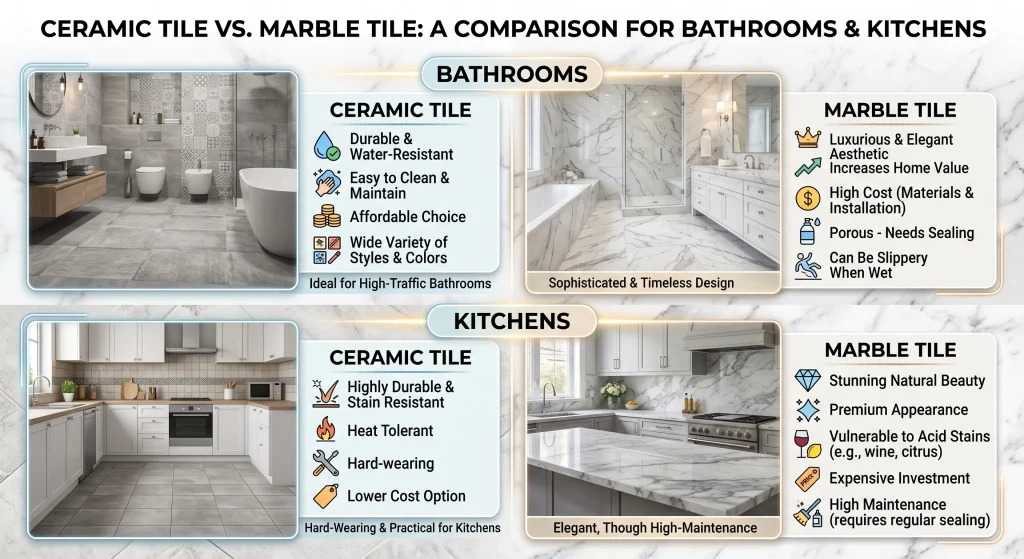
For kitchens, ceramic is usually the more practical choice. Kitchens deal with food spills, oil, dropped utensils, acidic ingredients, heavy foot traffic, and frequent cleaning. Glazed ceramic can handle these conditions with much less stress.
Marble can look beautiful in a kitchen, especially in luxury designs, but it is more vulnerable to etching and staining. Lemon juice, vinegar, wine, coffee, and tomato sauce can all leave marks if spills are not cleaned quickly. Polished marble can also show dull spots more clearly.
If you want a low-maintenance kitchen floor, ceramic is safer. If you want a luxury kitchen and are comfortable with careful maintenance, marble can be used, but it needs proper sealing and realistic expectations.
Ceramic Tile vs Marble Tile for Bathrooms
Bathrooms are one of the most popular spaces for both ceramic and marble. Ceramic is practical because it handles moisture well and is easy to clean. It is especially useful for showers, bathroom floors, and walls.
Marble gives bathrooms a high-end spa feeling. It can make even a small bathroom look elegant and expensive. However, because bathrooms are wet spaces, marble must be sealed properly and cleaned with suitable products. Hard water, soap residue, and harsh cleaners can affect the surface over time.
For a family bathroom, ceramic is usually better. For a master bathroom or luxury ensuite, marble can be a beautiful choice if you are ready for the maintenance.
Polished Marble in Wet Areas: What to Consider
The older comparison page raised an important practical point: a highly polished stone surface may not be the right choice where wet-surface traction is a priority. This does not mean every marble product is unsuitable for bathrooms. It means the specific finish and slip-performance rating should be checked for the intended location.
For bathrooms, showers and other wet areas, choose the material and finish based on documented product performance, the installation system and local requirements rather than appearance alone.
Which One Is Better for Busy Families?
For busy families, ceramic is usually the better option. It is more resistant to scratches, stains, water, and daily wear. It is easier to clean and does not require regular sealing. If children spill juice, pets run across the floor, or furniture gets moved around, ceramic is more forgiving.
Marble can still work in a family home, but it is better used in controlled spaces rather than the busiest rooms. For example, marble might work well in a powder room or formal entryway, but it may not be ideal for a heavily used kitchen or mudroom.
A good compromise is marble-look ceramic tile. It gives a similar visual effect while keeping the practical benefits of ceramic.
Considering Real Marble for Your Project?
If natural variation, premium appearance and genuine stone are priorities, compare Hunter Pavers’ current marble products, finishes and sizes before making a final material decision.
Final Verdict: Ceramic Tile vs Marble Tile
The final choice between ceramic tile vs marble tile depends on your priorities. If you want durability, affordability, easy cleaning, water resistance, and low maintenance, ceramic tile is usually the smarter choice. It is ideal for kitchens, bathrooms, hallways, rental homes, commercial areas, and busy family spaces.
If you want natural beauty, unique veining, luxury appeal, and a timeless design statement, marble tile is hard to beat. It works best in low-traffic or carefully maintained areas such as master bathrooms, formal foyers, powder rooms, and luxury interiors. The key is to understand that marble is not just a surface; it is a natural material that needs care.
Conclusion: Ceramic Tile vs Marble Tile
When comparing ceramic tile vs marble tile, the better option depends on the room and the lifestyle of the homeowner. Ceramic tile is the more practical choice if you need a surface that can handle moisture, foot traffic, spills, pets, children, and regular cleaning without much worry. It is also more budget-friendly and easier to install, which makes it a smart option for large areas and everyday spaces.
Marble tile is the better choice when visual impact matters more than low maintenance. It can make a room feel elegant, natural, and high-end, especially in bathrooms, entryways, and decorative spaces. However, it needs sealing, careful cleaning, and protection from acidic substances. If you want beauty with less maintenance, marble-look ceramic can be a balanced alternative; but if you want real natural stone and are ready to care for it, marble remains a timeless option.
Frequently Asked Questions About Ceramic vs Marble Tile
What is the main difference between marble and ceramic tile?
Marble is a natural metamorphic stone with unique veining and natural variation, while ceramic is a manufactured clay-based tile produced under controlled conditions.
Which is easier to maintain: ceramic or marble?
Ceramic is generally easier to maintain, especially when glazed. Marble needs stone-safe cleaning and may require sealing depending on the specific stone, finish and application.
Which is better for bathrooms?
Ceramic is usually the easier practical choice for wet areas. Marble can also be used successfully when the correct finish, installation method, sealing approach and slip-performance requirements are considered.
Can ceramic tile look like marble?
Yes. Modern ceramic tiles can reproduce marble-inspired colours and patterns. They provide a more consistent look, but they do not have the same natural variation as genuine marble.
Why is exact replacement easier with ceramic?
Because ceramic is manufactured, products from the same range and batch can be more visually consistent. Marble is natural, so veining and colour can vary significantly between pieces and batches.
What finishes are available for marble?
Common marble finishes include polished and honed surfaces, while other products may be tumbled, sandblasted or otherwise textured depending on the intended application.
Is marble worth the higher cost?
It can be when natural stone, unique veining and premium design character are priorities. Ceramic is usually the better fit when affordability, consistency and lower day-to-day maintenance matter more.